No Date G25C BG-204B (Regular Strike)
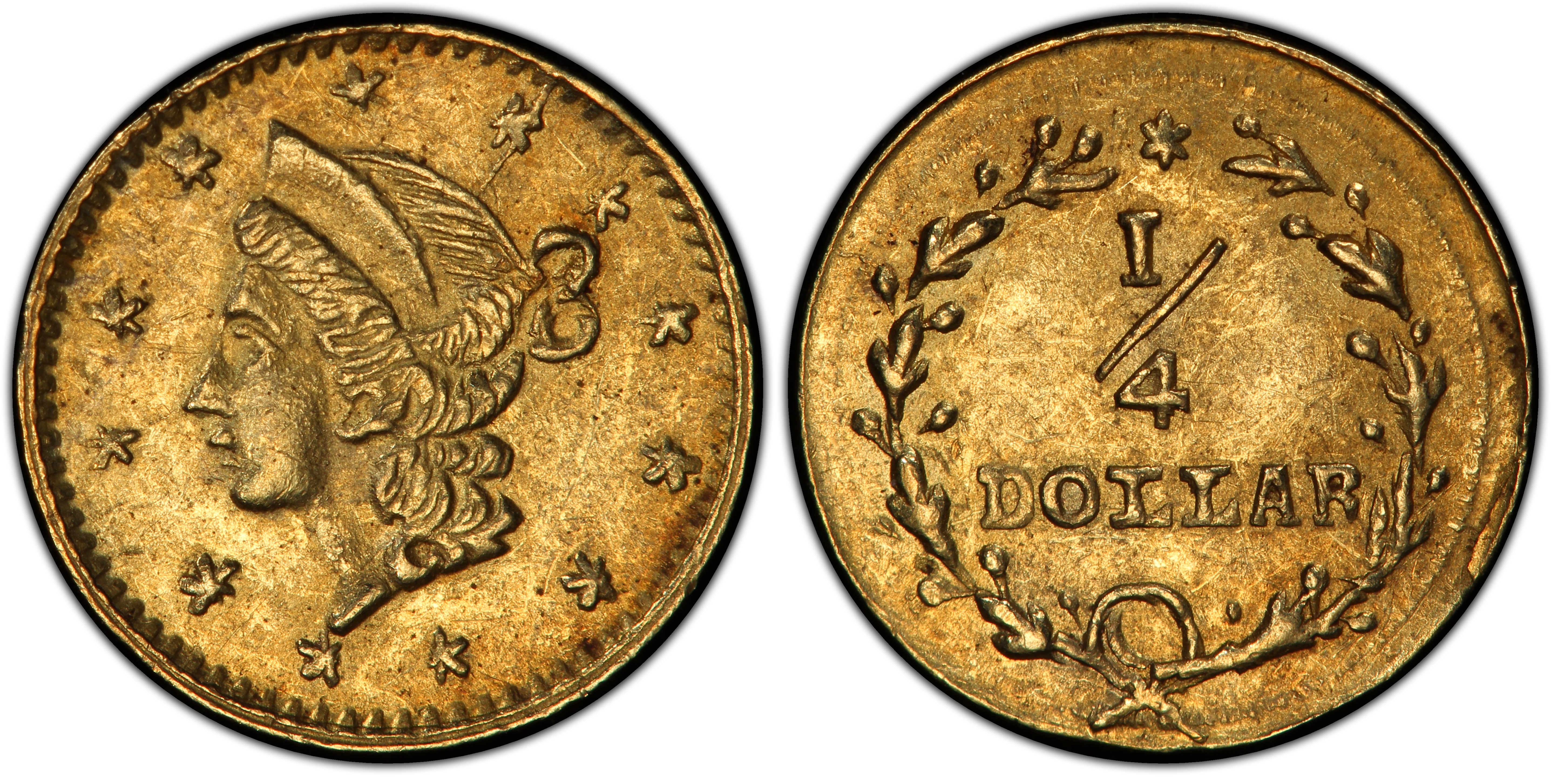
Obverse & Reverse
The No Date G25C BG-204B is an artifact of pure necessity, a tangible remnant of the chaotic, gold-fueled economy of early 1850s California. Following the 1848 discovery of gold at Sutter's Mill, a massive influx of prospectors and merchants flooded into California, creating a vibrant but deeply flawed commercial environment. While gold dust was plentiful, it was an impractical medium for small, everyday transactions. A pinch of dust for a drink or a loaf of bread was inherently inaccurate and prone to disputes. The U.S. Mint's nearest facility was in New Orleans, an arduous and dangerous journey away, and the establishment of the San Francisco Mint was still years off (opening in 1854, but not striking sufficient small change until 1856). This severe shortage of circulating small-denomination coinage created a vacuum that private enterprise rushed to fill. Jewelers and metallurgists, primarily in San Francisco, began striking their own small gold coins in 1852. These 'Period One' issues, as defined by numismatists Walter Breen and Ronald J. Gillio, were intended to circulate and facilitate daily trade. They were struck by hand, often crudely, using simple screw presses or even just a hammer and anvil. The BG-204B is a prime example of this genre. Research by numismatists, particularly analysis of die linkages, indicates that the obverse die used for BG-204B was also used for varieties BG-203, BG-204, BG-204A, and BG-204C. This shared die is attributed to the Joseph Brothers (Lionel and Josephus), who were prominent jewelers and merchants in San Francisco during this period. While the specific reverse die of BG-204B is unique to this variety, its shared obverse firmly places it within their workshop's output. These coins were generally accepted in local commerce despite often being underweight, as the convenience they offered far outweighed the slight deficiency in intrinsic value. The eventual ramp-up of federal coinage production from the San Francisco Mint rendered these private issues obsolete by 1856-1857, at which point most were withdrawn, melted, or lost to time. The BG-204B's survival as one of perhaps only two or three known examples makes it an extraordinary witness to the birth of California's economic infrastructure.
Associated EventCalifornia Gold Rush
Reason For MintingTo alleviate a severe shortage of small-denomination coinage for everyday commercial transactions in Gold Rush-era San Francisco.
Minter HistoryThe Joseph Brothers, Lionel and Josephus, were jewelers and merchants active in San Francisco from approximately 1852. While their pieces were unmarked, die analysis of surviving fractional gold has linked a series of common obverse dies, including the one used for BG-204B, to their private minting operations. They were among the most prolific producers of 'Period One' fractional gold, creating pieces that were vital, if unofficial, components of the region's currency during the peak of the Gold Rush coin shortage.
Historical SignificanceAs a 'Period One' issue, the BG-204B is a historically significant piece that served as actual circulating money, unlike later fractional gold issues which were primarily made as souvenirs. Its extreme rarity elevates it from a mere type coin to a key numismatic treasure, representing a direct link to the ad-hoc monetary solutions that enabled the phenomenal growth of Gold Rush California.
N/A
Denomination25 Cents
Minting Periodc. 1853-1854
Assayer/MinterJoseph Brothers (Attributed)
Geographic OriginSan Francisco, California
Obverse DescriptionA small, somewhat crudely rendered bust of Liberty facing left, her hair tied in a bun. The portrait is encircled by twelve five-pointed stars. This specific obverse die is known as the Joseph Brothers 12-star die and was used for several related varieties.
Obverse Inscription Reverse DescriptionThe denomination '1/4' appears in the center, surrounded by the inscription 'CALIFORNIA GOLD'. The reverse die is distinct from the more common BG-204, which features a prominent double-loop bow in its wreath; the wreath on BG-204B is different.
Reverse InscriptionCALIFORNIA GOLD 1/4
CompositionGold
Stated Fineness Actual FinenessTypically .800 to .900, using native California gold which contained a high percentage of silver.
EdgePlain
Unknown, but extremely small.
Survival Estimate2-3 known
Rarity ScaleR-8
The BG-204B is a numismatic trophy of the highest order. Its appeal is multi-faceted: it is a genuine 'Period One' California Fractional that likely circulated, it is tied to the famous California Gold Rush, and its status as an R-8 rarity places it among the most unobtainable varieties in the entire series. Acquiring an example is a landmark event for even the most advanced collector.
Key VarietiesThe BG-204 'family' shares a common Joseph Bros. obverse die but features different reverses. The primary varieties are: BG-204 (the most common, identified by a double-loop bow in the wreath), BG-204A (R-9, Unique?), BG-204B (R-8, this coin), and BG-204C (R-9, Unique?). No proof or special collector strikings are known to exist from the original period of issue.
Authentication TipsAuthentication requires expert examination. Key diagnostics include precise die markers on the 12-star Joseph Bros. obverse. The strike is often crude and may appear weak in areas, which is a characteristic of genuine pieces. Replicas are often sharply struck and have a soapy or artificial luster. The planchet should be thin. Any piece featuring a bear on the reverse is a modern fantasy piece. The presence of the '1/4' denomination is a key feature of these early issues intended for commerce. Given its extreme rarity, any newly discovered example should be submitted to a top-tier grading service (PCGS or NGC) for verification.
Shopping ConsiderationsFor a coin of this rarity, any available example is a 'premium quality' example. A prospective buyer should prioritize authenticity above all else. Look for an example certified by PCGS or NGC, which guarantees authenticity. Eye appeal is secondary but still important; an example with minimal marks, honest wear, and attractive original reddish-gold color would be ideal. Weakness of strike is to be expected on the high points of Liberty's hair and the central denomination. Avoid any coin that shows signs of tooling, harsh cleaning, or having been removed from jewelry, as these issues would significantly impair its value, even for an R-8 variety.
A coin's grade is its condition, rated on a 1-70 scale. For rare coins, this is the most critical factor in determining value, as a tiny difference in preservation can mean a huge difference in price.
Relevant Grade TypesOriginal issues were business strikes intended for circulation and are found in Circulated (1-58) and Mint State (MS, 60-70) grades. Given the coin's function as transactional currency, most survivors would be expected in circulated grades. No Proof (PR/PF) examples were struck during the original minting period, and no later-date collector restrikes of the BG-204B are known.
Mint State CharacteristicsAn uncirculated BG-204B would be a landmark discovery. It would exhibit full, frosty, or satiny mint luster, though the quality might be subdued due to the crude production methods. The strike would likely still show some inherent weakness in the center of the obverse and reverse, as is typical for hammered or early screw press coinage. Small planchet flaws or adjustment marks made prior to striking would be acceptable and not necessarily detract from the grade.
Circulated Wear PatternsWear will first appear on the highest points: Liberty's hair, cheek, and the numerals '1/4' on the reverse. On moderately circulated examples (VF-XF), the finer details of the hair will be flat, and the stars may show some loss of sharpness. In lower grades, the legends will begin to weaken, and the entire design will appear soft and flattened.
Key Factors For ValueFor an R-8 variety, the primary value driver is simply its existence and authenticity. Beyond that, a certified grade is paramount. Surface preservation is key; an example with clean, original surfaces will command a significant premium over one that has been cleaned, scratched, or damaged. Sharpness of the strike, while often incomplete, is a factor, with better-struck examples being more desirable. Finally, provenance and a CAC sticker would add a significant premium, confirming both quality for the grade and a history of ownership by discerning collectors.
PCGS Price Guide
| Grade | Price | Population |
|---|---|---|
| 58 | $22,500.00 | N/A |
| 58+ | $24,500.00 | N/A |
| 60 | $27,500.00 | N/A |
| 61 | $32,500.00 | N/A |
| 62 | $37,500.00 | 1 |