1855 G25C BG-226A (Regular Strike)
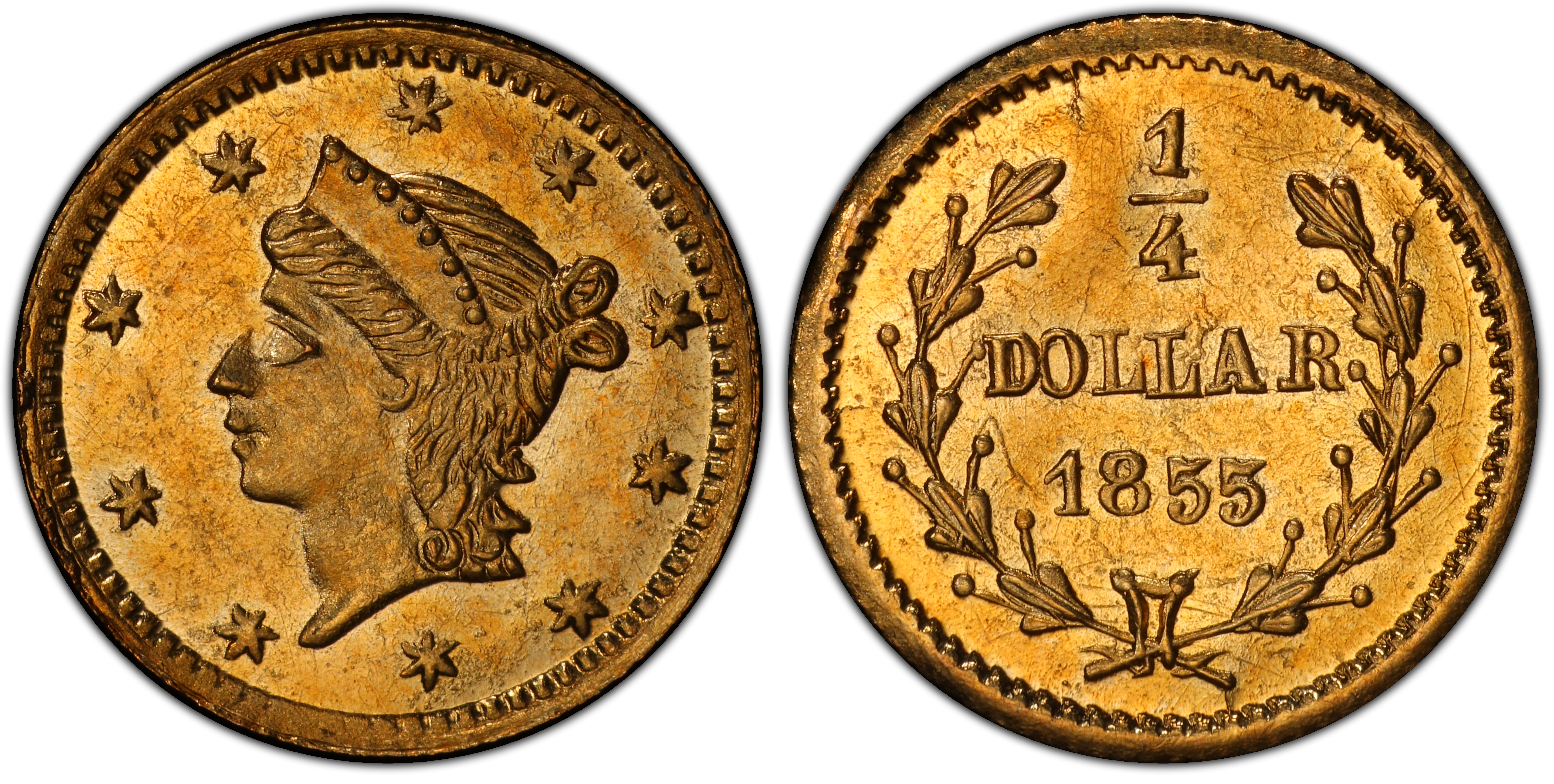
Obverse & Reverse
The 1855 BG-226A 25 Cents is a quintessential artifact from the 'Period One' of California Fractional Gold issuance (1852-1856), the era most numismatic historians agree represents legitimate, albeit private, coinage intended to alleviate a severe shortage of small change during the California Gold Rush. Following the discovery of gold in 1848, a massive influx of over 300,000 people descended upon California, creating a vibrant but chaotic economy. While gold dust was plentiful, the means to conduct small, daily transactions was not. A pinch of dust for a drink or a loaf of bread was an imprecise and unsatisfactory system. The federal government was slow to respond; the San Francisco Mint would not be fully operational until 1856, and its initial production focused on larger denominations. Into this monetary void stepped a number of enterprising jewelers and metalsmiths, many of French origin, who began striking their own small-denomination gold coins. Among the most prolific was Antoine Louis Nouizillet, a San Francisco jeweler to whom the BG-226A and similar varieties are attributed. These tiny gold pieces were not legal tender, but they contained a reasonably honest amount of gold for their stated value and were readily accepted in local commerce due to sheer necessity. They were struck by crude but effective hand-hammering methods, where a planchet was placed between two hand-cut dies and struck with a sledgehammer. This process resulted in coins of varying strike quality and often inconsistent shape, lending each a unique character. The 1855 issues represent a peak in this private minting activity, just before the U.S. Mint's output of silver and gold coins began to saturate the region, rendering the private issues obsolete by 1856-1857. The survival of pieces like BG-226A, many in circulated condition, and their recovery from contemporary shipwrecks like the S.S. Central America, provides tangible proof of their role as the 'coins of the realm' in the frantic, formative years of Gold Rush California.
Associated EventCalifornia Gold Rush
Reason For MintingTo provide a circulating medium for small commercial transactions due to a severe shortage of U.S. government-issued small-denomination coinage in Gold Rush-era California.
Minter HistoryAntoine Louis Nouizillet was a French jeweler who operated in San Francisco during the 1850s. He was one of the most significant and skillful private minters of California Fractional Gold. His work is characterized by a finer style of engraving compared to some of his contemporaries. He produced a variety of quarter dollar, half dollar, and dollar pieces, both round and octagonal. Nouizillet's business was eventually sold to another jeweler, Robert B. Gray & Co., around 1859-1860, who continued to use some of Nouizillet's old dies before creating his own. Nouizillet's issues are central to any collection of 'Period One' fractional gold.
Historical SignificanceAs a 'Period One' issue, the BG-226A is a historically significant piece that represents a solution to a critical economic problem on the American frontier. It is a direct link to the day-to-day life of the 'Forty-Niners,' demonstrating how private enterprise filled a vacuum left by the federal government. Unlike later 'Period Two' and 'Three' issues, which were primarily made as souvenirs, this coin was a functional tool of commerce in one of the most dynamic periods of American history.
BG-226A
Denomination25 Cents
Minting Period1855
Assayer/MinterAntoine Louis Nouizillet
Geographic OriginSan Francisco, California
Obverse DescriptionA small, left-facing Liberty Head, stylistically similar to the contemporary U.S. gold dollar. The hair is tied in a bun at the back. Liberty wears a coronet inscribed LIBERTY (often weakly struck or illegible). The head is surrounded by thirteen stars, representing the original colonies.
Obverse InscriptionLIBERTY
Reverse DescriptionThe denomination '1/4 DOLLAR' and the date '1855' are enclosed within a simple wreath composed of two branches tied by a bow at the bottom. The lettering and date are often crude.
Reverse Inscription1/4 DOLLAR 1855
CompositionGold
Stated Fineness Actual FinenessVariable, typically 14 to 22 karats. The native California gold used was naturally alloyed with silver, giving it a lighter color than federal issues.
EdgePlain
Unknown
Survival Estimate46-60 coins
Rarity ScaleR-5
This coin is highly sought after as a genuine, circulating artifact from the California Gold Rush. Its status as a 'Period One' issue, its direct connection to the commerce of the 'Forty-Niners,' and the romance of private gold coinage make it a classic collectible. The BG-226A is a specific, well-documented variety for specialists.
Key VarietiesThe BG-226A itself is a key die variety, distinguished from the similar BG-227. According to research for the second edition of the Breen-Gillio reference, the BG-226A obverse die features distinct, separate pearls on the upper portion of Liberty's coronet, likely from an engraver's touch-up. No later-date restrikes or special collector issues are known for this specific variety.
Authentication TipsAuthenticity is paramount. Genuine Period One fractionals must have a denomination (e.g., 'DOLLAR', 'DOL', 'CENTS'). Be wary of pieces that say only 'CALIFORNIA GOLD' without a denomination or feature a bear on the reverse; these are typically modern tokens. The strike should appear somewhat crude, consistent with hand-hammering, and not have the sharp, uniform look of a modern replica. Planchets are typically very thin. Compare the style of the Liberty head, stars, and lettering to high-resolution images of certified BG-226A examples. The specific die markers for BG-226A, particularly the distinct coronet pearls, are a key diagnostic.
Shopping ConsiderationsFor a premium quality example, look for a bold, well-centered strike. Given the manufacturing method, many are weakly struck in areas, particularly the word LIBERTY on the coronet, the date, and the centers of the stars. A coin with a strong strike on these features commands a significant premium. Original, uncleaned surfaces with some remaining satiny luster are highly desirable. Many surviving examples were used as jewelry and may show signs of soldering, harsh cleaning, or bending; these should be avoided by discerning collectors. Attractive, reddish-gold or mellow greenish-gold toning from the natural alloy is considered a positive attribute. Given the high number of counterfeits and replicas, purchasing examples certified by PCGS or NGC is strongly recommended.
A coin's grade is its condition, rated on a 1-70 scale. For rare coins, this is the most critical factor in determining value, as a tiny difference in preservation can mean a huge difference in price.
Relevant Grade TypesOriginal 1855 BG-226A coins were business strikes created for circulation. They are found in Circulated grades (AG-3 to AU-58) and Mint State grades (MS-60 to MS-70). The term 'Proof' (PR/PF) is not applicable, as no proof specimens were struck during the original period of issue, and no later restrikes are known.
Mint State CharacteristicsAn uncirculated BG-226A will exhibit original mint luster, which is typically soft and satiny rather than deeply prooflike, though some semi-prooflike examples exist. The strike is a critical factor; even high-grade specimens can be weakly struck on the high points like the center of the obverse and reverse due to the hammer-striking process. Small, mint-made planchet flaws or strike-throughs are not uncommon and are generally accepted. Contact marks may be present but should not be overly distracting. The overall eye appeal is paramount.
Circulated Wear PatternsWear first appears on the highest points of the design. On the obverse, this includes the hair above the eye and ear, the cheek, and the pearls on the coronet. On the reverse, the highest points of the wreath's leaves and the bow will show initial friction and smoothing. In lower grades (VG and below), the word LIBERTY on the coronet will be completely worn away, and the date and denomination will begin to merge with the fields.
Key Factors For ValueThe primary drivers of value for a BG-226A are grade and surface quality. An example with original, uncleaned surfaces will always be worth significantly more than a cleaned or damaged coin of the same grade. The sharpness of the strike is a major consideration; coins with a full or near-full strike on the coronet, date, and stars are highly prized. Eye appeal, which includes attractive toning and a well-centered strike, also plays a crucial role. Finally, certification by a top-tier grading service (PCGS or NGC) is essential for market acceptance and value, with a premium often paid for coins approved by CAC for their superior quality within the grade.
PCGS Price Guide
| Grade | Price | Population |
|---|---|---|
| 60 | $725.00 | N/A |
| 61 | $775.00 | 1 |
| 62 | $850.00 | 6 |
| 62+ | $950.00 | N/A |
| 63 | $1,025.00 | 5 |
| 63+ | $1,275.00 | N/A |
| 64 | $1,850.00 | 2 |
| 64+ | $2,150.00 | N/A |
| 65 | $2,750.00 | 1 |