1855 G25C BG-226 (Regular Strike)
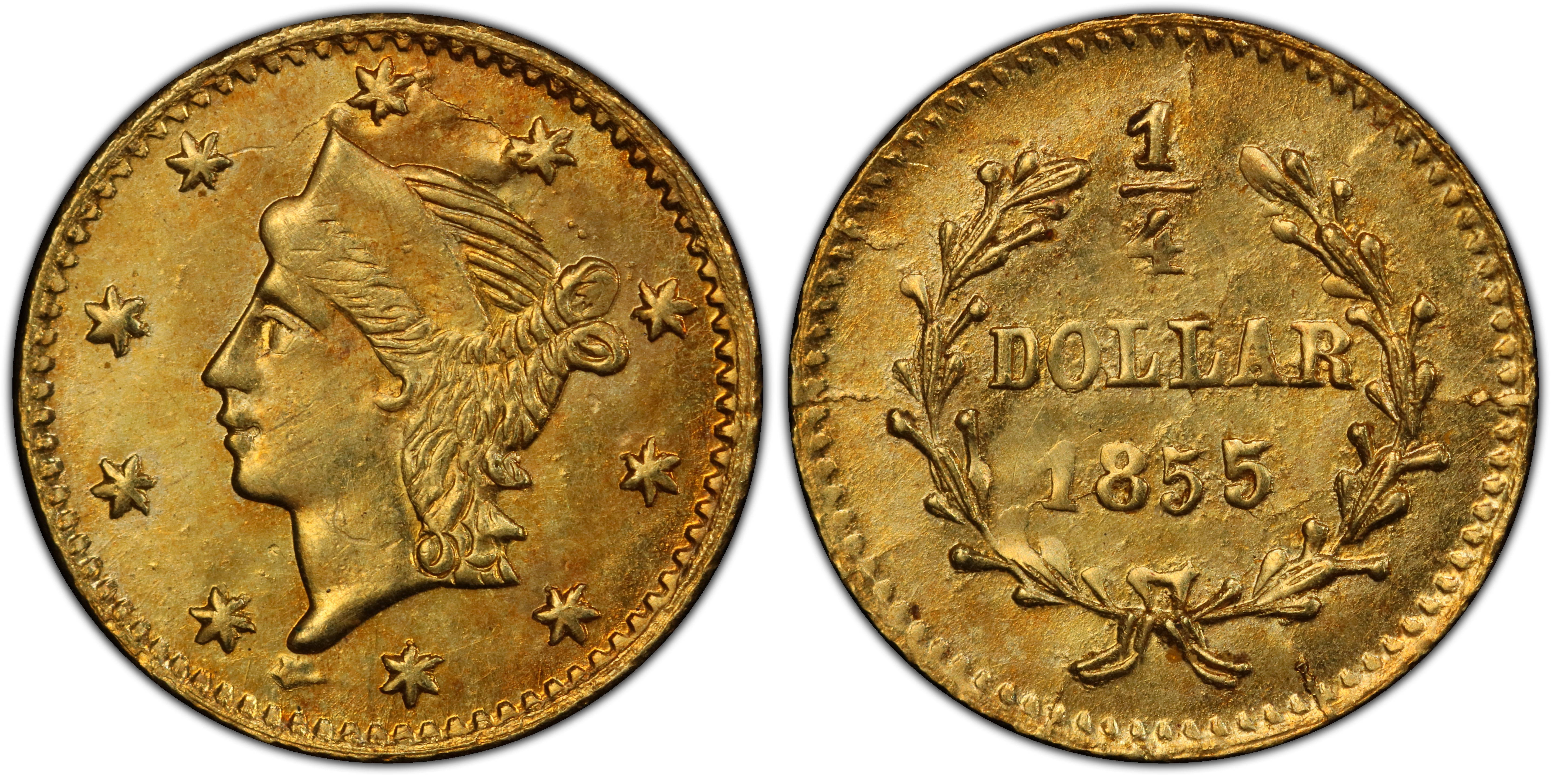
Obverse & Reverse
The 1855 BG-226 25 Cent piece is a tangible relic from the chaotic and economically vibrant era of the California Gold Rush. Following the discovery of gold in 1848, a massive influx of prospectors and merchants flooded California, creating a severe shortage of small-denomination coinage for daily transactions. While private assayers and minters quickly began producing large denomination gold coins ($5 to $50) to convert raw gold dust and nuggets into a more usable form, the need for coins to make small change remained acute. Simple transactions were often conducted with a 'pinch' of gold dust, a notoriously imprecise and unsatisfactory method. To fill this void, several San Francisco jewelers and metalworkers began striking their own small-denomination gold coins in 1852. These pieces, known as 'California Fractional Gold,' were produced in 25 Cent, 50 Cent, and $1 denominations. The BG-226 falls into what numismatists classify as 'Period One' (1852-1857) issues. These early pieces are considered to be the most historically significant as they were genuinely intended to, and did, circulate as currency to alleviate the coin shortage before the San Francisco Branch Mint could produce sufficient federal coinage. They were struck by hand, using a hammer and die on a simple block, resulting in frequent variations in strike quality. The designs often mimicked federal gold coinage, featuring a Liberty head, to foster public acceptance. However, these tiny coins were often underweight for their face value. While initially accepted in commerce, their small size made them easy to lose, and by 1853 they had become popular as souvenirs that could be easily mailed back East. This shift in purpose further incentivized minters to reduce the gold content. After 1857, and especially after the Coinage Act of 1864 which prohibited private coinage, these pieces were produced almost exclusively as keepsakes ('Period Two' and 'Three' issues). The BG-226, as a Period One issue, represents the series' most authentic and functional phase, a direct product of the economic necessity and entrepreneurial spirit that defined Gold Rush California.
Associated EventCalifornia Gold Rush
Reason For MintingTo alleviate a severe shortage of small-denomination coinage for daily commercial transactions in Gold Rush-era California.
Minter HistoryThe specific minter of the BG-226 variety is unknown, which is common for many Period One California Fractional Gold issues. Production was often carried out by various jewelers and artisans in San Francisco who did not place their own identifying marks on the coins. These craftsmen operated small, private enterprises and used relatively simple equipment to meet the immediate commercial needs of the burgeoning local economy. Prominent known minters of the era included Deriberpe & Nouizillet and Frontier & Deviercy, but a direct link to this specific variety has not been established.
Historical SignificanceThe BG-226 is a prime example of a 'Period One' California Fractional Gold coin, representing the most legitimate and utilitarian phase of this fascinating series. It serves as a direct monetary solution to a critical economic problem—the lack of circulating small change—that plagued one of the most significant periods of American westward expansion. Its existence underscores the private ingenuity that filled the gaps left by the federal government in a remote and rapidly growing territory.
BG-226
Denomination25 Cents
Minting Period1855
Assayer/MinterUnknown Private Minter
Geographic OriginSan Francisco, California
Obverse DescriptionA small, crudely rendered bust of Liberty facing left, modeled after the federal gold dollars of the period. She wears a coronet, and her hair is tied in a bun. Thirteen stars encircle the portrait.
Obverse Inscription[No Inscription]
Reverse DescriptionThe denomination '1/4 DOLLAR' and the date '1855' are enclosed within a simple wreath of two branches tied with a bow at the bottom. The legend 'CALIFORNIA GOLD' is inscribed around the periphery, outside the wreath.
Reverse InscriptionCALIFORNIA GOLD 1/4 DOLLAR 1855
CompositionGold
Stated Fineness Actual FinenessVariable, but Period One issues are typically composed of native California gold, which contains a natural silver alloy, resulting in a fineness generally ranging from .800 to .900.
EdgePlain
Unknown
Survival EstimateFewer than 75 estimated to exist
Rarity ScaleR-5 to High R-6
The BG-226 is highly sought after as a genuine 'Period One' issue, representing the original purpose of California Fractional Gold. Its connection to the Gold Rush, its status as a private territorial coin, and its intrinsic rarity make it a prized item for specialists. The primitive charm and historical importance of these tiny gold coins give them an appeal that transcends their small size.
Key VarietiesThe primary variety is the regular strike BG-226. The Breen-Gillio reference work is the definitive guide to die marriages and subtle variations within the series, which can be identified by star placement, date position, and letter punches. No special collector issues like proofs or restrikes from the original period are known for this variety.
Authentication TipsAuthentic Period One pieces like the BG-226 often exhibit a weak or uneven strike due to the hand-hammering process. Look for a 'soft' appearance, especially on the high points. The planchets are often thin and may not be perfectly round. Replicas and modern counterfeits are frequently sharp, well-made, and often have a brassy or unnaturally yellow color. Genuine pieces have a slightly lighter, silvery-gold hue due to the natural silver content. The lettering and date punches on genuine examples may show slight irregularities, whereas fakes often have a modern, uniform look. Purchase of certified examples from PCGS or NGC is strongly recommended as the field is rife with forgeries.
Shopping ConsiderationsFor a premium quality BG-226, look for a well-centered strike with as much design detail as possible, particularly on Liberty's hair and the wreath leaves. Original, uncleaned surfaces are paramount; many examples have been cleaned or used in jewelry. A coin with original reddish-gold or coppery toning often commands a premium. Luster should be subdued and satiny, not overly bright or prooflike. Avoid examples that are bent, holed, or show evidence of tooling or repairs. Given the crude manufacturing, minor planchet flaws or unstruck areas are common and should be evaluated on a case-by-case basis; they do not always detract if the overall eye appeal is strong.
A coin's grade is its condition, rated on a 1-70 scale. For rare coins, this is the most critical factor in determining value, as a tiny difference in preservation can mean a huge difference in price.
Relevant Grade TypesAll original 1855 BG-226 coins were struck as business strikes intended for commerce, and they are graded on the Circulated (1-58) and Mint State (MS, 60-70) scales. No Proof (PR/PF) examples were struck during the original period of issue, and there are no known later-date collector restrikes of this specific variety.
Mint State CharacteristicsUncirculated examples of BG-226 are very rare. A typical Mint State specimen will likely exhibit some weakness in the strike, particularly on the highest points of Liberty's hair and the wreath. Luster is typically soft and satiny rather than flashy. Due to the softness of the gold and crude handling at the time of manufacture, it is common to see small, scattered contact marks or planchet imperfections even on high-grade examples.
Circulated Wear PatternsWear first appears on the high points of the design. On the obverse, check the hair above Liberty's eye and ear, and the cheek. On the reverse, the highest points of the wreath leaves and the bow will show the first signs of friction. In lower grades (VG and below), the stars on the obverse will begin to merge with the field and the finer details of the wreath will be completely worn away.
Key Factors For ValueThe primary value drivers for a BG-226 are grade and surface quality. An example with minimal marks and original, uncleaned surfaces will always command a significant premium. Strike quality is also critical; a coin with a bold, well-centered strike is far more desirable than a weakly struck or off-center example. Eye appeal, including attractive original toning, plays a major role. A sticker from CAC (Certified Acceptance Corporation) indicating premium quality for the grade will add a substantial premium for this issue.
PCGS Price Guide
| Grade | Price | Population |
|---|---|---|
| 53 | $350.00 | 1 |
| 53+ | $360.00 | N/A |
| 55 | $375.00 | 1 |
| 55+ | $390.00 | N/A |
| 58 | $410.00 | 7 |
| 58+ | $425.00 | 1 |
| 60 | $450.00 | N/A |
| 61 | $475.00 | 6 |
| 62 | $550.00 | 13 |
| 62+ | $600.00 | N/A |
| 63 | $725.00 | 13 |
| 63+ | $800.00 | N/A |
| 64 | $2,500.00 | 4 |