1853 G50C BG-409 (Regular Strike)
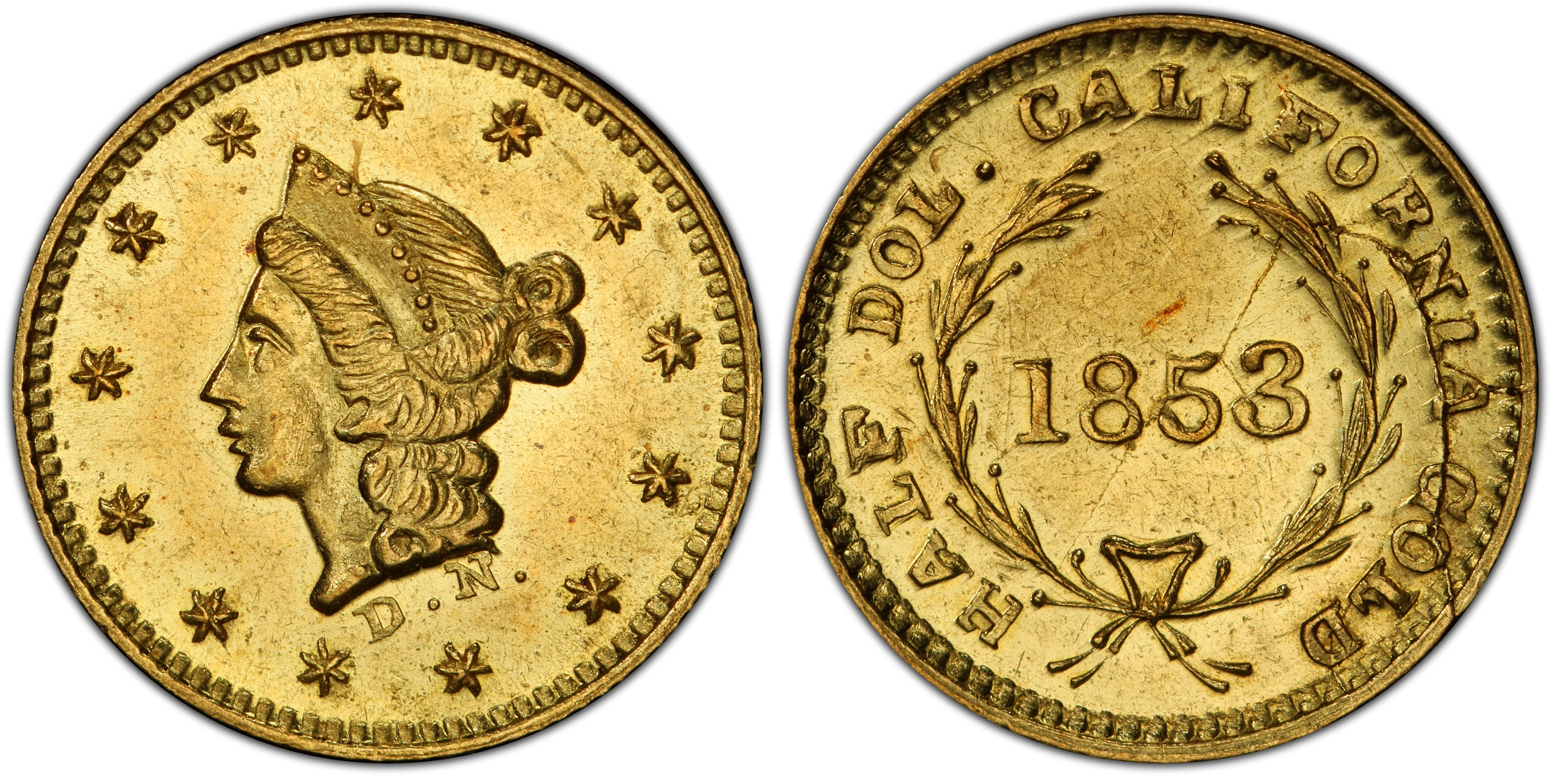
Obverse & Reverse
The 1853 BG-409 half dollar is a tangible relic from the chaotic and economically vibrant zenith of the California Gold Rush. Following the discovery of gold at Sutter's Mill in 1848, a massive influx of over 300,000 people descended upon California, creating an instant and overwhelming demand for housing, goods, services, and, most critically, a functional medium of exchange. While miners extracted vast quantities of gold dust, the region suffered from a severe shortage of official United States coinage, particularly for small-scale, everyday transactions. A pinch of gold dust for a drink at a saloon was an imprecise and often contentious method of payment. Larger private and territorial gold coins ($5 and up) from firms like Moffat & Co. addressed the needs of bankers and merchants, but the public was starved for small change. Into this monetary vacuum stepped a number of entrepreneurial manufacturing jewelers in San Francisco. Between 1852 and 1857, a period numismatists classify as 'Period One' of fractional gold production, these artisans began striking their own tiny gold coins in quarter dollar, half dollar, and dollar denominations. Unlike the later 'Period Two' issues (1858-1882), which were largely made as souvenirs, the Period One pieces were created out of genuine commercial necessity and are believed to have actually circulated. The BG-409 is a prime example of this utilitarian coinage. Struck crudely by the 'hammer method'—where a planchet was placed between two dies on an anvil-like surface and struck with a sledgehammer—their quality varied immensely. These coins were technically illegal, as the U.S. Constitution reserves the right to coin money for the federal government. However, the realities of frontier life and the distance from federal authority allowed this private industry to flourish for several years. The intrinsic value of the gold in these pieces was often slightly less than their face value, making them profitable for the issuers and essentially a form of token coinage, yet they were accepted in trade due to the desperate need for a divisible currency. The opening of the San Francisco Mint in 1854 and its increasing output of official coinage eventually rendered these private fractionals obsolete for commerce, leading to their gradual disappearance from circulation.
Associated EventCalifornia Gold Rush
Reason For MintingTo alleviate a severe shortage of small-denomination coinage for daily commercial transactions in Gold Rush-era California.
Minter HistoryThe specific minter of the BG-409 variety is unknown, a common trait for much of the fractional gold series. Research by Walter Breen and Ronald Gillio suggests these pieces were the work of various San Francisco jewelers, many of French origin, such as Antoine Louis Nouzillet, M. Deriberpie, and the firm of Frontier, Deviercy & Co. These individuals possessed the requisite skills in die-sinking and metallurgy. They operated small, private enterprises, producing coins as a profitable sideline to their main jewelry businesses. They did not mark all of their work, leaving a legacy of anonymous but historically vital coinage.
Historical SignificanceThe BG-409 and its contemporary Period One fractionals represent a classic example of private enterprise filling a crucial economic void left by the federal government on the American frontier. They are direct artifacts of the region's unique 'gold dust' economy and the challenges it faced. Their existence demonstrates the ingenuity of local artisans and the intense demand for a standardized medium of exchange to support the booming population. As a class, they are among the most historically significant and avidly collected series of U.S. private coinage.
While Donald Kagin's work is a foundational text for U.S. private gold, the specialized series of California Fractional Gold is cataloged almost exclusively by the Breen-Gillio (BG) numbering system from the reference 'California Pioneer Fractional Gold'. BG-409 is the standard and universally accepted attribution for this variety.
Denomination50 Cents
Minting Period1853
Assayer/MinterUnknown. Attributed generally to one of the numerous manufacturing jewelers active in San Francisco during the 1852-1856 period.
Geographic OriginSan Francisco, California
Obverse DescriptionA fairly crude representation of a Liberty Head, facing left, with hair tied in a bun. She is surrounded by thirteen six-pointed stars. The date '1853' is below the bust. Notably, this variety is an overdate, with the final '3' clearly punched over a '2', a diagnostic feature often listed as 1853/2.
Obverse Inscription1853
Reverse DescriptionThe central device is a simple wreath composed of two branches tied with a bow at the bottom. The denomination '50' is inside the wreath, and the word 'CENTS' is below it. The legend 'CALIFORNIA GOLD' encircles the wreath along the upper periphery.
Reverse InscriptionCALIFORNIA GOLD 50 CENTS
CompositionGold
Stated Fineness Actual FinenessVariable, typically between .800 and .900 fine. The gold used was often native California bullion, which contained a natural alloy of silver, giving some examples a lighter or 'greener' gold color.
Weight0.38 grams
Diameter10.00 mm
EdgePlain
Unknown. No official records were kept by the private minters.
Survival Estimate31-75. The NGC census lists 61 examples graded across all conditions, which strongly supports this estimate.
Rarity ScaleR-5 (Very Scarce)
This coin is highly sought after as a genuine 'Period One' fractional that was made for circulation. Its appeal is enhanced by the clear 1853/2 overdate, which adds a layer of numismatic intrigue. It represents a tangible link to the height of the Gold Rush and is one of the more accessible varieties of this historic series.
Key VarietiesThe primary variety is the 1853/2 overdate, which characterizes all known examples of BG-409. No significant sub-varieties or die states are widely recognized. As a Period One issue intended for commerce, there are no known patterns, trial pieces, or later-date proof restrikes associated with the BG-409 dies. Collectors should be aware of modern replicas, which are not considered numismatic varieties.
Authentication TipsAuthentic BG-409s are struck in gold, not brass or gilt base metal. The weight should be very close to 0.38 grams. Crucially, as a Period One issue, it must have a clear denomination (50 CENTS). Many modern fakes or souvenir tokens will say 'CALIFORNIA GOLD' without a denomination, or feature a bear on the reverse; these are not genuine coins. Look for the distinctive 1853/2 overdate on the obverse. The strike is often crude and may be uneven, which is a characteristic of hammer striking, not a sign of a fake.
Shopping ConsiderationsA premium quality example for its grade will show a bold strike, especially on the Liberty portrait and the digits of the date and denomination. Many were weakly struck due to the crude minting process, so well-centered and sharply defined coins command a premium. Look for original, uncleaned surfaces which often exhibit a satiny or sometimes prooflike luster and pleasing reddish-gold or honey-gold toning. Avoid examples that have been used as jewelry, which may show evidence of solder, harsh cleaning, or a plugged hole. Even on Mint State examples, small planchet flaws or adjustment marks are common and should be evaluated for their impact on eye appeal.
A coin's grade is its condition, rated on a 1-70 scale. For rare coins, this is the most critical factor in determining value, as a tiny difference in preservation can mean a huge difference in price.
Relevant Grade TypesOriginal BG-409 half dollars were business strikes intended for circulation. They are found in Circulated grades (AG-3 to AU-58) and, more rarely, in Mint State grades (MS-60 to MS-70). No proofs were struck during the original minting period, and there are no known later-date proof restrikes of this specific variety.
Mint State CharacteristicsAn uncirculated BG-409 will exhibit full mint luster, which is typically a vibrant, satiny texture often described as 'rippling'. The strike is a key determinant of quality; many are softly struck, particularly on the highest points of the hair above Liberty's eye and on the leaves of the wreath. A sharp strike is rare and desirable. Due to the softness of the gold and crude handling, even high-grade Mint State examples often show small, scattered contact marks. Planchet quality can also vary, with some showing minor striations or fissures original to the manufacturing process.
Circulated Wear PatternsWear first appears on the highest points of the design. On the obverse, this includes the hair over Liberty's brow and ear, her cheek, and the tips of the stars. On the reverse, the highest points of the wreath's leaves and the numerals '50' will show the first signs of friction and flattening. In lower grades (VG and below), the date and legends will become weak, and the individual hair strands will merge into a flat surface.
Key Factors For ValueBeyond the numerical grade, value is driven by three key factors: strike, surface quality, and eye appeal. A sharply struck coin with clear details, especially the overdate, is far more valuable than a weakly struck coin of the same grade. Original, uncleaned surfaces with attractive natural toning command significant premiums over coins that have been cleaned, polished, or show excessive abrasions. The presence of a CAC sticker, indicating premium quality for the grade, adds a substantial premium for this series, as it confirms to the market that the coin possesses superior strike and surfaces.
PCGS Price Guide
| Grade | Price | Population |
|---|---|---|
| 45 | N/A | 1 |
| 50 | $250.00 | 2 |
| 50+ | $265.00 | N/A |
| 53 | $280.00 | 5 |
| 53+ | $315.00 | N/A |
| 55 | $360.00 | 19 |
| 55+ | $385.00 | N/A |
| 58 | $425.00 | 42 |
| 58+ | $450.00 | N/A |
| 60 | $475.00 | 7 |
| 61 | $500.00 | 21 |
| 62 | $525.00 | 44 |
| 62+ | $600.00 | N/A |
| 63 | $800.00 | 21 |
| 63+ | $950.00 | N/A |
| 64 | $1,500.00 | 9 |
| 64+ | $1,650.00 | N/A |
| 65 | $2,000.00 | N/A |