1853 G$1 BG-519 (Regular Strike)
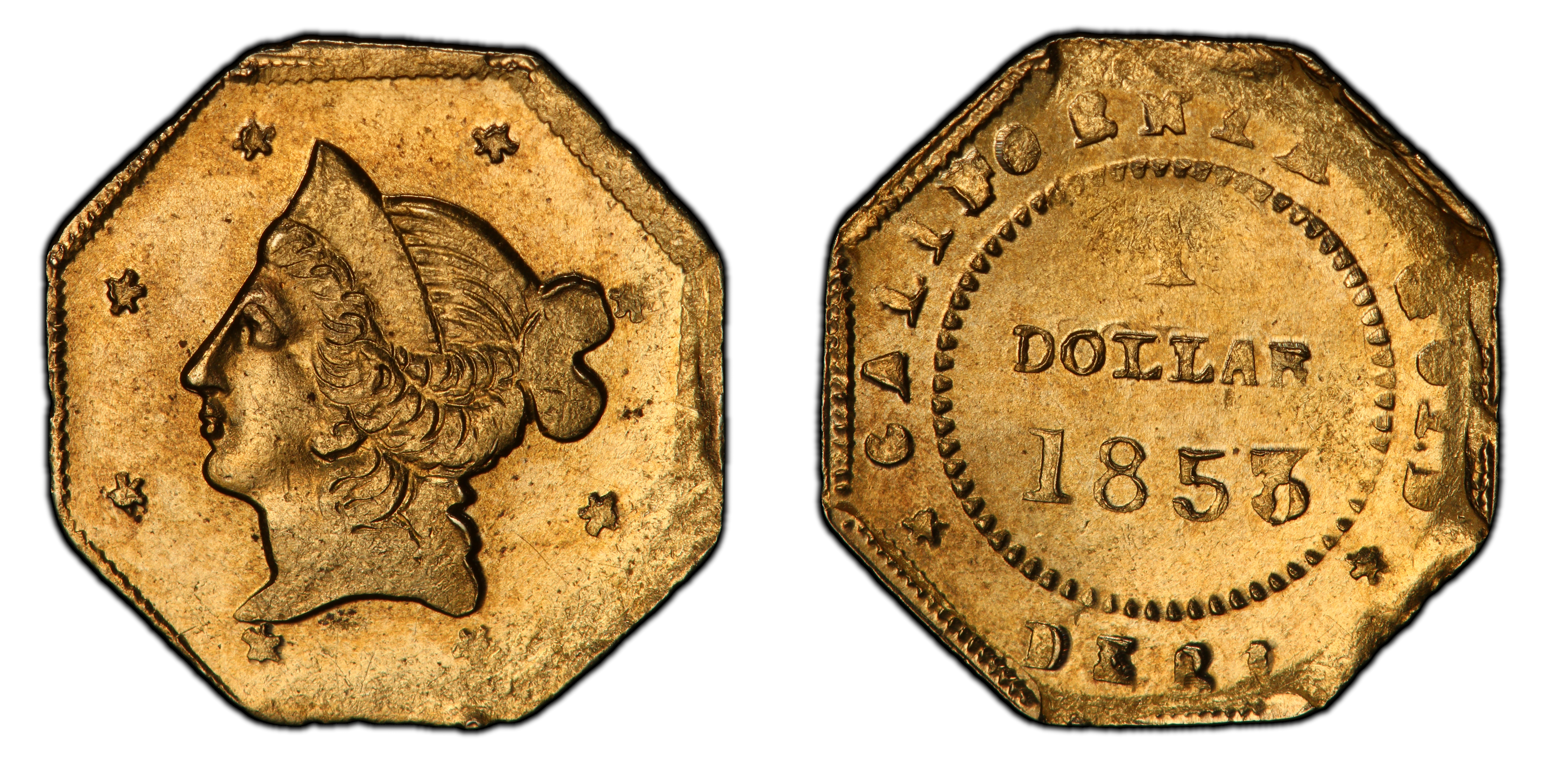
Obverse & Reverse
The 1853 Octagonal Gold Dollar, cataloged as Breen-Gillio 519, is a quintessential artifact from the first period (1852-1857) of California's private gold coinage. Born from the acute necessity of the Gold Rush, this piece represents a tangible solution to a severe shortage of circulating small change. In the chaotic, gold-dust-fueled economy of early San Francisco, transactions for daily goods were frustratingly imprecise, often settled with a 'pinch' of gold dust. While private assayers like Moffat & Co. and Wass, Molitor & Co. were striking larger denomination coins ($5 to $50), a chasm existed for denominations under a quarter eagle. Federal coinage was scarce on the isolated West Coast, and the San Francisco Mint would not be fully operational until 1856. Seizing this commercial opportunity, numerous jewelers and metalsmiths, many of whom were French immigrants, began striking their own fractional denominations. These 'Period One' issues were not mere tokens, but were intended to, and did, circulate as currency, containing gold value close to their stated face value. The BG-519 was struck by the firm of M. Deriberpe and Antoine Louis Nouizillet, San Francisco jewelers whose partnership produced a number of varieties. The initials 'DERI' are sometimes associated with this specific coin in numismatic literature. The crude but functional manufacturing process, often involving hand-cut dies and manual screw presses or even hammers, resulted in coins of varying strike quality. Public reception was mixed; while they filled a vital need, their unofficial status and sometimes inconsistent weight made some merchants wary. However, their convenience was undeniable. As federal coinage became more plentiful after 1856, the practical need for these fractional pieces diminished. Many were likely melted down, while others were kept as souvenirs of the Gold Rush, a practice that became the primary driver for the later, often underweight 'Period Two' issues. Today, the BG-519 is a prized numismatic relic, embodying the ingenuity and frontier capitalism that defined one of America's most dynamic historical eras.
Associated EventCalifornia Gold Rush
Reason For MintingTo alleviate a severe shortage of small-denomination circulating coinage for daily commerce in Gold Rush-era San Francisco.
Minter HistoryMarius Deriberpe and Antoine Louis Nouizillet were French jewelers operating in San Francisco during the Gold Rush. Like many craftsmen in the city, they recognized the critical lack of small change and applied their metallurgical skills to meet the demand. They formed a partnership (identified by the 'D.N.' mark on some issues) and produced a variety of fractional gold coins in quarter, half, and dollar denominations during the 'Period One' era of 1852-1856. Their issues are noted for their relatively high gold content and intent for actual circulation, distinguishing them from the later souvenir pieces made by other jewelers. Nouizillet was also involved in another partnership, Nouizillet & Routhier ('N.R.'). The firm's operations ceased as the U.S. Branch Mint in San Francisco ramped up production of federal coinage, rendering private issues obsolete.
Historical SignificanceAs a 'Period One' issue, the BG-519 is significant as a genuine circulating medium of exchange from the height of the Gold Rush, not merely a souvenir. It demonstrates the privatization of coinage in the absence of federal supply and serves as a direct link to the daily economic life of miners, merchants, and settlers in 1850s California.
N/A
DenominationG$1
Minting Period1853
Assayer/MinterDeriberpe & Nouizillet
Geographic OriginSan Francisco, California
Obverse DescriptionA left-facing Liberty Head, modeled after the contemporary federal gold coinage designed by James B. Longacre. The portrait is simple, with hair tied in a bun. The field is plain, without stars.
Obverse Inscription Reverse DescriptionThe central design element is the denomination '1' and the word 'DOLLAR' with the date '1853' below. A simple wreath surrounds the denomination and date. The legend 'CALIFORNIA GOLD' is inscribed around the periphery, separated from the inner wreath. The abbreviation 'DERIB' for the minter appears at the bottom.
Reverse InscriptionCALIFORNIA GOLD 1 DOLLAR 1853 DERIB
CompositionGold
Stated Fineness Actual FinenessTypically around .880 to .900 fine, consistent with Period One issues, but can vary.
EdgePlain
Unknown
Survival Estimate75-125
Rarity ScaleR-4 to R-5
This octagonal dollar is highly sought after as a representative of the earliest, functional period of California fractional gold. Its distinct shape, clear date, and attribution to a known maker make it a cornerstone piece for specialists in territorial gold and Gold Rush history. Its tangible connection to commerce in 1850s San Francisco provides a powerful historical allure.
Key VarietiesNo major varieties, patterns, or official restrikes of the BG-519 are known to exist. The entire issue consists of business strikes from the original 1853 period.
Authentication TipsAuthentic examples must have the denomination 'DOLLAR' clearly stated. Replicas made later as souvenirs often omit the word 'dollar' to circumvent anti-counterfeiting laws, or may feature a bear on the reverse, which is never present on genuine issues. The strike on genuine pieces is often somewhat soft or uneven, particularly on the highest points of Liberty's hair and the wreath; a perfectly sharp, modern-looking strike should be viewed with suspicion. The planchets were often crudely prepared, so unstruck areas or minor planchet flaws are not uncommon and can be a sign of authenticity. The 'DERIB' inscription should be closely compared to known genuine examples.
Shopping ConsiderationsA premium quality example for its grade will exhibit a bold strike for the issue, with clear details on Liberty's hair and the reverse wreath. Original, uncleaned surfaces are paramount; many surviving pieces have been harshly cleaned or used as jewelry, and these should be avoided or heavily discounted. Look for pleasing, original 'old gold' toning, which can range from a bright yellow-gold to a deeper reddish-orange hue. Luster can range from satiny to semi-prooflike, and any remaining luster is a significant value-add. Check the octagonal points for excessive wear or damage. A CAC sticker is particularly valuable for this series, confirming both authenticity and superior quality for the grade.
A coin's grade is its condition, rated on a 1-70 scale. For rare coins, this is the most critical factor in determining value, as a tiny difference in preservation can mean a huge difference in price.
Relevant Grade TypesAll original BG-519 coins are business strikes intended for circulation. They are found in Circulated grades (AG-3 to AU-58) and, more rarely, in Mint State (MS-60 to MS-70). No original Proofs were struck. Any piece described as a 'Proof' would be a modern replica or fantasy piece and not a genuine Period One fractional coin.
Mint State CharacteristicsAn uncirculated (MS) example will possess original mint luster, which is typically soft and satiny rather than deeply frosty. The strike is a key differentiator; many are softly struck, so a well-defined Liberty portrait and wreath command a premium. Due to the small size and crude minting process, even Mint State examples may show minor planchet flaws or handling marks that do not impede the grade but should be noted for eye appeal.
Circulated Wear PatternsWear first appears on the highest points of Liberty's hair, particularly the strands above her ear and the bun. The cheek and coronet are also susceptible to early friction. On the reverse, the high points of the wreath's leaves and the numeral '1' will show the first signs of flattening. In lower grades (VG and below), the inscriptions 'CALIFORNIA GOLD' and 'DERIB' will become faint and merge with the rim.
Key Factors For ValueThe primary value drivers are grade and surface preservation. An example with original, uncleaned 'skin' is vastly preferred over a cleaned, brighter piece of the same grade. Strike quality is a close second; a sharply struck coin will always command a significant premium over a weakly struck one. Eye appeal, including attractive original toning and a lack of distracting marks, is crucial. Finally, third-party certification by PCGS or NGC is essential for market acceptance, and the addition of a CAC sticker for high-end, original examples adds a further, often substantial, premium.
PCGS Price Guide
| Grade | Price | Population |
|---|---|---|
| 30 | $325.00 | N/A |
| 35 | $330.00 | N/A |
| 40 | $350.00 | 1 |
| 45 | $360.00 | 5 |
| 45+ | $360.00 | N/A |
| 50 | $400.00 | 10 |
| 50+ | $425.00 | N/A |
| 53 | $465.00 | 8 |
| 53+ | $500.00 | N/A |
| 55 | $575.00 | 13 |
| 55+ | $625.00 | N/A |
| 58 | $725.00 | 29 |
| 58+ | $800.00 | N/A |
| 60 | $975.00 | 9 |
| 61 | $1,125.00 | 5 |
| 62 | $1,500.00 | 28 |
| 62+ | $1,750.00 | N/A |
| 63 | $2,500.00 | 8 |
| 63+ | $2,750.00 | N/A |
| 64 | $3,000.00 | 3 |
| 64+ | $3,500.00 | N/A |
| 65 | $4,500.00 | 2 |