1854 G$1 BG-513 (Regular Strike)
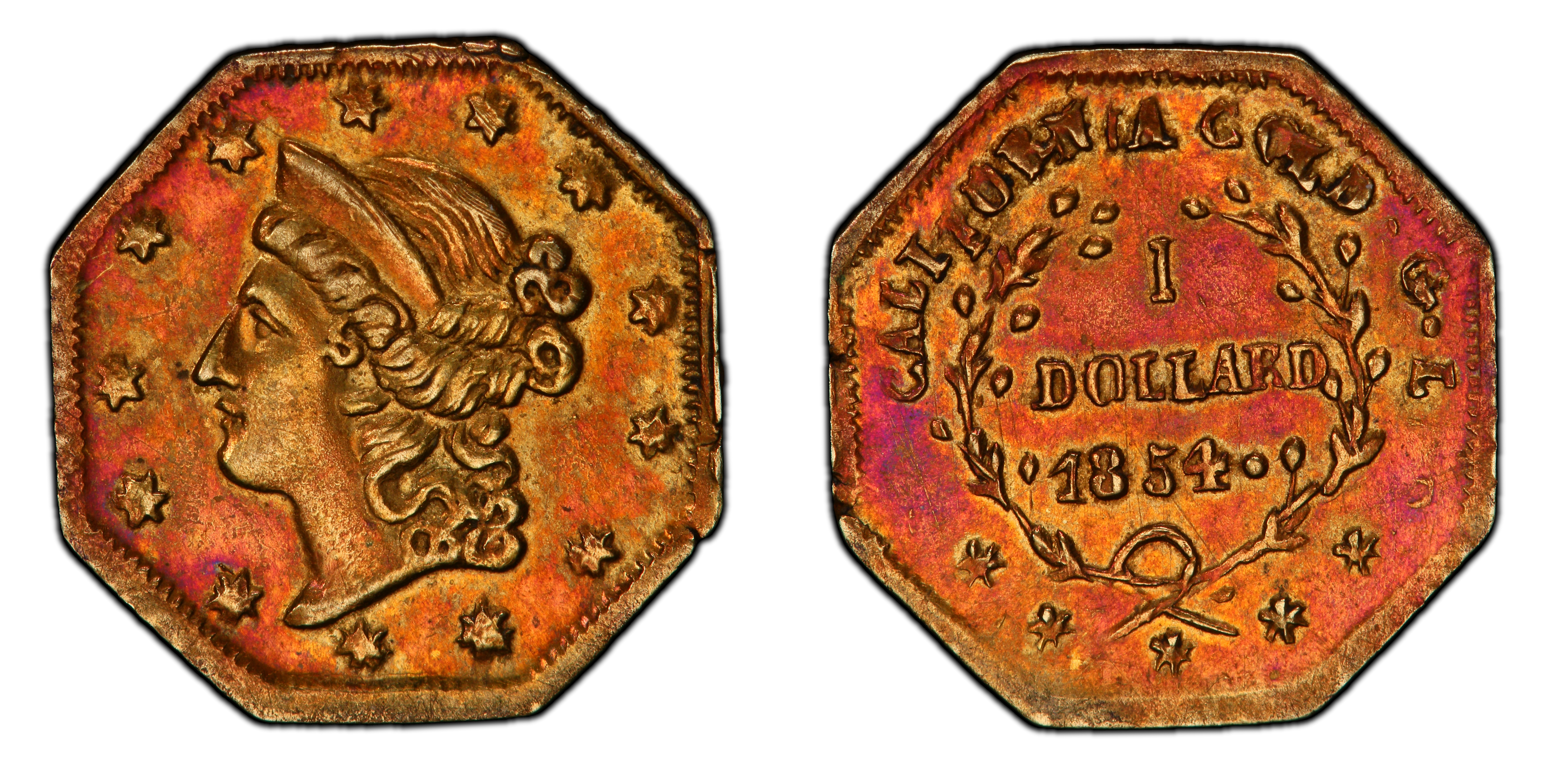
Obverse & Reverse
The 1854 Octagonal Gold Dollar, cataloged as Breen-Gillio 513, is a fascinating and extremely rare artifact from the chaotic, formative years of the California Gold Rush. Following the discovery of gold at Sutter's Mill in 1848, a massive influx of prospectors and merchants flooded into California, but the monetary system could not keep pace. Gold dust became the primary medium of exchange, an inefficient and often inequitable system. While several private mints began striking larger denomination coins ($5 and up), there was a severe, crippling shortage of small-denomination coinage for everyday transactions. Federal efforts were slow to materialize; the U.S. Branch Mint in San Francisco did not begin operations until 1854 and its initial output of small coins was woefully insufficient and quickly hoarded. Into this void stepped a number of entrepreneurial jewelers and metalsmiths in San Francisco, many of French origin, who began striking their own fractional denomination gold coins in quarter, half-dollar, and dollar sizes starting in 1852. These issues, now categorized by numismatists as 'Period One' (1852-1857) California Fractional Gold, were created not as souvenirs, but as a genuine, circulating medium of exchange. They were struck from native California gold, often alloyed with the naturally occurring silver, giving them a distinct lighter color. The BG-513 is a prime example of this utilitarian coinage. Unlike the later 'Period Two' issues which were often underweight and made for the tourist trade, Period One pieces like BG-513 were generally made to honest weight and fineness, closely approximating their federal counterparts to encourage public acceptance. Their very existence speaks to a specific moment of economic necessity on the American frontier, a private solution to a government failure. The extreme rarity of the BG-513 variety today suggests a very small initial mintage, perhaps the work of a single jeweler testing a design. Each surviving piece passed through the hands of miners, merchants, and gamblers, a tangible link to the frenetic commerce of Gold Rush San Francisco before the monetary system was fully stabilized.
Associated EventCalifornia Gold Rush
Reason For MintingTo alleviate a severe shortage of small-denomination coinage for daily commerce in California before the San Francisco Mint was fully operational.
Minter HistoryThe specific minter of BG-513 is unknown. It was part of a group of 'Period One' issues created by various private jewelers in San Francisco between 1852 and 1857. Prominent known makers of other fractional gold pieces from this era include M. Deriberpe and Antoine Louis Nouizillet, though no definitive link has been established for this specific variety.
Historical SignificanceAs a 'Period One' issue, the BG-513 represents the legitimate, circulating private currency of the California Gold Rush. Its existence demonstrates the private sector's response to a critical economic need on the frontier. Its extreme rarity makes it a key variety for specialists, representing a fleeting and scarcely surviving part of America's monetary history.
N/A
Denomination$1
Minting Period1854
Assayer/MinterUnknown. Attributed to the group of San Francisco jewelers producing fractional gold during this period. A single auction reference noted 'G.L' in the description, but this attribution is not widely confirmed.
Geographic OriginSan Francisco, California
Obverse DescriptionOctagonal shape. The obverse features a Liberty Head, styled after the contemporary U.S. gold coinage by James B. Longacre. The portrait is typically surrounded by a number of stars, though the exact count and arrangement for BG-513 is not consistently documented due to its rarity.
Obverse InscriptionLIBERTY (on coronet)
Reverse DescriptionOctagonal shape. The reverse design is centered on the denomination. Typically, a wreath or a circle of beads encloses the numeral '1' and the word 'DOLLAR'. The date '1854' is also present on the reverse.
Reverse Inscription1 DOLLAR 1854
CompositionGold (likely with a natural silver alloy)
Stated Fineness Actual FinenessVariable, but Period One issues were generally struck at a fineness intended to approximate their face value.
EdgePlain
Extremely small; unknown.
Survival Estimate2-3 known examples.
Rarity ScaleR-8
This coin's appeal is immense, stemming from its status as a genuine circulating artifact of the Gold Rush, its octagonal shape, and its legendary rarity. It is a trophy coin for the most advanced specialists in Territorial gold.
Key VarietiesThe BG-513 is itself a key variety. No major sub-varieties, restrikes, or patterns are known due to its extreme rarity. The primary distinction in the series is between the 'Period One' (1852-1857) circulating issues like this one, and the later 'Period Two' (1859-1882) souvenir issues, which were often underweight and stylistically different.
Authentication TipsAuthentication is paramount. Any genuine example must be compared against the photographic plates in the Breen-Gillio reference, 'California Pioneer Fractional Gold'. Key diagnostics include die markers, the precise shape and position of the numerals and letters, and the overall fabric of the coin. Genuine Period One pieces must have a stated denomination (e.g., 'DOLLAR' or 'DOL.'). Many modern replicas and fantasy pieces exist; caution and third-party certification by PCGS or NGC are mandatory.
Shopping ConsiderationsAcquisition of a BG-513 is a major numismatic event. A potential buyer should prioritize a specimen with the sharpest possible strike, especially on Liberty's hair and the details of the reverse wreath. Original, uncleaned surfaces are critical; many fractional pieces have been harshly cleaned or used as jewelry. Look for the characteristic luster of native California gold, which is often soft and satiny. Given the R-8 rarity, any example, regardless of minor imperfections, is a major prize. Provenance is also a significant factor in value.
A coin's grade is its condition, rated on a 1-70 scale. For rare coins, this is the most critical factor in determining value, as a tiny difference in preservation can mean a huge difference in price.
Relevant Grade TypesAll known examples are business strikes, intended for circulation. They are found in Circulated grades (AG-3 to AU-58) and, very rarely, in Mint State (MS-60 to 70). No original proofs from the 1850s are known or believed to exist for this private issue. Any piece described as a 'Proof' would be a later striking or a misattribution.
Mint State CharacteristicsA true Mint State BG-513 would be a pinnacle rarity. Quality is defined by the sharpness of the strike; many fractionals are somewhat crudely struck, so a coin with full central details (hair curls, wreath leaves) would be exceptional. Luster should be intact, likely with a soft, slightly satiny texture characteristic of the alloy. Contact marks are expected due to the softness of the gold and handling in commerce, but large, distracting marks will detract significantly from the grade and eye appeal.
Circulated Wear PatternsWear first appears on the highest points of the design. On the obverse, this includes Liberty's cheek, the hair above the ear, and the coronet. On the reverse, the high points of the wreath leaves and the numeral '1' will show the first signs of friction. In lower grades (Fine and below), the stars on the obverse will begin to merge with the fields, and the legends will become soft.
Key Factors For ValueFor an ultra-rarity like BG-513, the primary factor is simply existence and authenticity. Beyond that, value is determined by surface preservation and strike. An example with original, uncleaned surfaces and minimal distracting marks will command a massive premium over a cleaned or damaged specimen of the same technical grade. A sharp strike is highly desirable, as many were weakly produced. Eye appeal, including attractive original toning, further enhances value. A CAC sticker would provide significant validation of quality for the grade.
PCGS Price Guide
| Grade | Price | Population |
|---|---|---|
| 58 | $42,500.00 | 3 |