No Date G25C BG-204C (Regular Strike)
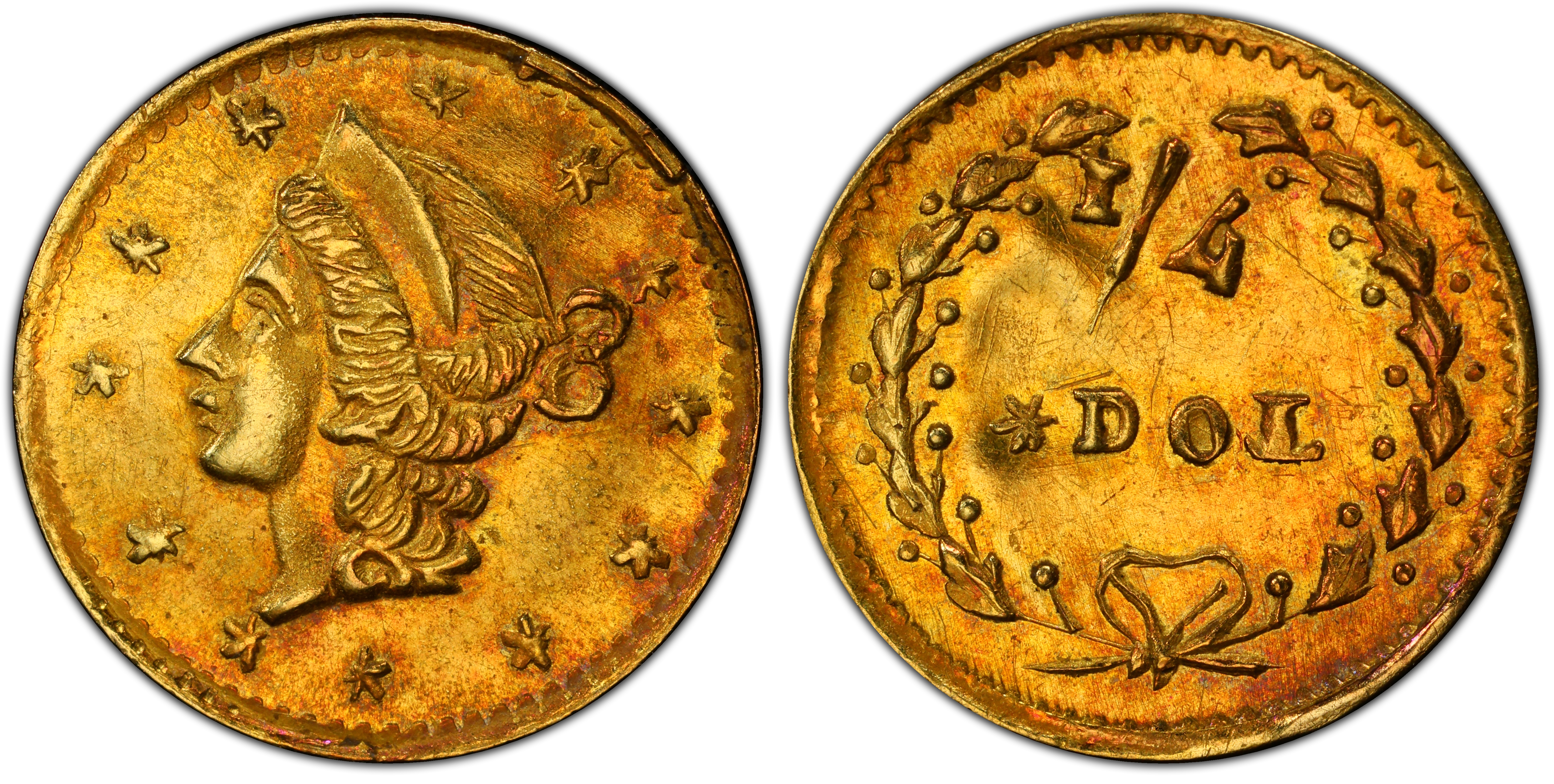
Obverse & Reverse
The No Date (1853) G25C, cataloged as Breen-Gillio 204C, is a quintessential artifact from the chaotic and economically vibrant era of the California Gold Rush. Following the discovery of gold at Sutter's Mill in 1848, a massive influx of over 300,000 people descended upon California, creating an instant and overwhelming demand for housing, goods, and services. This explosive growth, however, was not matched by an adequate supply of federal coinage. Gold dust, weighed crudely and often inaccurately, became the default medium of exchange, but it was impractical and fraught with peril for small, everyday transactions. A 'pinch' of gold for a drink at a saloon was a highly variable and unsatisfactory method of payment. The United States government was slow to respond; the San Francisco Mint would not be fully operational until 1856, and initially, federal assay offices were only authorized to produce large denomination ingots. This created a severe 'small change' famine. Into this monetary vacuum stepped a number of enterprising private minters, primarily jewelers and metallurgists, many of whom were of French origin, located in San Francisco. Between 1852 and 1857 (a period numismatists classify as 'Period One'), these craftsmen began striking their own small-denomination gold coins in 25-cent, 50-cent, and one-dollar values. The BG-204C is a product of this initial, utilitarian phase. Unlike the later 'Period Two' issues (1859-1882), which were often underweight and primarily intended as souvenirs for a growing tourist trade, the Period One pieces were struck with the genuine intent of facilitating commerce. Evidence from shipwrecks and contemporary accounts suggests they achieved a degree of circulation, accepted by merchants out of sheer necessity despite not being legal tender. These coins were typically produced by the 'hammer method,' where dies were struck by hand, resulting in significant variations in strike quality. The BG-204C, as a No Date variety, is characteristic of these early, sometimes rushed, productions. Its existence speaks to a specific moment in American history where the frontier economy outpaced the federal government's ability to service it, forcing a return to a more localized and privatized form of currency.
Associated EventCalifornia Gold Rush
Reason For MintingTo alleviate a severe shortage of small-denomination coinage for daily commercial transactions in Gold Rush-era California.
Minter HistoryThe specific minter or jeweler responsible for the BG-204C variety is unknown, as is common for many Period One California Fractional Gold issues. Most of these early pieces were unsigned. However, historical context points to a small community of jewelers and assayers in San Francisco, many of whom were French immigrants like M. Deriberpe, Antoine Louis Nouizillet, Pierre Frontier, and Eugene Deviercy. These craftsmen possessed the necessary skills in metallurgy and die-cutting to produce coinage. They operated in a legal gray area, creating a product that was desperately needed by the local economy. Their operations ceased producing fractional gold for circulation around 1856-1857, as the new San Francisco Mint finally began to produce enough federal silver and gold coins to satisfy the region's commercial needs.
Historical SignificanceThe BG-204C is a tangible link to the primitive but functional economy of the California Gold Rush. It represents a period of private, localized currency that was essential for the region's growth before the full establishment of federal minting operations. As a 'Period One' issue, it is among the pieces most likely to have actually circulated, making it a key historical document of commerce on the American frontier, distinct from the later souvenir issues.
N/A
Denomination25 Cents
Minting Period(1853)
Assayer/MinterUnknown Private Minter
Geographic OriginSan Francisco, California
Obverse DescriptionFeatures a Liberty Head portrait facing left, similar in style to the contemporary federal gold coinage by Christian Gobrecht. The portrait is surrounded by thirteen six-pointed stars arranged along the periphery.
Obverse Inscription Reverse DescriptionA simple wreath of two branches tied with a bow at the bottom. Inside the wreath is the denomination '25 CENTS'.
Reverse Inscription25 CENTS
CompositionGold
Stated Fineness Actual FinenessTypically struck from native California gold, which naturally contained silver, resulting in a fineness of approximately .800 to .900.
EdgePlain
Unknown
Survival Estimate2-3 known
Rarity ScaleR-8
The BG-204C is an issue of the highest rarity and numismatic importance within the popular California Fractional Gold series. Its appeal lies in its 'Period One' status, meaning it was created for commerce, not as a souvenir. As an R-8 variety, it represents an almost unobtainable prize for the advanced specialist, with only two or three examples believed to exist. Ownership of a BG-204C signifies a collection of the utmost sophistication.
Key VarietiesBG-204C is a unique die marriage and represents a key variety in itself. There are no known major sub-varieties from the original minting period. As a 'Period One' issue, it is not associated with later-date souvenir restrikes, which were more common for 'Period Two' designs. The broader BG-204 designation includes other die pairings (BG-204, BG-204A, BG-204B), but BG-204C is a distinct and extremely rare variety.
Authentication TipsAuthentication of any California Fractional Gold requires expert examination. For BG-204C, focus on precise die characteristics found in the Breen-Gillio reference. Genuine Period One pieces were hand-struck and often exhibit weak or unevenly struck areas, especially at the centers or peripheries; modern fakes are often sharply and uniformly struck. The planchets were often crude and thin. The luster should be authentic and not the result of modern polishing. The specific arrangement and shape of the stars on the obverse and the lettering and wreath details on the reverse are critical diagnostic points. All suspected examples should be authenticated by a top-tier grading service like PCGS or NGC.
Shopping ConsiderationsGiven its extreme R-8 rarity, any opportunity to acquire a BG-204C is a major event. A potential buyer must prioritize authenticity above all else, insisting on certification from PCGS or NGC. Price will be a secondary consideration to the mere availability of an example. When evaluating the coin, eye appeal is paramount. Look for an example with minimal distracting marks, as the soft gold is easily damaged. Even a weakly struck example is highly desirable, but a piece with a sharp strike on the Liberty Head and central denomination would command a significant premium. Original, uncleaned surfaces with some remaining luster are vastly preferable to a cleaned or polished specimen, no matter how high the technical grade. Due to its rarity, any example, regardless of grade or condition problems, would be a cornerstone of a major collection.
A coin's grade is its condition, rated on a 1-70 scale. For rare coins, this is the most critical factor in determining value, as a tiny difference in preservation can mean a huge difference in price.
Relevant Grade TypesOriginal examples of BG-204C are business strikes, created for circulation. They are found in Circulated grades (AG-3 to AU-58) and, very rarely, in Mint State (MS-60 to 70). No proofs were struck during the original minting period, nor are there any known later-date Proof restrikes for this specific variety.
Mint State CharacteristicsA Mint State BG-204C would be a phenomenal rarity. Quality is defined by the sharpness of the strike, the quality of the luster, and the preservation of the surfaces. Due to being hand-hammered on potentially crude planchets, even uncirculated examples can show weakness in the strike, particularly on the highest points of Liberty's hair and the leaves of the wreath. Luster is typically soft and satiny, not deeply reflective. Given their utilitarian nature and softness, contact marks are common and must be evaluated carefully; a few light, scattered marks on a lustrous, well-struck piece would define a premium gem.
Circulated Wear PatternsOn the obverse, wear first appears on the high points of Liberty's hair, particularly the strands above the ear and the coronet. The cheek and the tips of the stars will then show flatness. On the reverse, the highest points of the wreath's leaves and the bow will wear first. In lower grades (VG and below), the central denomination '25 CENTS' and the peripheral stars will become faint and may merge with the fields.
Key Factors For ValueFor a coin of this rarity, the primary factor for value is simply its existence and authenticity. Beyond that, a certified grade is crucial. Surface quality is the next most important factor; an example with original, undisturbed skin and luster is exponentially more valuable than one that has been cleaned, polished, or repaired. Strike quality is also key; a coin with a bold strike on the central devices and clear legends will always be prized. Finally, outstanding eye appeal, perhaps derived from a light, attractive patina over lustrous surfaces, would place an example at the absolute pinnacle of desirability and value for the issue.
PCGS Price Guide
| Grade | Price | Population |
|---|---|---|
| 62 | N/A | 1 |
| 63 | N/A | N/A |