1855 G50C BG-406 (Regular Strike)
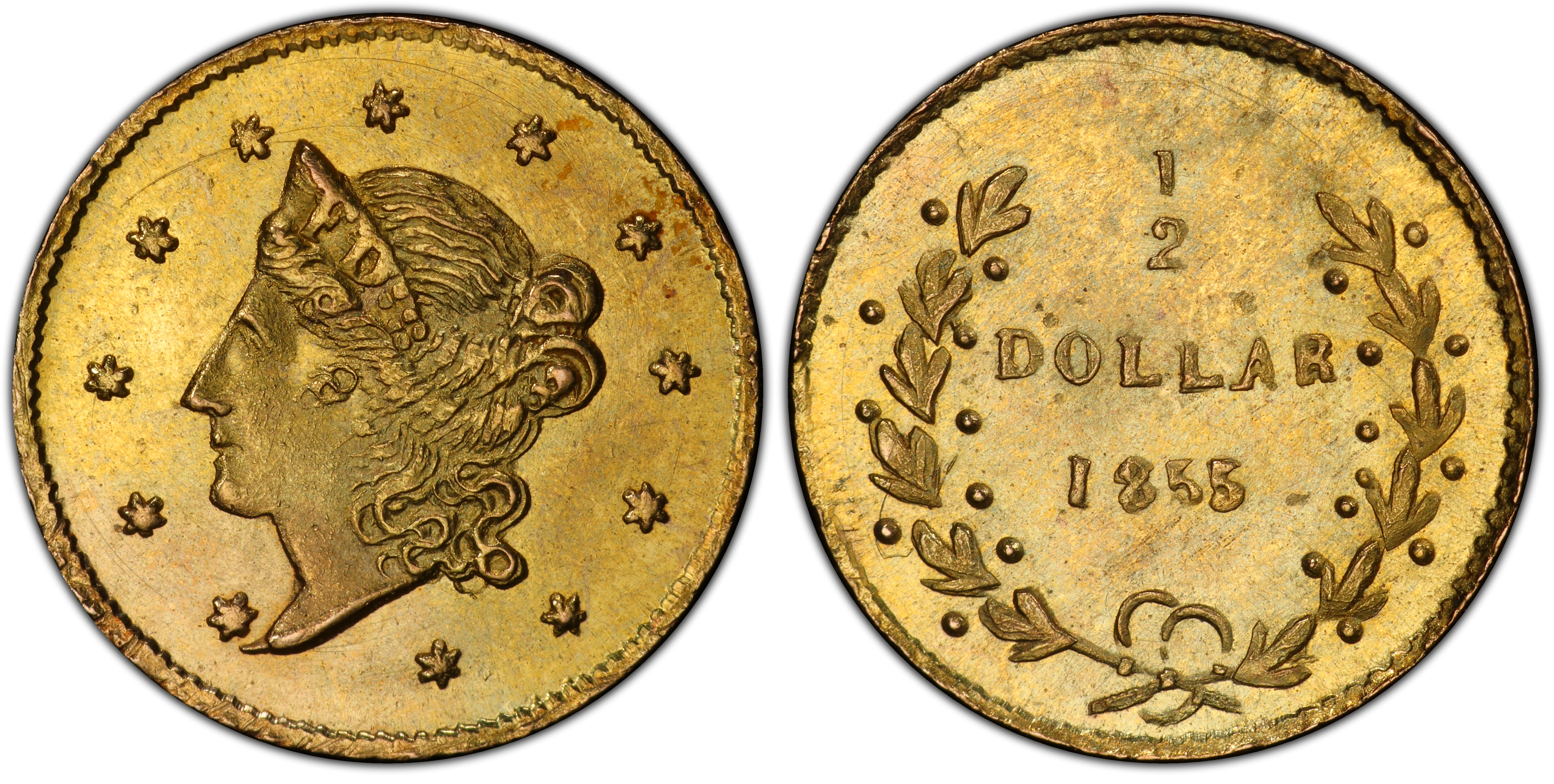
Obverse & Reverse
The 1855 BG-406 50 Cent piece is a tangible relic from the chaotic and economically vibrant zenith of the California Gold Rush. Following the discovery of gold at Sutter's Mill in 1848, a massive influx of prospectors and merchants descended upon California, creating an instant economy. However, this boom was severely hampered by a chronic shortage of small-denomination coinage. Gold dust, weighed in 'pinches,' served as a crude medium of exchange, but it was imprecise, inefficient, and prone to theft and fraud. While private assayers like Moffat & Co. and Kellogg & Co. produced larger denomination gold coins, the critical need for everyday pocket change remained unmet. This void was filled by a small group of San Francisco jewelers and metalworkers, many of French origin, who began striking their own quarter, half, and one-dollar gold pieces starting in 1852. These issues, now known as 'Period One' California Fractional Gold, were struck with the explicit purpose of facilitating daily commerce. The BG-406, attributed to the firm of Frontier, Deviercy & Co., is a classic example of this genre. Produced by hand using the 'hammer method'—where a planchet was placed between two dies and struck with a sledgehammer—these coins were never intended to be perfect. Their intrinsic value was often less than their face value, but in the inflated economy of Gold Rush San Francisco, their convenience far outweighed any deficiency in gold content. They were accepted in trade, used to buy drinks, meals, and other necessities, and served as a vital lubricant for the region's commerce until the San Francisco Mint began producing sufficient quantities of federal coinage in 1856-57, rendering the private issues obsolete. The survival of any BG-406 today is remarkable, as most were lost, heavily circulated, or melted down once federal coins became plentiful.
Associated EventCalifornia Gold Rush
Reason For MintingTo alleviate a severe shortage of small-denomination coinage for daily commercial transactions in Gold Rush-era San Francisco.
Minter HistoryFrontier, Deviercy & Co. was a partnership of French jewelers Pierre Frontier and Eugene Deviercy, active in San Francisco during the heart of the Gold Rush, from roughly 1852 to 1856. Like other private minters of the era, such as Antoine Louis Nouizillet and M. Deriberpe, they applied their skills as metallurgists and engravers to meet the booming demand for small change. Their firm produced a variety of denominated fractional gold pieces, often marked with the initials 'F.D.' or, as in the case of BG-406, left unattributed but identifiable by die characteristics. Their work is characteristic of 'Period One' issues, which were created primarily for circulation and tended to mimic the Liberty Head design of contemporary federal gold dollars. After the initial period, the firm's partners were involved in various other configurations, and their dies were sometimes used for later, Period Two souvenir strikings.
Historical SignificanceThe BG-406 is a prime example of a 'Period One' California Fractional Gold coin, representing a crucial, privately-issued currency that enabled the day-to-day economy of the California Gold Rush to function. Its existence underscores the severity of the coinage shortage on the West Coast and the ingenuity of private entrepreneurs who stepped in to fill a need the federal government was slow to meet. It is a direct link to the commerce of miners, merchants, and pioneers in one of the most dynamic periods of American history.
BG-406
Denomination50 Cents
Minting Period1855
Assayer/MinterFrontier, Deviercy & Co.
Geographic OriginSan Francisco, California
Obverse DescriptionA small Liberty Head facing left, similar in style to the U.S. Type 1 Gold Dollar. The portrait is surrounded by thirteen six-pointed stars arranged in an arc. The date '1855' appears below the bust.
Obverse Inscription1855
Reverse DescriptionThe denomination '1/2' is centrally located within a wreath. The legend 'CALIFORNIA GOLD' encircles the wreath.
Reverse Inscription1/2 CALIFORNIA GOLD
CompositionGold
Stated Fineness Actual FinenessVariable, typically 14 to 22 karats. California gold bullion naturally contained silver, resulting in a lighter color than federal issues.
EdgePlain
Unknown
Survival Estimate13-30 coins
Rarity ScaleR-6+
The BG-406 is highly sought after as a rare, dated 'Period One' fractional that was made for actual circulation during the Gold Rush. Its connection to the San Francisco firm of Frontier, Deviercy & Co. adds to its appeal for specialists. The raw, handmade quality and historical importance make it a prized possession for collectors of territorial and pioneer gold.
Key VarietiesThe primary variations for this issue are in die states. At least one early die state, designated 'State I,' has been noted by auction houses. As the dies were used, they would develop cracks and other imperfections, making coins struck later subtly different from the initial strikings. There are no known major design variations or official restrikes for this specific variety.
Authentication TipsAuthentic BG-406 specimens must have a denomination ('1/2') and will not feature a bear on the reverse, a common feature of modern replicas. The strike is often somewhat crude due to the hammer-striking process, and weakness in spots is common. Compare the coin to high-resolution images from major auction houses (PCGS, NGC, Heritage) to match the specific die characteristics, such as the shape of the numerals and letters and their position relative to the wreath and Liberty's bust. Genuine pieces are made of gold, not brass or gold-plate, and have a distinct feel and luster. Third-party grading is highly recommended for authentication.
Shopping ConsiderationsWhen acquiring a BG-406, look for a specimen that is 'well struck for the issue,' as this is a key determinant of quality. Many examples exhibit weakness on the reverse details, so a piece with a bold '1/2' and clear legends commands a premium. Check for pleasing, original surfaces with some remaining luster; many survivors are cleaned or have been mounted as jewelry, so problem-free examples are scarce. Eye appeal is paramount. An example with attractive, original reddish-gold toning is far more desirable than a brighter, dipped-out coin. Carefully inspect for tooling, smoothing of the fields, or repairs, especially around the rim.
A coin's grade is its condition, rated on a 1-70 scale. For rare coins, this is the most critical factor in determining value, as a tiny difference in preservation can mean a huge difference in price.
Relevant Grade TypesAll original 1855 BG-406 examples are business strikes, intended for circulation. They are found in Circulated grades (AG-3 to AU-58) and, very rarely, in Mint State (MS, 60-70). No proofs were struck during the original minting period, and there are no known later-date proof restrikes of this specific variety.
Mint State CharacteristicsAn uncirculated BG-406 is exceptionally rare. Quality is defined by the strength of the strike and the quality of the luster. A premium MS example would show sharp details on Liberty's coronet and hair strands, and on the leaves of the reverse wreath. However, a hallmark of the issue is a degree of inherent weakness, particularly on the reverse, so a 'full strike' is relative. Luster is typically satiny and can be slightly reflective or 'prooflike' in the fields on early strikes. Small, scattered contact marks are expected due to the softness of the gold and primitive handling, but large, distracting marks will detract significantly from the grade and value.
Circulated Wear PatternsWear first appears on the highest points of the design. On the obverse, friction will first dull the luster on Liberty's cheek, hair above the eye, and the coronet. On the reverse, the high points of the wreath's leaves and bow will show wear first. In lower grades (Fine and below), the individual hair strands will merge, the stars will become faint, and the reverse legends will start to weaken, blending into the fields.
Key Factors For ValueFor the BG-406, value is driven by three main factors: grade, surface quality, and strike. A high-grade, problem-free example (e.g., AU-58 or better) is substantially more valuable than a circulated or damaged piece. Surface quality is crucial; coins with original, uncleaned 'skin' and attractive eye appeal are highly prized. Finally, the strike's sharpness is a major consideration. An example noted as 'well struck for the issue,' with a bold reverse, will command a significant premium over a weakly struck counterpart of the same grade. A CAC sticker on an already-graded coin provides a third-party endorsement of quality for the grade and adds a strong premium.
PCGS Price Guide
| Grade | Price | Population |
|---|---|---|
| 40 | $750.00 | 1 |
| 45 | $775.00 | N/A |
| 45+ | $800.00 | N/A |
| 50 | $825.00 | N/A |
| 50+ | $850.00 | N/A |
| 53 | $875.00 | N/A |
| 53+ | $900.00 | N/A |
| 55 | $925.00 | 1 |
| 55+ | $950.00 | N/A |
| 58 | $975.00 | 6 |
| 58+ | $1,025.00 | N/A |
| 60 | $1,300.00 | 1 |
| 61 | $1,500.00 | 1 |
| 62 | $1,850.00 | 6 |
| 62+ | $2,250.00 | N/A |
| 63 | $3,000.00 | 2 |
| 63+ | $3,500.00 | N/A |
| 64 | $4,000.00 | N/A |
| 64+ | $4,750.00 | 1 |
| 65 | $6,750.00 | 2 |