1853 G25C BG-217A (Regular Strike)
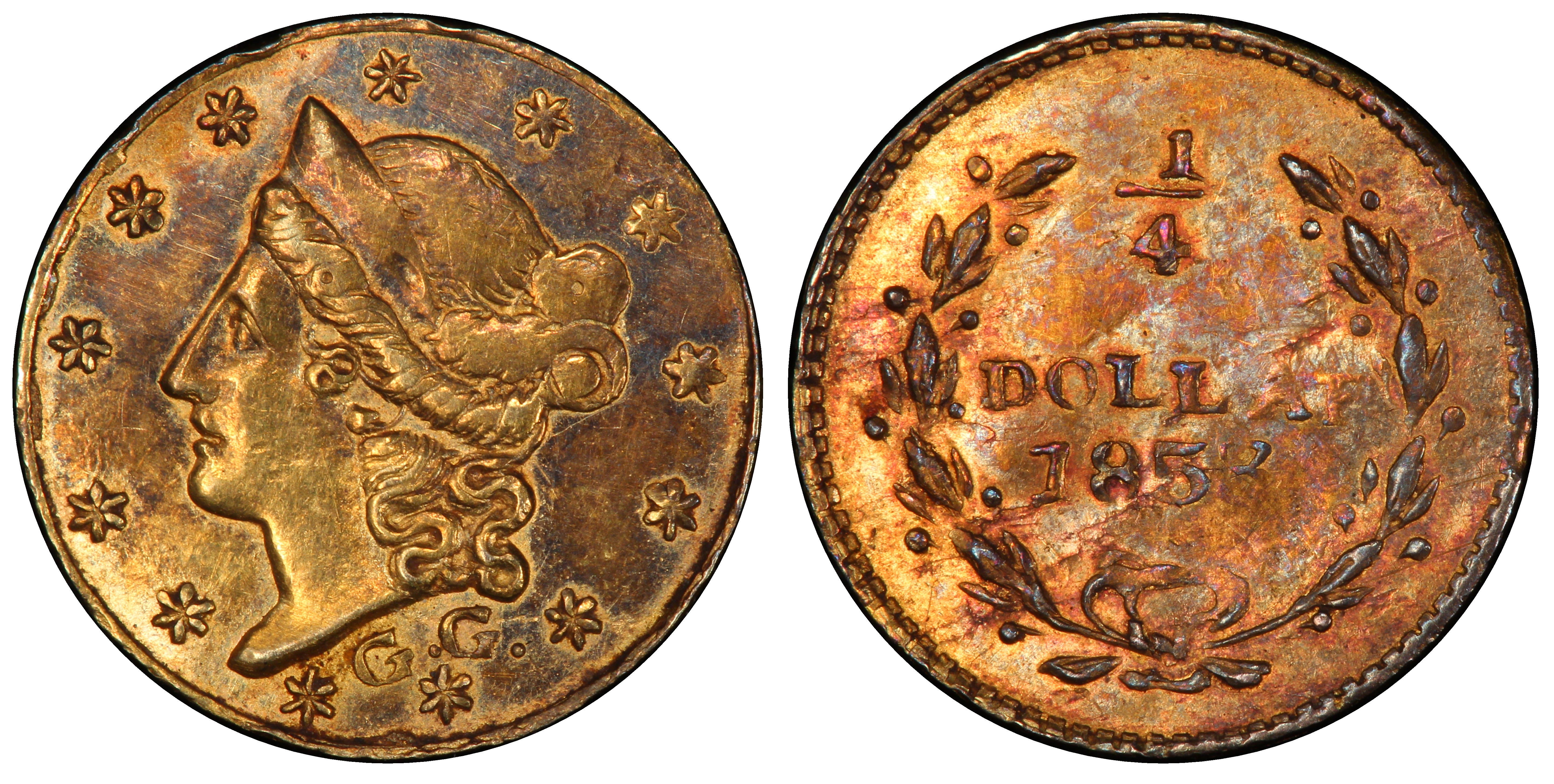
Obverse & Reverse
The 1853 BG-217A 25 Cent piece is a quintessential artifact of the California Gold Rush, a tangible solution to a severe economic problem that plagued the booming territory. Following the discovery of gold in 1848, hundreds of thousands of prospectors and merchants flooded into California. While gold dust and large-denomination private assayer coins ($5 and up) were plentiful, the region suffered from a chronic and debilitating shortage of small-denomination coinage for everyday transactions. A pinch of gold dust was an inaccurate and often contentious method of payment for a drink or a loaf of bread. This monetary vacuum spurred a number of San Francisco jewelers and metallurgists to take matters into their own hands. From 1852 to 1856, a period numismatists classify as 'Period One,' these craftsmen began striking their own fractional gold coins in 25 cent, 50 cent, and one-dollar denominations. These were not government-sanctioned coins but were privately issued tokens intended for commerce, struck from the very gold being pulled from the Sierra Nevada foothills. The BG-217A, attributed to French jeweler Antoine Louis Nouizillet, was one such issue. These tiny coins were not made with the sophisticated steam presses of a federal mint but were crudely produced by hand, with dies struck by heavy hammers. This primitive technique accounts for their often irregular strikes, inconsistent planchet thickness, and overall rustic charm. While technically underweight for their face value, the inflated boomtown economy of Gold Rush San Francisco allowed them to circulate, as the need for a medium of exchange outweighed concerns about their precise intrinsic worth. Evidence of their circulation has been confirmed through contemporary accounts and the recovery of worn examples from shipwrecks of the era, such as the S.S. Central America. By 1854, the establishment of the San Francisco Mint began to alleviate the coin shortage with federal issues, and the necessity for these private fractionals waned. Many were likely melted down, while others were kept as souvenirs, their novelty and small size making them easy to mail back east. Today, they are prized by collectors as direct links to the chaotic, innovative, and foundational period of California's history.
Associated EventCalifornia Gold Rush
Reason For MintingTo alleviate a severe shortage of small-denomination coinage for daily commercial transactions in Gold Rush-era San Francisco.
Minter HistoryAntoine Louis Nouizillet was a French jeweler who operated a business in San Francisco during the Gold Rush. Along with contemporaries like M. Deriberpe and the firm of Frontier, Deviercy & Co., Nouizillet was a key producer of 'Period One' California fractional gold. His pieces are known for their distinctive, somewhat crude, yet classic Liberty Head designs, which emulated contemporary U.S. federal gold coinage. His business, including his dies, hubs, and punches, was later purchased by Robert B. Gray & Co. in the late 1850s.
Historical SignificanceThe BG-217A and its fractional gold brethren represent a fascinating chapter of American monetary history, demonstrating private enterprise stepping in to fill a void left by the federal government. They are physical evidence of the unique economic conditions of the California Gold Rush and stand as the smallest circulating gold coins in U.S. history.
N/A
Denomination25 Cents
Minting Period1853
Assayer/MinterAntoine Louis Nouizillet
Geographic OriginSan Francisco, California
Obverse DescriptionA crudely rendered bust of Liberty faces left, her hair tied in a bun at the back. She is surrounded by a circle of 11 five-pointed stars. The date, 1853, is positioned below the bust. The portrait style is a distinct imitation of the federal gold dollars of the period, but with a more primitive execution.
Obverse Inscription1853
Reverse DescriptionThe central device is a simple, open wreath of two branches tied with a bow at the bottom. Inside the wreath, the denomination is expressed as '1/4'.
Reverse Inscription1/4
CompositionGold
Stated FinenessNot stated on coin; struck from native California gold.
Actual FinenessVariable, typically .800 to .885 fine, with the natural alloy containing a significant amount of silver, often giving the coins a lighter yellow or greenish-gold hue.
Weight0.25 grams
Diameter9.50 mm
EdgePlain
Unknown
Survival EstimateFewer than 75 believed to exist.
Rarity ScaleR-5 (Very Scarce)
This coin is highly sought after for its direct connection to the California Gold Rush, its status as a 'Period One' issue made for commerce, and its affordability relative to larger territorial gold coins. The primitive, handmade quality gives each piece a unique character, appealing to collectors who appreciate the raw history of the American West.
Key VarietiesThe BG-217A is a specific die marriage and does not have major varieties from its original minting. However, collectors of the broader series should be aware of 'Period Two' (1859-1882) and 'Period Three' (post-1882) issues, which were primarily made as souvenirs rather than for circulation and often have different designs (like Indian heads). Additionally, some Period One dies were later used by figures like Herman Kroll in the early 20th century to produce restrikes or fantasy pieces, which are numismatically distinct and less valuable than the original 1850s issues.
Authentication TipsAuthenticity is paramount. Genuine Period One pieces were hammer-struck, often resulting in slightly uneven fields and strikes that are not perfectly centered. The luster should be original and satiny, not the result of modern polishing. The gold color should be consistent with native California gold, often a bit lighter yellow due to the silver content. Modern replicas and counterfeits are extremely common; many are gold-plated base metal and feel lightweight. Comparison with high-resolution images of certified examples is essential. Any piece featuring a bear on the reverse is a modern fantasy item. Authentication by a major grading service (PCGS, NGC) is highly recommended.
Shopping ConsiderationsA premium quality example for its grade will exhibit a bold strike for the issue, especially on Liberty's hair and the numbers in the date. Many examples are weakly struck in the center or peripheries due to the crude minting process. Seek out coins with smooth, problem-free surfaces that retain some original mint luster. Common issues to avoid are cleaning (which imparts hairline scratches and ruins the original 'skin'), bending, and evidence of having been mounted in jewelry. Eye appeal is crucial; coins with an attractive, original reddish or greenish-gold toning command a significant premium over lackluster or cleaned specimens.
A coin's grade is its condition, rated on a 1-70 scale. For rare coins, this is the most critical factor in determining value, as a tiny difference in preservation can mean a huge difference in price.
Relevant Grade TypesOriginal period issues were business strikes intended for circulation and are found in Circulated (1-58) and Mint State (MS, 60-70) grades. Due to their use in commerce, most surviving examples are circulated. No true Proofs were struck during the original 1853 minting period. Any piece described as a 'Proof' is likely a later-date restrike or fantasy piece from Period Three and should be considered a separate numismatic category.
Mint State CharacteristicsAn uncirculated BG-217A will display full, unbroken satiny luster across its surfaces. However, due to the crude, low-pressure hammer striking, even a Mint State example may not be fully struck up; weakness on the highest points of Liberty's hair and the wreath is common and often acceptable. The surfaces of these tiny gold coins are very soft, so even a 'new' example can have small planchet flaws or mint-made adjustment marks. Contact marks, even minor ones, can significantly impact the grade.
Circulated Wear PatternsWear first appears on the highest points of the design. On the obverse, check for flatness on Liberty's hair above her eye and on her cheekbone. On the reverse, the high points of the wreath's leaves and the bow will show initial friction and loss of detail. In lower grades (VF and below), the stars and the date will begin to merge with the fields, and the fine details of the hair will be completely worn away.
Key Factors For ValueFor the BG-217A, value is driven by three primary factors: grade, surface quality, and eye appeal. A sharply struck coin with minimal marks and original, lustrous surfaces will always command a premium. Many examples have been cleaned over the years; one with its original 'skin' is far more desirable. Attractive, honest toning, often a subtle reddish or olive-gold hue, significantly enhances eye appeal. The presence of a CAC sticker indicates premium quality for the grade and will add a substantial premium, as it confirms the coin's quality among discerning specialists.
PCGS Price Guide
| Grade | Price | Population |
|---|---|---|
| 53 | N/A | 1 |
| 62 | $20,000.00 | 1 |