1856 G50C BG-434 (Regular Strike)
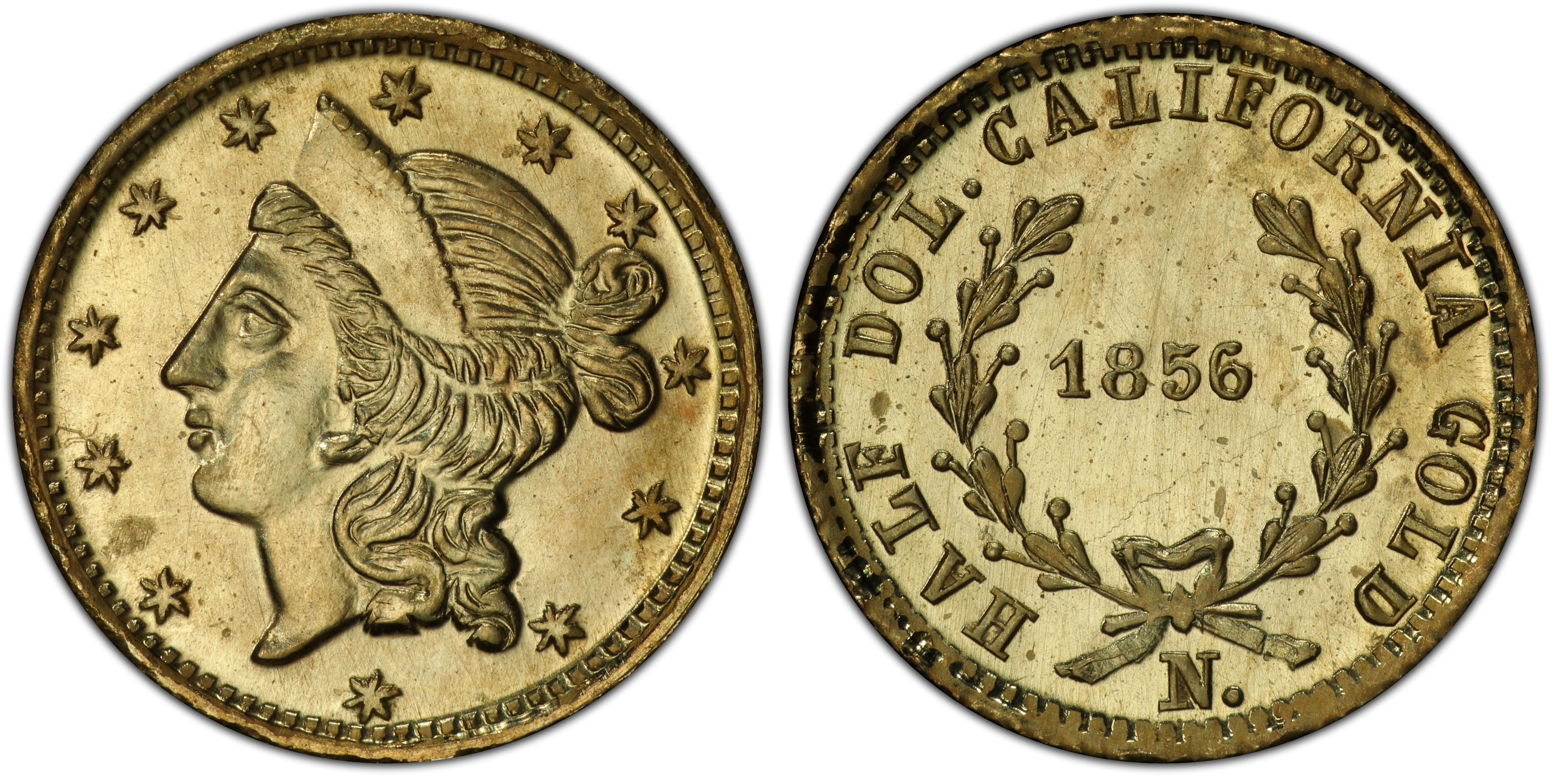
Obverse & Reverse
The 1856 BG-434 half dollar is a quintessential artifact from the closing days of the first, most commercially significant era of California Fractional Gold production. Struck in the chaotic and economically vibrant San Francisco of the 1850s, these diminutive gold coins were born of pure necessity. The California Gold Rush, which began in 1848, had flooded the region with hundreds of thousands of people and vast quantities of raw gold dust and nuggets. However, the United States Mint was slow to establish a branch in the West (the San Francisco Mint only began operations in 1854), creating a severe and chronic shortage of official small-denomination coinage for daily transactions. A pinch of gold dust for a drink at the saloon was an inaccurate and wasteful system. To fill this crucial gap in commerce, numerous private assayers, jewelers, and metallurgists began striking their own coins from native California gold. The years from 1852 to 1856, known to numismatists as 'Period One,' are defined by these privately issued coins that were genuinely intended to and did circulate as money. They were produced with a semblance of adherence to federal weight standards—though almost always lighter—and their designs often mimicked those of official U.S. coinage, like the Liberty Head motif, to inspire public confidence. The BG-434, dated 1856, marks the end of this period. By this time, the new federal mint in San Francisco was ramping up production of silver coinage, gradually alleviating the small-change crisis. This federal supply rendered the private issues redundant, and their production ceased until a revival in 1859, which saw the coins produced primarily as souvenirs ('Period Two' issues) rather than essential currency. The BG-434 therefore represents the last of its kind: a privately-minted gold coin created for the gritty, day-to-day commerce of a gold rush boomtown, a tangible link to a time when private enterprise directly addressed the failures of a distant federal government.
Associated EventCalifornia Gold Rush
Reason For MintingTo alleviate a severe shortage of small-denomination coinage for daily commercial transactions in Gold Rush-era California.
Minter HistoryThe specific minter or jewelery firm responsible for the BG-434 variety is unknown, as is the case for many Period One California Fractional Gold issues. Production was often anonymous or marked with simple initials. Most were produced by French immigrant jewelers and metallurgists operating in San Francisco, who possessed the requisite skills for die-sinking and coin striking. These artisans used locally sourced gold, which characteristically contained a high percentage of silver, giving the coins a slightly paler color than their federal counterparts. Production was crude, typically employing the 'hammer striking' method, where dies were struck by hand with a sledgehammer, resulting in coins of varying strike quality.
Historical SignificanceAs a 'Period One' issue, the BG-434 is historically significant as a genuine circulating medium of exchange from the height of the Gold Rush. It exemplifies the private, entrepreneurial response to a critical economic need and represents the final year of this utilitarian phase of fractional gold production before the San Francisco Mint's output made them obsolete. Its existence is a direct reflection of the unique economic conditions of mid-19th century California.
N/A
Denomination50 Cents
Minting Period1856
Assayer/MinterUnknown private minter
Geographic OriginSan Francisco, California
Obverse DescriptionA fairly crude rendering of a Liberty Head facing left, her hair tied in a bun. She is encircled by 12 five-pointed stars. The portrait style is simple and distinct to this private issue.
Obverse Inscription Reverse DescriptionThe date '1856' is centrally located within a wreath composed of two branches tied with a ribbon at the bottom. The inscription 'HALF DOL.' appears at the upper-left periphery and 'CALIFORNIA GOLD' is at the lower periphery, outside the wreath.
Reverse InscriptionHALF DOL. CALIFORNIA GOLD 1856
CompositionGold
Stated Fineness Actual FinenessVariable, typically 14 to 22 karats. Composed of unrefined native California gold, which often contained a significant natural alloy of silver.
Weight0.70 grams
Diameter11.10 mm
EdgePlain
Unknown
Survival Estimate150-200 known
Rarity ScaleLow R-4
The BG-434 is sought after as a representative of the final year of the circulating 'Period One' fractional gold. Its crude but charming design, direct connection to the Gold Rush, and tangible history make it a popular type coin. Its defined rarity as Low R-4 makes it scarce enough to be challenging but accessible enough to be collectible.
Key VarietiesBG-434a: A trial piece or pattern struck in copper from the same dies. Extremely rare. BG-1322: A known cast counterfeit of the BG-434, historically significant in its own right to specialists studying the full spectrum of fractional gold production and imitation.
Authentication TipsGenuine BG-434 specimens are very thin and struck on solid gold planchets. Many replicas are thicker and gold-plated. The strike is often weak or uneven in spots due to the hammer-striking process; a perfectly sharp, uniform strike should be viewed with suspicion. The coin must bear a denomination (e.g., 'HALF DOL.'); souvenir issues made after 1882 typically lack a denomination. The style of the Liberty head and lettering is crude and should match known genuine examples precisely. Third-party grading by a major service (PCGS or NGC) is highly recommended.
Shopping ConsiderationsFor a premium quality example, look for a sharp, well-centered strike, particularly on the date and the word 'HALF'. Due to the softness of the gold, contact marks are common; seek a coin with minimal distracting marks on the obverse portrait and reverse fields. Original, uncleaned surfaces are paramount and command a significant premium. Many examples have been cleaned or used as jewelry; look for signs of polishing (hairline scratches) or evidence of solder removal. Coins with a smooth, almost proof-like surface quality for the grade are highly desirable. Given the prevalence of counterfeits, purchasing a certified example from a reputable dealer is the safest approach.
A coin's grade is its condition, rated on a 1-70 scale. For rare coins, this is the most critical factor in determining value, as a tiny difference in preservation can mean a huge difference in price.
Relevant Grade TypesOriginal 1856 BG-434 issues were business strikes intended for circulation. They are found in Circulated grades (AG-3 to AU-58) and Mint State grades (MS-60 to MS-70). No proofs were struck during the original period of issue. Any pieces described as 'Proof' are typically later-made fantasy items or restrikes and are not considered original.
Mint State CharacteristicsUncirculated examples of BG-434 often exhibit a soft, satiny luster characteristic of high-purity, unalloyed gold. The strike is a key determinant of quality; many were weakly or unevenly struck by hand. A well-struck piece will show clear details in Liberty's hair and the wreath leaves. Due to the primitive planchet preparation, it is not uncommon to see faint die polishing lines or adjustment marks under the luster, which are perfectly acceptable. Small planchet flaws are also common. Contact marks are frequent due to the softness of the gold, with the highest points of the design like Liberty's cheek and hair bun being the most susceptible.
Circulated Wear PatternsWear first appears on the highest points of the design. On the obverse, this includes Liberty's cheek, the hair above her eye, and the bun at the back of her head. On the reverse, the highest points of the wreath's leaves and the numerals of the date will show the first signs of friction. In lower grades (VG and below), the stars on the obverse and the lettering on the reverse will begin to merge with the fields.
Key Factors For ValueBeyond the numerical grade, the primary drivers of value for an 1856 BG-434 are surface preservation and strike quality. An example with original, lustrous surfaces that has never been cleaned will always be worth significantly more than a cleaned coin of the same grade. A sharp, well-centered strike is highly prized and commands a premium. Eye appeal is also critical; coins with a pleasing, original reddish-gold or mellow yellow-gold color are favored over those with dull or washed-out surfaces. A CAC sticker, indicating premium quality for the grade, adds a significant premium for this issue.
PCGS Price Guide
| Grade | Price | Population |
|---|---|---|
| 35 | $200.00 | 1 |
| 40 | $210.00 | N/A |
| 45 | $215.00 | 1 |
| 45+ | $220.00 | N/A |
| 50 | $225.00 | 1 |
| 50+ | $230.00 | N/A |
| 53 | $235.00 | 1 |
| 53+ | $245.00 | N/A |
| 55 | $250.00 | 15 |
| 55+ | $300.00 | N/A |
| 58 | $350.00 | 31 |
| 58+ | $375.00 | N/A |
| 60 | $400.00 | 8 |
| 61 | $425.00 | 16 |
| 62 | $475.00 | 41 |
| 62+ | $550.00 | N/A |
| 63 | $975.00 | 17 |
| 63+ | $1,100.00 | N/A |
| 64 | $1,850.00 | 9 |
| 64+ | $2,250.00 | N/A |
| 65 | $2,500.00 | 1 |
| 65+ | $2,750.00 | 1 |
| 66 | $3,500.00 | 1 |