1859 G25C BG-704 (Regular Strike)
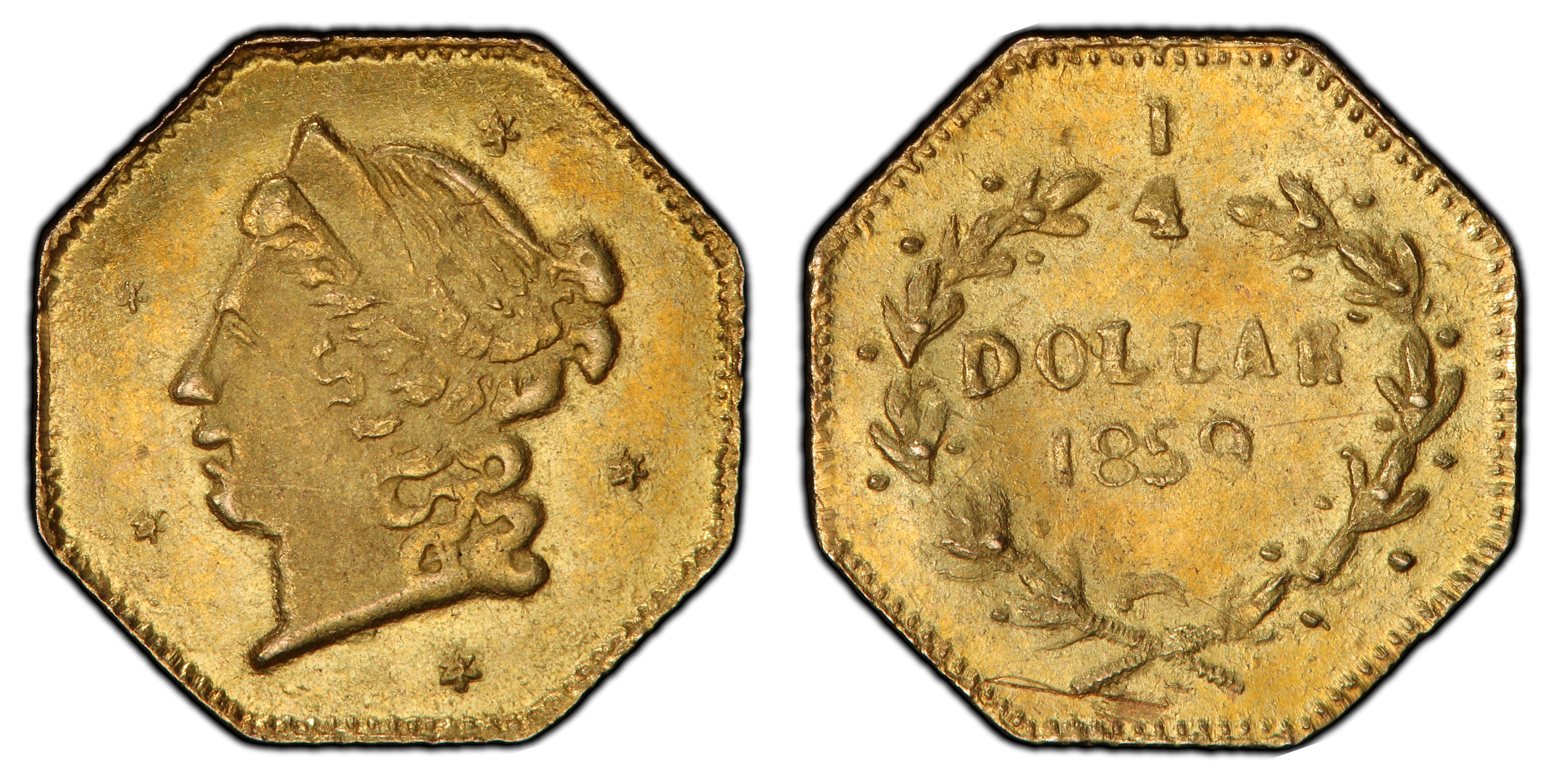
Obverse & Reverse
The 1859 G25C BG-704 is a product of the second phase of California Fractional Gold production (1859-1882), a period numismatists often refer to as the 'Jeweler's Issues.' Following the initial California Gold Rush boom, the acute shortage of small-denomination coinage that had spurred the creation of the first fractional gold pieces (Period One, 1852-1857) was somewhat alleviated by the output of the official San Francisco Mint, which opened in 1854. However, a secondary market emerged for the tiny gold coins, driven less by commercial necessity and more by their appeal as souvenirs and keepsakes. Jewelers and metalworkers, many of whom had been involved in the earlier coinage, stepped in to meet this demand. Robert B. Gray & Co., a prominent San Francisco jewelry firm, was a key player in this era. In late 1858 or early 1859, Gray acquired the coining equipment, dies, and hubs of another established fractional gold minter, Antoine Louis Nouizillet. This acquisition allowed Gray to immediately begin production, sometimes using Nouizillet's old dies before creating new ones. The BG-704 is an early product of Gray's operation, struck in the first year of this new period. Unlike the Period One issues, which generally attempted to conform to federal coinage standards in design and weight, the Period Two pieces were often lighter than their stated face value and exhibited more varied and sometimes cruder artistry. They were manufactured primarily via the 'hammer method,' where a planchet was placed on a bottom die (anvil die) and struck with a sledgehammer-driven top die (punch die). This process resulted in inconsistent strike quality and frequent die breaks, characteristics common to the series. These pieces circulated to a limited extent but were largely sold to locals and tourists as mementos of the Golden State. Their production continued, technically in violation of the Private Coinage Act of 1864, until federal enforcement finally halted the practice in the early 1880s. The BG-704 stands as a tangible artifact from this transitional era, representing the shift from utilitarian private money to a celebrated collectible souvenir still deeply rooted in the Gold Rush narrative.
Associated EventCalifornia Gold Rush
Reason For MintingPrimarily created to satisfy a growing demand for souvenirs and novelty items related to the California Gold Rush, rather than to alleviate a critical shortage of circulating small change.
Minter HistoryRobert B. Gray & Co. was a San Francisco-based jewelry and watchmaking firm active during the mid-to-late 19th century. The company entered the fractional gold coining business around 1859 after purchasing the equipment of French jeweler Antoine Louis Nouizillet. Gray's firm became a significant producer of Period Two fractional gold, striking various 25 cent, 50 cent, and dollar pieces. His issues are often identifiable by a hallmark 'G' on the obverse, although this is not present on all varieties. Gray's pieces are noted in the Breen-Gillio reference as being generally of higher weight and intrinsic value compared to other Period Two issues. The firm's coining operations continued into the 1870s before ceasing production.
Historical SignificanceThe BG-704 is significant as it marks the beginning of the 'Period Two' issues of California Fractional Gold, highlighting the evolution of these pieces from essential currency substitutes to commercial souvenirs. It represents the private enterprise of jewelers like Robert B. Gray & Co. who adapted to changing market demands while continuing a uniquely Californian numismatic tradition.
N/A
Denomination25 Cents
Minting Period1859
Assayer/MinterRobert B. Gray & Co.
Geographic OriginSan Francisco, California
Obverse DescriptionA crudely executed Liberty Head facing left, surrounded by thirteen five-pointed stars. The portrait style is simplistic, characteristic of many Period Two issues. The date '1859' is below the bust.
Obverse Inscription1859
Reverse DescriptionThe denomination '1/4' is at the center, surrounded by a wreath composed of two branches tied by a bow at the bottom. The legend 'CALIFORNIA GOLD' encircles the wreath along the octagonal border.
Reverse InscriptionCALIFORNIA GOLD 1/4
CompositionGold
Stated Fineness Actual FinenessVariable, typically 14 to 21 karats for Period Two issues.
Weight0.24 grams
Diameter9.60 mm
EdgePlain
Unknown
Survival EstimateFewer than 15 known
Rarity ScaleR-7 (4 to 12 known)
The 1859 G25C BG-704 is highly sought after due to its extreme rarity and its status as a foundational 'Period Two' issue by a major maker, Robert B. Gray & Co. Its octagonal shape and direct connection to the post-Gold Rush souvenir trade make it a historically fascinating and visually distinctive collectible.
Key VarietiesThe primary variety is the regular strike as described. No major varieties, patterns, or official restrikes are known to exist for the BG-704. The obverse die was also used to strike the BG-705 variety, which is paired with a different reverse die.
Authentication TipsAuthenticity is paramount for this series. Genuine examples will have a slightly crude but sharp strike from hammer coining, not the soft, cast-like appearance of many modern replicas. Examine the style of the numerals in the date and the lettering; they should match known genuine examples. The planchet should be solid gold, not plated, and the weight should be close to the known standard for the variety. Many counterfeits bear a bear on the reverse, which is a fantasy element not found on genuine denominated pieces. Prospective buyers should rely on third-party certification from PCGS or NGC.
Shopping ConsiderationsGiven its R-7 rarity, any example of BG-704 is a major acquisition. A premium quality specimen would exhibit a relatively sharp strike for the issue, with clear definition in Liberty's hair and the wreath leaves. Original, undisturbed surfaces with some remaining luster are highly desirable. Check for common problems such as jewelry mounting (removed loops or solder), harsh cleaning, scratches, or tooling. Eye appeal is critical; examples with a pleasing, original reddish-gold patina command significant premiums. Due to the crude manufacturing, minor planchet flaws or slight off-center strikes are common and may not detract significantly unless they impact major design elements.
A coin's grade is its condition, rated on a 1-70 scale. For rare coins, this is the most critical factor in determining value, as a tiny difference in preservation can mean a huge difference in price.
Relevant Grade TypesAll original 1859 G25C BG-704 coins were struck as business strikes for circulation or sale, and are graded on the Circulated (1-58) and Mint State (MS, 60-70) scales. No Proof (PR/PF) examples were struck during the original minting period, and no later-date restrikes or special collector issues are known to exist for this specific variety.
Mint State CharacteristicsAn uncirculated BG-704 will display full mint luster, which is typically satiny or slightly prooflike in protected areas. The strike is often somewhat weak in the centers due to the nature of hammer coining; a coin with unusually sharp detail on Liberty's hair and the wreath would be considered exceptional. Small planchet flaws, fissures, or adjustment marks made prior to striking are common and should be noted. Contact marks, even small ones, can be prominent due to the softness of the gold.
Circulated Wear PatternsWear first appears on the highest points of the design. On the obverse, check for flatness on Liberty's cheek, the hair just above the ear, and the coronet. On the reverse, the high points of the bow and the leaves at the top of the wreath will show the first signs of friction. In lower grades (VF and below), the stars on the obverse will begin to lose their sharpness and the finer details of the wreath will merge.
Key Factors For ValueRarity is the primary driver of value for the BG-704. Beyond that, grade and surface quality are paramount. An example with original, uncleaned surfaces and a strong strike will command a massive premium over a cleaned or weakly struck counterpart, even if their numerical grades are similar. Eye appeal, characterized by attractive original color and minimal distracting marks, is crucial. For an ultra-rare issue like this, certification by PCGS or NGC is virtually required for market acceptance, and a CAC sticker would denote premium quality for the grade, adding a further significant premium.
PCGS Price Guide
| Grade | Price | Population |
|---|---|---|
| 45 | $350.00 | 1 |
| 61 | $775.00 | N/A |
| 62 | $850.00 | 4 |
| 62+ | $950.00 | N/A |
| 63 | $1,150.00 | 5 |
| 63+ | $1,500.00 | N/A |
| 64 | $2,500.00 | 3 |