1866 G25C BG-738 (Regular Strike)
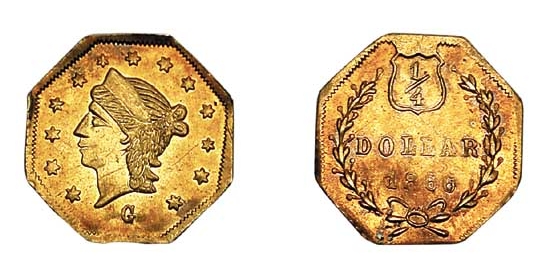
Obverse & Reverse
The California Gold Rush, beginning in 1848, created an immense and immediate need for coinage. Gold dust and nuggets served as the primary medium of exchange, but this was impractical for small, everyday transactions. The U.S. Mint in Philadelphia was too distant to alleviate the shortage, leading to the rise of private minters who struck coins from local gold. While the initial frenzy saw the production of large-denomination slugs and eagles, the subsequent economic boom created a persistent demand for fractional currency. By the 1860s, a decade after the initial rush, California's economy had matured, but the scarcity of federal small change remained a problem, exacerbated by the hoarding of silver and gold during the Civil War. Into this environment stepped numerous jewelers and assayers, such as Robert B. Gray, who began producing small-denomination gold 'tokens' or 'charms,' often denominated as 25 Cents, 50 Cents, and One Dollar. These pieces, while technically not legal tender, circulated out of sheer necessity and public acceptance. The 1866 BG-738 25 Cents is a product of this later period. It was struck by Robert B. Gray & Co., a prominent San Francisco firm known for its production of these small gold pieces. These coins were not intended to meet the strict federal standards for weight or fineness but served as a convenient substitute for government-issued coinage. The designs often mimicked federal issues, with a Liberty head on the obverse and a wreath on the reverse, to foster public trust. The federal government viewed these private issues with growing concern, and legislation passed in 1864 eventually outlawed the private minting of coins, though production of these small 'tokens' continued illicitly and with evolving designs (like omitting the word 'DOLLAR') into the early 1880s. The BG-738 is a quintessential example of this fascinating and complex chapter in American monetary history, representing a private solution to a public problem in a frontier economy still finding its footing.
Associated EventPost-Civil War Economic Expansion in California
Reason For MintingTo alleviate a chronic shortage of small-denomination coinage for everyday commercial transactions in California.
Minter HistoryRobert B. Gray was a manufacturing jeweler located in San Francisco, a key figure in the production of California Fractional Gold during the 1860s and 1870s. Operating as Robert B. Gray & Co., his firm was one of the most prolific producers of these small-denomination pieces. His work is identified by the distinctive 'G' mintmark that appears on the reverse of many varieties attributed to him, including the BG-738. While not a formal assayer in the same vein as the earlier Gold Rush pioneers, Gray's business capitalized on the continued need for circulating small change. His products were generally well-made and gained a degree of public acceptance, filling a crucial economic niche before the widespread circulation of federal minor coinage on the West Coast.
Historical SignificanceThe 1866 BG-738 is significant as a tangible artifact of the persistent economic autonomy of the American West long after the initial Gold Rush. It demonstrates the continued reliance on private and semi-official currency to facilitate local commerce in the absence of sufficient federal coinage and represents the later, more refined period of California Fractional Gold production before federal legislation fully suppressed the practice.
N/A
Denomination25 Cents
Minting Period1866
Assayer/MinterRobert B. Gray & Co.
Geographic OriginSan Francisco, California
Obverse DescriptionA beaded border encircles a portrait of Liberty Head facing left, her hair tied in a bun. She wears a coronet inscribed with the word 'LIBERTY'. Thirteen stars surround the portrait, representing the original colonies.
Obverse InscriptionLIBERTY
Reverse DescriptionA wreath of two olive branches, tied with a bow at the bottom, encircles the denomination '25 CENTS' and the date '1866'. Below the bow is the small initial 'G', the mintmark of Robert B. Gray.
Reverse Inscription25 CENTS 1866 G
CompositionGold
Stated Fineness Actual FinenessTypically ranges from .450 to .650 (11 to 15 karats)
Weight0.25 grams
Diameter10.00 mm
EdgePlain
Unknown
Survival Estimate200-300
Rarity ScaleR-5
The BG-738 is highly popular with collectors due to its status as a genuine, circulating piece from a known maker (Robert B. Gray), its attractive classic design mimicking federal coinage, and its relative affordability compared to earlier California territorial issues. It serves as an accessible entry point into the fascinating world of fractional gold.
Key VarietiesThe BG-738 is a specific die marriage ('Breen-Gillio' catalog number). While there are no major varieties of this specific catalog number from the period of issue, the broader series of 25 Cents gold pieces contains numerous die varieties from different makers. No known patterns, trial pieces, or official later-date restrikes exist for this specific variety. Collectors should be aware of contemporary counterfeits and modern replicas, which are common.
Authentication TipsAuthentic BG-738 examples exhibit sharp, well-defined details, especially in Liberty's hair and the leaves of the wreath. The 'G' mintmark should be crisp and correctly formed. The planchets are typically thin and the strike can sometimes be slightly uneven. Common counterfeits are often cast, showing a porous or soapy surface texture under magnification. They may also be overweight, have incorrect lettering fonts, or exhibit a brassy, unnatural color. Genuine pieces have a distinctive rich gold luster, even when worn.
Shopping ConsiderationsA premium quality example for its grade will possess a sharp strike, with full details on the highest points of the design such as the coronet, hair curls, and the bow on the reverse. Seek out pieces with smooth, lustrous surfaces free of distracting marks, cleaning, or tooling. Original, uncleaned 'skin' with a gentle reddish-gold toning is highly desirable. Avoid examples that have been harshly cleaned, polished, or mounted in jewelry, as this significantly impairs their value. Pay close attention to the area around the 'G' mintmark; a weak or mushy strike here is common but a sharp strike commands a premium.
A coin's grade is its condition, rated on a 1-70 scale. For rare coins, this is the most critical factor in determining value, as a tiny difference in preservation can mean a huge difference in price.
Relevant Grade TypesOriginal period issues of BG-738 were all business strikes intended for circulation and are found in Circulated (1-58) and Mint State (MS, 60-70) grades. No Proof (PR/PF) examples were struck during the original period of issue, and no official later-date Proof restrikes are known to exist. Any piece described as a 'Proof' is likely a modern copy or fantasy piece.
Mint State CharacteristicsAn uncirculated (MS) BG-738 typically exhibits a soft, satiny luster rather than a hard, frosty one. The strike is often somewhat weak in the centers, particularly on the highest points of Liberty's hair and the wreath's bow. The gold is soft, so even high-grade Mint State examples will often show minor contact marks or 'chatter' from handling in bags or bins. A premium MS coin will have minimal marks, a strong strike for the issue, and vibrant, original luster.
Circulated Wear PatternsWear first appears on the high points of the design. On the obverse, friction will first dull the luster on Liberty's cheek, coronet, and the hair above her ear. On the reverse, the highest points of the leaves in the wreath and the loops of the bow will show wear first. In lower grades (VG and below), the word 'LIBERTY' on the coronet becomes indistinct and the individual leaves of the wreath begin to merge.
Key Factors For ValueThe primary value drivers for an 1866 BG-738 are grade and surface quality. An example with original, undisturbed surfaces will always be worth significantly more than one that has been cleaned or polished, even if the cleaned coin has less wear. A sharp strike is a major plus, as many were weakly struck. Eye appeal is crucial; coins with a pleasing, original reddish-gold hue command strong premiums. For certified coins, a CAC sticker indicates premium quality for the grade and will add a significant premium, as it confirms the coin's quality and originality in a field rife with problem coins.
PCGS Price Guide
| Grade | Price | Population |
|---|---|---|
| 53 | $900.00 | N/A |
| 53+ | $950.00 | N/A |
| 55 | $1,050.00 | 1 |
| 55+ | $1,100.00 | N/A |
| 58 | $1,200.00 | 2 |
| 58+ | $1,350.00 | N/A |
| 60 | $1,500.00 | 1 |
| 61 | $1,600.00 | 1 |
| 62 | $2,000.00 | 2 |
| 62+ | $2,250.00 | N/A |
| 63 | $2,650.00 | 1 |
| 63+ | $3,000.00 | N/A |
| 64 | $3,500.00 | 1 |