1853 G$1 BG-505 (Regular Strike)
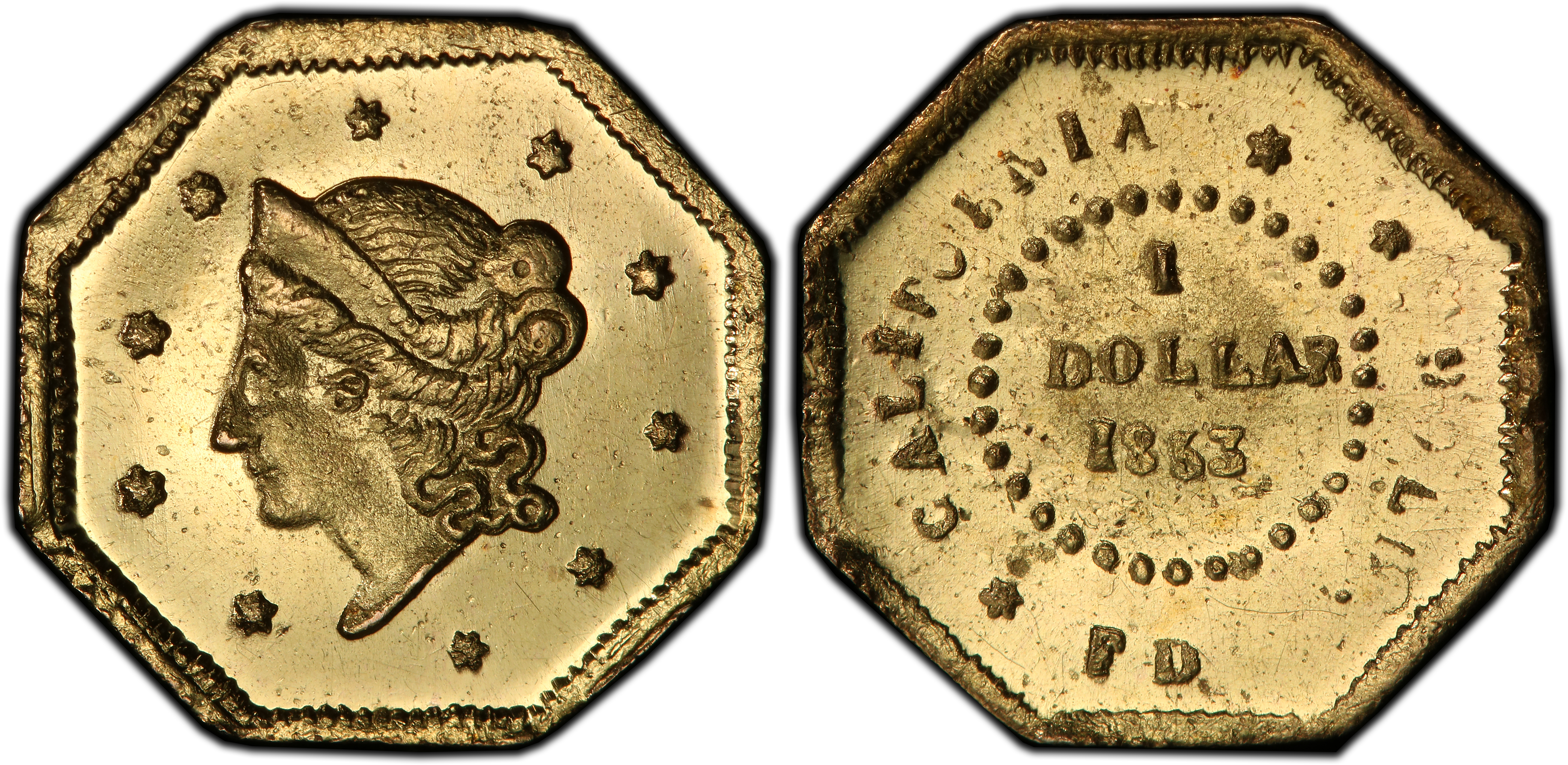
Obverse & Reverse
The 1853 BG-505 One Dollar piece is a quintessential artifact from the 'Period One' of California Fractional Gold production (1852-1857), an era defined by urgent necessity and private enterprise. In the chaotic, booming economy of Gold Rush California, the flood of newcomers and extracted gold dust created a paradoxical crisis: an acute shortage of small-denomination coinage for daily commerce. Federal coins were scarce, and the larger private issues from assayers like Moffat & Co. or Wass, Molitor & Co. did not solve the problem of making change. Into this void stepped manufacturing jewelers and engravers, who began striking their own quarter, half, and one-dollar pieces. These were not government issues but were tolerated and widely used to facilitate transactions, from buying a meal to paying for laundry. The BG-505 was struck by the firm of Pierre Frontier and Eugene Deviercy, French jewelers located in San Francisco. Their pieces, identified by the 'FD' initials on the reverse, were among the many varieties that filled the monetary gap before the San Francisco Mint could produce sufficient federal coinage. These tiny gold coins were typically produced by the crude 'hammer method,' where dies were struck manually, leading to variations in strike quality. While initially intended for circulation, their minuscule size made them somewhat impractical. By as early as 1853, they also became popular as souvenirs—a tangible piece of the California dream that could be easily sent back East in a letter. This dual purpose complicates their history; many surviving examples show wear from circulation, while others were preserved as keepsakes. The eventual influx of federal coinage and the impracticality of the tiny gold pieces led to the end of their production for commerce around 1857, though later 'Period Two' issues would be made almost exclusively for the souvenir trade.
Associated EventCalifornia Gold Rush
Reason For MintingTo alleviate a severe shortage of small denomination coinage for everyday commercial transactions in Gold Rush-era San Francisco.
Minter HistoryFrontier, Deviercy & Co. was a partnership of San Francisco-based French jewelers, Pierre Frontier and Eugene Deviercy. Active during the peak of the Gold Rush, they were among the most prolific producers of 'Period One' California Fractional Gold. Their work is identified by the initials 'F.D.' which appear on the reverse of their issues. The firm was known for producing octagonal and round coins in various denominations. Like other private minters of the era, they operated in a legal gray area, creating a necessary product for the local economy that functioned as currency out of sheer utility. The partnership was one of several configurations involving these individuals, who were central figures in the private minting scene.
Historical SignificanceThe BG-505 is a tangible representation of the economic growing pains of the American West. It demonstrates how private enterprise filled a crucial monetary void left by the federal government during a period of massive and rapid economic expansion. As a 'Period One' issue, it is considered a legitimate circulating medium of its time, unlike the later souvenir pieces, making it highly significant to collectors of pioneer and territorial coinage.
BG-505
Denomination$1
Minting Period1853
Assayer/MinterFrontier, Deviercy & Co.
Geographic OriginSan Francisco, California
Obverse DescriptionA head of Liberty, facing left, with hair tied in a bun. She wears a coronet, and her portrait is surrounded by thirteen six-pointed stars arranged around the octagonal border.
Obverse Inscription Reverse DescriptionThe denomination '1' and 'DOLLAR' are enclosed within a circle of beads. Below the beaded circle are the initials 'F D' for Frontier, Deviercy. The date '1853' is positioned at the bottom, below the initials.
Reverse Inscription1 DOLLAR 1853 F D
CompositionGold
Stated Fineness Actual FinenessVariable, but generally below the .900 standard of federal coinage. Period One issues were typically struck from native California gold, which contained natural silver alloys, and were often intentionally underweight.
Diameter12.00 mm
EdgePlain
Unknown
Survival Estimate150-200 known
Rarity ScaleR-4
The BG-505 is prized as an authentic circulating issue from the height of the California Gold Rush. Its octagonal shape, clear date, and identified maker ('FD') make it a very popular type coin. It offers a direct connection to the tumultuous and romanticized history of the American West.
Key VarietiesThere are no major, recognized varieties or restrikes specifically for the BG-505 designation from the original minting period. As a 'Period One' issue, it is distinct from the later 'Period Two' (1859-1882) souvenir pieces, which sometimes reused or muled older dies. No special collector issues, such as proofs or patterns, are known for this variety.
Authentication TipsGenuine Period One fractionals like the BG-505 are typically very thin and were struck with a denomination (e.g., 'DOLLAR'). Replicas are often thicker, have a soapy or cast-like appearance, and may feature incorrect designs like a bear on the reverse. The style of the Liberty head and the font used for the inscriptions should be compared with known genuine examples. Look for sharp, albeit sometimes uneven, strike characteristics typical of manual hammer striking, rather than the uniform pressure of a modern press. The presence of the 'F D' initials is a key diagnostic.
Shopping ConsiderationsA premium quality example for its grade will exhibit a bold, well-centered strike, which is uncommon for the series. Look for sharpness in the stars on the obverse and the letters and numerals on the reverse. Original, uncleaned surfaces with some remaining mint luster command a significant premium. The soft gold is prone to marks, so finding a piece with minimal abrasions is a major plus. Be wary of coins that have been holed and plugged for jewelry, a common fate for these small pieces. Eye appeal is paramount; specimens with a pleasing, original reddish-gold or orange-gold patina are highly desirable over cleaned, bright yellow examples.
A coin's grade is its condition, rated on a 1-70 scale. For rare coins, this is the most critical factor in determining value, as a tiny difference in preservation can mean a huge difference in price.
Relevant Grade TypesOriginal period issues of BG-505 were business strikes intended for circulation and are found in Circulated grades (AG-3 to AU-58) and Mint State grades (MS-60 to 70). The majority of surviving examples are circulated. No Proofs were struck during the original period of issue, and there are no known later-date collector restrikes in Proof format for this specific variety.
Mint State CharacteristicsUncirculated examples are scarce. Quality is determined by the sharpness of the strike, surface preservation, and luster. Many were produced using the hammer method, so strikes can be uneven. A well-struck piece will show clear definition in Liberty's hair and the individual letters of the reverse legends. Luster is typically soft and satiny rather than deeply prooflike. Due to the softness of the gold and rudimentary handling, even high-grade Mint State examples will often show minor planchet flaws or small contact marks.
Circulated Wear PatternsWear first appears on the high points of the design: Liberty's cheek, the hair above her ear, and the coronet. On the reverse, the highest points of the letters in 'DOLLAR' and the numeral '1' will show initial friction. On more heavily circulated examples, the stars on the obverse will begin to lose their points and the delicate 'F D' initials on the reverse may become faint.
Key Factors For ValueThe primary value driver is grade, followed closely by surface quality. An example with original, undisturbed skin and luster is worth significantly more than a cleaned or polished piece of the same grade. Strike quality is also critical; a sharply struck coin with full details will always command a premium. Eye appeal, including attractive original toning, is a major factor. Finally, certification by a top-tier grading service (PCGS or NGC) is essential for market acceptance, and a CAC sticker signifying premium quality for the grade adds a further substantial premium.
PCGS Price Guide
| Grade | Price | Population |
|---|---|---|
| 35 | $450.00 | 2 |
| 40 | $500.00 | 2 |
| 45 | $550.00 | 4 |
| 45+ | $560.00 | N/A |
| 50 | $585.00 | 7 |
| 50+ | $590.00 | N/A |
| 53 | $625.00 | 4 |
| 53+ | $635.00 | N/A |
| 55 | $650.00 | 30 |
| 55+ | $700.00 | N/A |
| 58 | $850.00 | 28 |
| 58+ | $925.00 | N/A |
| 60 | $1,200.00 | 5 |
| 61 | $1,400.00 | 3 |
| 62 | $2,000.00 | 13 |
| 62+ | $2,350.00 | N/A |
| 63 | $3,800.00 | 7 |
| 63+ | $4,250.00 | N/A |
| 64 | $5,250.00 | 2 |
| 64+ | $6,000.00 | N/A |
| 65 | $7,500.00 | N/A |