1853 G25C BG-215 (Regular Strike)
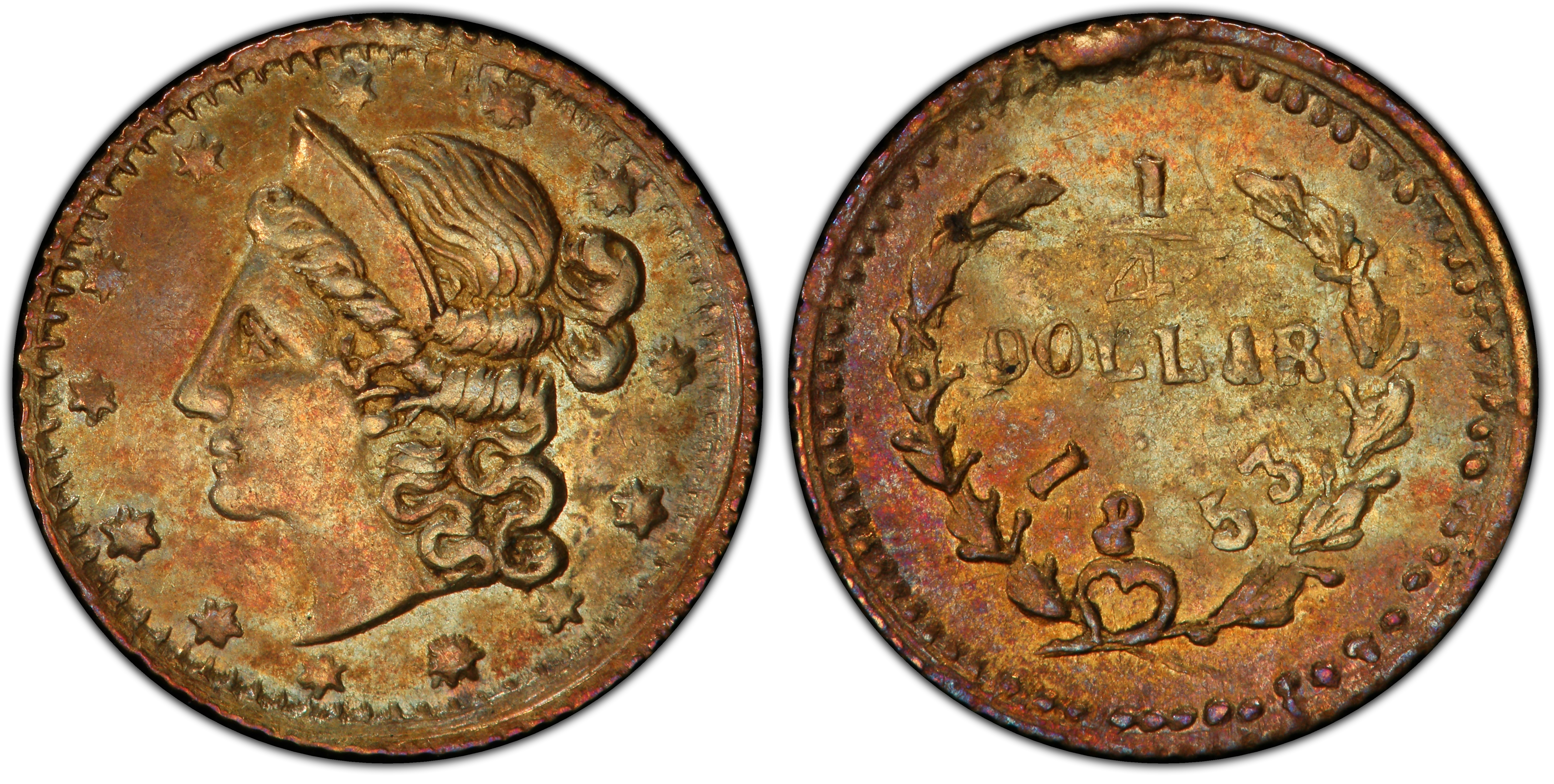
Obverse & Reverse
The 1853 BG-215 25 Cents is a tangible artifact from the zenith of the California Gold Rush, a period of chaotic growth and monetary improvisation. Following the discovery of gold in 1848, a massive influx of over 300,000 people descended upon California, overwhelming the region's primitive economy. This population explosion created an acute, chronic shortage of small-denomination coinage essential for daily transactions. With the nearest U.S. Mint in Philadelphia, and the San Francisco Mint not opening until 1854, commerce was often conducted with pinches of gold dust, a notoriously inaccurate and inefficient method. This monetary vacuum prompted private enterprise to fill the void. Jewelers, metallurgists, and other skilled craftsmen in boomtowns like San Francisco began producing their own coinage, colloquially known as 'California Fractional Gold.' These pieces, struck in denominations of 25 cents, 50 cents, and one dollar, were the grease in the wheels of the Gold Rush economy, allowing miners and merchants to purchase a meal, a drink, or supplies without resorting to barter or imprecise gold dust. The BG-215 is classified as a 'Period One' issue (1852-1856), a crucial distinction. Unlike the later, often underweight 'souvenir' pieces of Period Two and Three, Period One coins were genuinely intended to circulate and alleviate the coin shortage. Their designs often mimicked those of the official U.S. gold dollar, lending them a sense of legitimacy. Most were crudely manufactured using a hammer-striking process, resulting in frequent weak strikes and planchet irregularities. Despite being unofficial, they were widely accepted in local commerce out of sheer necessity. The eventual establishment of the San Francisco Mint and the increased supply of federal silver and gold coinage rendered these fractional pieces obsolete. Most were eventually withdrawn, spent, or melted, leading to the extreme rarity of surviving examples like the BG-215 today.
Associated EventCalifornia Gold Rush
Reason For MintingTo alleviate a severe shortage of small-denomination coinage for everyday commercial transactions in Gold Rush-era California.
Minter HistoryThe specific minter of the BG-215 variety is unknown to numismatic researchers. However, the production of Period One fractional gold was dominated by a small community of jewelers and artisans operating in San Francisco. Many were of French origin, such as Antoine Louis Nouizillet and M. Deriberpe, who applied their skills in working with precious metals to meet the region's desperate need for circulating change. These minters operated without direct government sanction, and their identities were often not explicitly placed on the coinage, leading to many 'maverick' issues whose precise origins are lost to history.
Historical SignificanceThe BG-215, like other Period One fractionals, represents a critical solution to a severe economic problem. It is a prime example of private coinage stepping in where a government service was absent, directly enabling the day-to-day economy of the American West's most significant commercial boom. Its immense rarity today is a testament to its original utilitarian purpose and the harsh conditions of circulation.
BG-215
Denomination25 Cents
Minting Period1853
Assayer/MinterUnknown
Geographic OriginSan Francisco, California
Obverse DescriptionA small Liberty Head facing left, likely modeled after Christian Gobrecht's design for the U.S. Gold Dollar. The hair is tied in a bun at the back. The portrait is encircled by thirteen five-pointed stars, which are often weakly struck or indistinct. The date '1853' appears below the bust.
Obverse Inscription1853
Reverse DescriptionThe central device is a simple wreath composed of two branches tied with a bow at the bottom. The denomination '1/4' is within the wreath, though on many examples this feature is softly struck. The legend 'CALIFORNIA GOLD' encircles the wreath along the upper periphery.
Reverse InscriptionCALIFORNIA GOLD 1/4
CompositionGold
Stated Fineness Actual FinenessVariable, typically made from native California gold which contained a natural alloy of silver, resulting in a fineness likely between .800 and .900.
EdgePlain
Unknown
Survival Estimate4-12 pieces known
Rarity ScaleR-7 (Low)
This coin is highly sought after for its extreme rarity, direct connection to the height of the California Gold Rush, and its status as a Period One 'circulating' issue. Completing a set of California Fractional Gold is a monumental challenge, making any example of an R-7 variety a landmark acquisition.
Key VarietiesThere are no known major varieties or officially produced restrikes of the BG-215. All known examples are considered business strikes from the original 1853 production.
Authentication TipsAuthentication requires expert examination. Genuine examples are struck in gold, not brass, and have a characteristic soft, slightly yellowish luster due to the native silver content. The strike is almost always uneven, with some elements sharp and others faint. The style of the Liberty head and lettering should be compared to known genuine examples; counterfeits often have crude, misshapen letters or a portrait that is stylistically incorrect. Look for evidence of casting (bubbles, seams) or the sharp, uniform details characteristic of modern fakes. Third-party certification by PCGS or NGC is highly recommended for this issue.
Shopping ConsiderationsGiven its R-7 rarity, any opportunity to acquire a BG-215 is significant. A 'premium quality' example would be one that, despite any inherent strike weakness, shows minimal circulation wear and retains some original luster. Pay close attention to the surfaces; problem-free coins command a significant premium. Due to their history of use, many survivors are damaged. Look carefully for evidence of having been mounted in jewelry, cleaning (hairlines), or repairs (plugging). Even a 'details' graded coin (e.g., AU Details, Plugged) is considered highly collectible and valuable. Strike sharpness on the date and the '1/4' on the reverse is a key value differentiator.
A coin's grade is its condition, rated on a 1-70 scale. For rare coins, this is the most critical factor in determining value, as a tiny difference in preservation can mean a huge difference in price.
Relevant Grade TypesAll original 1853 BG-215 coins were struck as business strikes intended for circulation. They are found in Circulated grades (AG-3 to AU-58) and, very rarely, in Mint State (MS-60 to 70). No Proof examples were struck during the original minting period, and no later-date Proof restrikes of this variety are known to exist.
Mint State CharacteristicsAn uncirculated BG-215 is exceptionally rare. Quality is defined by the sharpness of the strike and the quality of the luster. These coins were typically struck by hammer, so a fully struck example is almost unknown; weakness on the stars and the central reverse is expected. Luster is typically soft and satiny rather than deeply frosty. Due to the tiny size and crude production, even Mint State examples will have planchet flaws and some light contact marks.
Circulated Wear PatternsWear first appears on the highest points of the design: the hair above Liberty's eye and ear, and the cheek. On the reverse, the high points of the wreath's leaves and the numerals '1/4' will show friction first. On lower-grade examples, the stars and date will begin to merge with the fields, and the reverse legend becomes faint.
Key Factors For ValueFor the BG-215, rarity is the primary value driver. Beyond that, the key factors are surface preservation and strike. An example with original, uncleaned surfaces will always be prized over a cleaned or damaged coin, even if the latter is of a slightly higher grade. A sharper-than-average strike, particularly one that clearly shows the date and the denomination, adds significant value and eye appeal. Any coin certified by PCGS or NGC is desirable, and a CAC sticker on such a rare and crudely made issue would denote exceptional quality for the grade.
PCGS Price Guide
| Grade | Price | Population |
|---|---|---|
| 55 | $1,600.00 | N/A |
| 55+ | $1,750.00 | N/A |
| 58 | $2,000.00 | 4 |
| 58+ | $2,250.00 | N/A |
| 60 | $2,650.00 | N/A |
| 61 | $3,000.00 | 1 |
| 62 | $3,750.00 | 2 |
| 62+ | $4,250.00 | N/A |
| 63 | $5,250.00 | 2 |
| 63+ | $5,750.00 | N/A |
| 64 | $6,500.00 | 1 |