1854 G$1 BG-506 (Regular Strike)
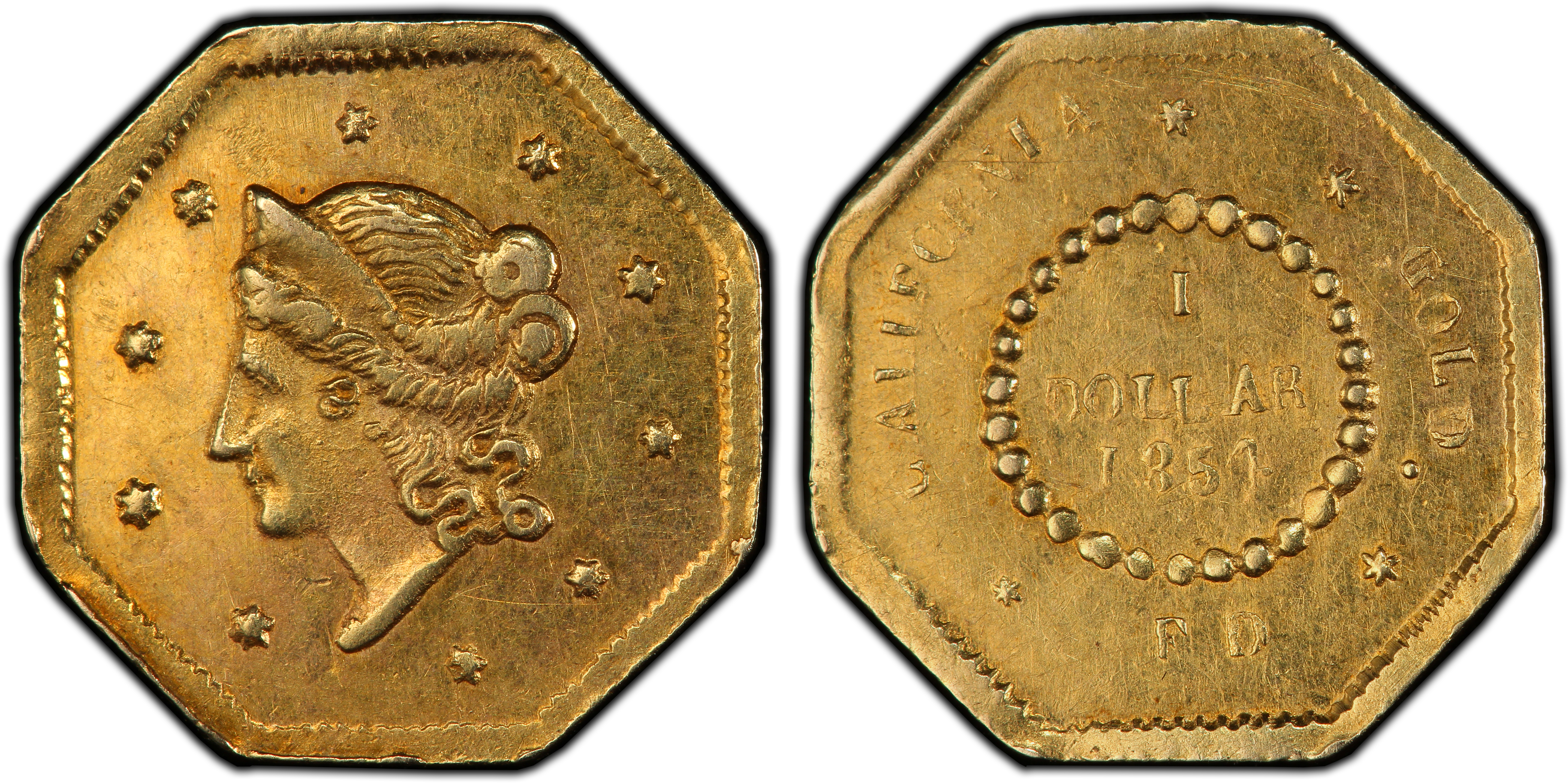
Obverse & Reverse
The 1854 Octagonal Gold Dollar, cataloged as Breen-Gillio 506, is a quintessential artifact from the chaotic, commerce-starved apex of the California Gold Rush. Following the discovery of gold at Sutter's Mill in 1848, a massive influx of prospectors and merchants descended upon California, creating a vibrant but monetarily crippled economy. Gold dust and nuggets, the primary medium of exchange, were impractical and prone to waste and fraud. While large-denomination private and federal assay bars and coins began to appear, the desperate need for small-denomination currency to facilitate daily transactions—paying for a meal, a drink, or basic supplies—went largely unmet. The United States Mint in Philadelphia was too distant to provide relief, and the new San Francisco Mint would only begin its own limited gold dollar production in this very year, 1854. Into this void stepped enterprising San Francisco jewelers and metallurgists. Among the most prolific and skilled was Antoine Louis Nouizillet, a French immigrant whose name is associated with many of the finer quality 'Period One' (1852-1857) fractional gold pieces. These small, privately issued coins were not official legal tender but were accepted in trade out of sheer necessity. They were crudely but effectively manufactured, often by the 'hammer method,' where dies were struck by hand. This resulted in coins of varying strike quality, often with misaligned elements, but which served their purpose. The BG-506 is a product of this environment, a tangible piece of the effort to impose monetary order on a frontier society awash in gold but starved for change. Its octagonal shape was a common feature of the era, a visual cue meant to distinguish it from Federal gold dollars and perhaps associate it with the larger, respected $50 'slugs' of the U.S. Assay Office. As the San Francisco Mint ramped up production of federal coinage in the mid-1850s, the necessity for these private issues waned, and they gradually disappeared from circulation, becoming curiosities and souvenirs. The extreme rarity of the BG-506 variety today speaks to a very low original mintage and a high rate of attrition through circulation and melting, cementing its status as a prized relic of American ingenuity and westward expansion.
Associated EventCalifornia Gold Rush
Reason For MintingTo alleviate a severe shortage of small-denomination coinage for daily commerce in Gold Rush-era San Francisco.
Minter HistoryAntoine Louis Nouizillet was a French jeweler and watchmaker who established a business in San Francisco during the Gold Rush. Active from approximately 1853 to 1859, he was one of the most significant and skilled producers of 'Period One' California fractional gold. His issues are noted for their relatively high quality of design and execution compared to some of his contemporaries. Nouizillet's business was located on Montgomery Street, the heart of San Francisco's commercial district. He produced quarter dollar, half dollar, and dollar denominations in both round and octagonal formats. Around 1859, he sold his business, including his dies and punches, to Robert B. Gray & Co., who would continue the tradition of striking fractional gold pieces into 'Period Two.'
Historical SignificanceThe BG-506, like other 'Period One' fractionals, represents a crucial, privately-driven solution to a systemic failure of currency supply during a pivotal moment in U.S. economic history. It demonstrates the resourcefulness of frontier entrepreneurs and serves as a direct link to the day-to-day transactions that built the economy of Gold Rush California before the full establishment of federal minting operations on the West Coast.
BG-506
Denomination$1
Minting Period1854
Assayer/MinterAntoine Louis Nouizillet
Geographic OriginSan Francisco, California
Obverse DescriptionA fairly crude rendering of a Liberty Head, facing left, with hair tied in a bun. The portrait is encircled by thirteen five-pointed stars, which are often weakly struck and irregularly spaced due to the manual minting process.
Obverse Inscription Reverse DescriptionThe central device is the denomination '1' and 'DOLLAR' below it, all contained within a circle of beads. The legend 'CALIFORNIA GOLD' appears around the periphery, outside the beaded circle. The date '1854' is located at the bottom, beneath the beaded circle.
Reverse InscriptionCALIFORNIA GOLD / 1 / DOLLAR / 1854
CompositionGold
Stated Fineness Actual FinenessNot precisely recorded, but typically struck from native California gold, which contained a natural alloy of silver, resulting in a fineness likely between .850 and .900.
Weight1.51 grams
Diameter12.20 mm
EdgePlain
Unknown, but presumed to be extremely small.
Survival Estimate4 to 6 known examples.
Rarity ScaleR-7
As an R-7 'Period One' octagonal dollar, the BG-506 is a landmark rarity in an already popular field. Its appeal lies in its extreme scarcity, its direct connection to the height of the Gold Rush, and the challenge of acquiring one of the very few known specimens. It is a trophy coin for the advanced specialist in California or territorial gold.
Key VarietiesAs a specific die marriage (BG-506), there are no major varieties. No special collector issues, patterns, or later-date restrikes of the BG-506 die pair are known to exist. The variety itself is the key.
Authentication TipsAuthentication requires expert examination. Genuine examples exhibit a characteristic crude, manual strike. The surfaces may show slight unevenness or buckling. The details, particularly the stars and legends, are often soft. Fakes, especially modern ones, often appear too perfect, with sharp, uniform details and flat, lifeless fields. Weight and specific gravity tests are crucial, though they can be inconclusive without comparison to known genuine pieces. Authentication by a top-tier grading service (PCGS or NGC) that specializes in this series is essential.
Shopping ConsiderationsFor a coin of this rarity, any example offered is a major event. A 'premium quality' specimen would be one that is well-centered and shows as much of the design detail as possible, particularly on the Liberty head and the date. Original, uncleaned surfaces with a hint of reddish-gold toning are highly desirable. Most known examples are in circulated grades; an uncirculated specimen would be a monumental condition rarity. Buyers must be wary of tooling, smoothing of the fields to hide marks, or repairs. Given the rarity, even a damaged or holed example would command a very strong price. Focus on originality and eye appeal for the grade.
A coin's grade is its condition, rated on a 1-70 scale. For rare coins, this is the most critical factor in determining value, as a tiny difference in preservation can mean a huge difference in price.
Relevant Grade TypesOriginal period issues of BG-506 were business strikes intended for circulation, and are found in Circulated (1-58) and, very rarely, Mint State (MS, 60-70) grades. No Proofs were struck during the original period of issue, nor are any later-date Proof restrikes known for this specific variety.
Mint State CharacteristicsAn uncirculated BG-506 would be judged on the sharpness of the strike and quality of its luster. Due to the primitive hammer-striking method, a fully sharp strike would be an exception; weakness on the high points of Liberty's hair and the central reverse details is to be expected. Luster would likely be soft and satiny rather than bright and flashy. Bag marks are less of a concern than planchet flaws or adjustment marks made prior to striking, which are common for this series.
Circulated Wear PatternsWear first appears on the highest points of the design: Liberty's cheek, hair above the eye and ear, and the top of the hair bun. On the reverse, the numeral '1' and the letters in 'DOLLAR' will show initial friction. In lower grades (VG and below), the stars will begin to merge with the fields, and the date and peripheral legends will become faint.
Key Factors For ValueFor the BG-506, rarity is the paramount factor. Value differences between grades are immense. A coin with original, undisturbed surfaces is prized above all else; any cleaning, polishing, or tooling will severely impact its value. Eye appeal is critical: examples with a pleasing, even strike (for the issue) and attractive original color command significant premiums. Given the handful of known survivors, simply being certified as genuine and problem-free by a major grading service establishes the coin's foundational value.
PCGS Price Guide
| Grade | Price | Population |
|---|---|---|
| 35 | $2,750.00 | 1 |
| 40 | $3,000.00 | N/A |
| 45 | $4,000.00 | 1 |
| 45+ | $4,250.00 | N/A |
| 50 | $4,500.00 | N/A |
| 50+ | $4,750.00 | N/A |
| 53 | $5,100.00 | N/A |
| 53+ | $5,500.00 | N/A |
| 55 | $6,000.00 | 1 |
| 55+ | $6,500.00 | N/A |
| 58 | $7,750.00 | 1 |
| 58+ | $8,500.00 | N/A |
| 60 | $9,250.00 | N/A |
| 61 | $11,000.00 | 1 |
| 62 | $13,750.00 | 2 |
| 62+ | $16,500.00 | N/A |
| 63 | $22,500.00 | N/A |