1867 G25C BG-741 (Regular Strike)
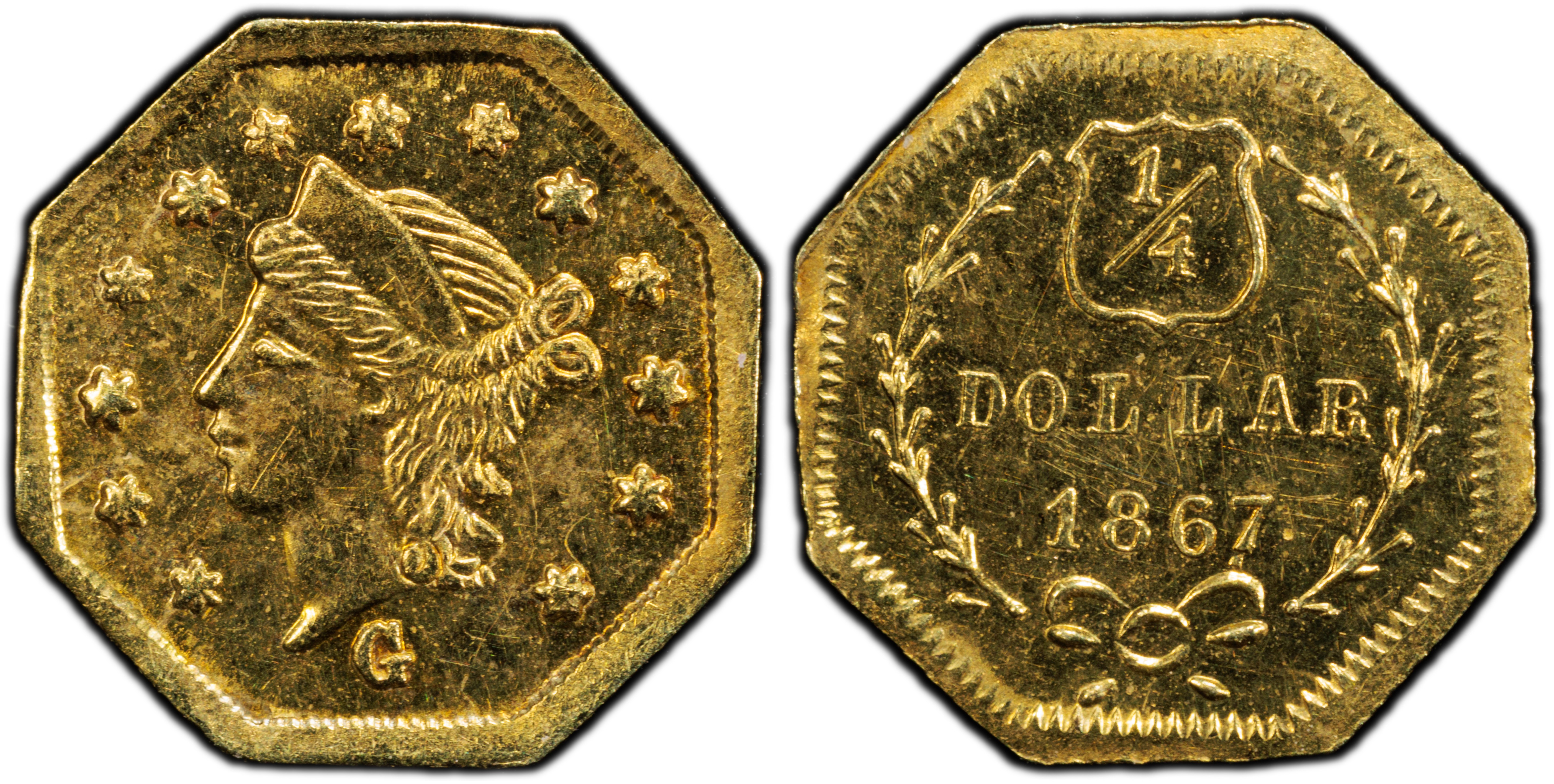
Obverse & Reverse
The 1867 BG-741 25 Cents is a quintessential example of a 'Period Two' California Fractional Gold piece. These fascinating and enigmatic issues arose from the unique economic conditions of post-Gold Rush California. While the initial wave of fractional gold (Period One, 1852-1856) was struck to alleviate a severe shortage of small-denomination coinage for daily commerce, the context for Period Two issues is more complex. By the late 1850s and 1860s, the San Francisco Mint was in full operation, supplying the region with official federal silver and gold coins, which largely negated the commercial necessity for private issues. Concurrently, the Private Coinage Act of 1864 explicitly outlawed the striking of private coins intended to circulate as money. In this new legal and economic environment, the production of fractional gold shifted from a monetary to a novelty purpose. Enterprising jewelers in San Francisco, many of whom were French immigrants, recognized a burgeoning market for souvenirs and keepsakes. San Francisco was becoming a tourist destination, and these tiny, intricate gold coins were the perfect mementos of a visit to the Golden State. These 'jeweler's issues' were not intended for circulation, which explains why they are often found in high grades today. They were typically underweight and of a lower, variable fineness compared to their Period One predecessors, as their value was in their novelty, not their intrinsic metal content. The BG-741, like its contemporaries, was likely produced using a simple hammer-striking method, resulting in variability in strike quality. The passage of the 1864 Act drove this industry further underground, but production continued unabated into the 1880s, with many pieces being backdated to avoid legal scrutiny from the Secret Service, which finally cracked down on the practice in 1883, bringing the era to a close. The BG-741 variety is a tangible link to this fascinating period of numismatic history, representing a transition from utilitarian private money to a celebrated collectible souvenir industry on the American frontier.
Associated EventPost-Gold Rush California Commerce and Tourism
Reason For MintingPrimarily struck for sale as souvenirs and jewelry charms rather than for monetary circulation, following the 1864 prohibition of private coinage.
Minter HistoryThe specific minter of the BG-741 variety is unknown, as is common for many Period Two jeweler's issues. The dies were not signed, and records were not kept. However, production of such pieces is broadly attributed to various San Francisco-based manufacturing jewelers and private minting concerns active in the 1860s and 1870s. Prominent firms from this era known to have produced fractional gold include Robert B. Gray & Co. and the Levison Brothers (who later became the California Jewelry Co.), though no definitive link has been made to this specific variety.
Historical SignificanceThis coin represents the second phase of California fractional gold production, where the pieces evolved from quasi-monetary necessities into commercial souvenirs. It highlights the ingenuity of private entrepreneurs in adapting to changing laws and economic conditions, and serves as a historical marker for the rise of tourism in San Francisco. Its existence, post-1864, demonstrates a period of lax federal enforcement regarding private coinage, which only ended with a Secret Service crackdown in 1883.
N/A
Denomination25 Cents
Minting Period1867
Assayer/MinterAnonymous
Geographic OriginSan Francisco, California
Obverse DescriptionA head of Liberty facing left, with 'LIBERTY' inscribed on her coronet. The portrait is surrounded by 13 six-pointed stars, representing the original colonies. The date, 1867, is positioned below the bust.
Obverse InscriptionLIBERTY 1867
Reverse DescriptionThe denomination '1/4' appears in the center, enclosed within a wreath of leaves and berries. The wreath is open at the top.
Reverse Inscription1/4
CompositionGold
Stated Fineness Actual FinenessVariable, but generally lower than monetary-issue gold.
EdgePlain
Unknown
Survival Estimate13-30 (based on R-6 rarity rating)
Rarity ScaleR-6
The BG-741 is sought after for its high rarity (R-6), classic Liberty Head design, and octagonal shape, which is emblematic of the territorial gold series. As a Period Two issue, it is a key component for specialists assembling a complete collection by Breen-Gillio numbers and represents the fascinating 'souvenir' era of fractional gold production.
Key VarietiesThere are no major, widely recognized die varieties of BG-741 from the original minting period. No special collector issues such as Proofs, patterns, or official restrikes are known to exist for this specific variety; all known examples are considered regular business strikes, albeit intended for the souvenir market.
Authentication TipsGenuine examples are very small and thin. Counterfeits are often thicker, have a soapy or cast-like appearance, and may have incorrect details in the stars or wreath. Look for sharp, albeit sometimes unevenly impressed, details consistent with hammer striking. The '1/4' on the reverse should be crisp. The gold color should be consistent with 19th-century alloys, often appearing slightly brassy or reddish depending on the composition. Any piece that seems unusually heavy, thick, or perfectly struck should be viewed with suspicion and authenticated by a professional.
Shopping ConsiderationsA premium quality example of BG-741 will exhibit a bold strike, particularly on the date and Liberty's coronet, which are often weakly struck on this variety. Seek out pieces with minimal contact marks and original, undisturbed luster; many survivors are found in Mint State grades due to their souvenir purpose. Avoid examples that have been cleaned, polished, or used as jewelry (evidenced by solder marks or holes). Attractive, original toning, often a deep golden-orange hue, adds significant eye appeal. Pay close attention to the planchet quality, as some pieces exhibit minor natural flaws or fissures which may or may not detract from the overall quality depending on their severity.
A coin's grade is its condition, rated on a 1-70 scale. For rare coins, this is the most critical factor in determining value, as a tiny difference in preservation can mean a huge difference in price.
Relevant Grade TypesOriginal period issues of BG-741 were business strikes, although intended as souvenirs rather than for commerce. They are found in both Circulated (1-58) and, more commonly, Mint State (MS, 60-70) grades. No true Proof (PR/PF) examples were struck during the original period of issue, and no later-date Proof restrikes are known.
Mint State CharacteristicsIn uncirculated grades, the BG-741 often displays a soft, satiny luster. Strike quality is a key differentiator; many specimens are softly struck, particularly on the date below the bust and on the word 'LIBERTY' on the coronet. A well-struck example with full details is rare and commands a significant premium. Due to the primitive minting process, small planchet flaws or striations are common and may not negatively impact the grade if they are not distracting. High-grade examples may exhibit prooflike or deep mirror prooflike surfaces, which are exceptionally rare for the variety.
Circulated Wear PatternsOn circulated examples, wear first appears on the highest points of the design. On the obverse, this includes Liberty's cheek, the hair above the eye, and the coronet. On the reverse, the leaves and berries of the wreath will show the first signs of friction. In lower grades (VF and below), the stars will begin to lose their points and the date will become faint.
Key Factors For ValueThe primary value drivers for a BG-741 are rarity and grade. Sharpness of strike is paramount; an MS-62 with a bold strike can be more desirable than an MS-64 with a weak strike. Surface preservation is critical: coins with clean, mark-free fields and original luster are prized. Eye appeal, including attractive original skin and pleasing color, significantly enhances value. A CAC sticker, indicating premium quality for the grade, will add a substantial premium for this and other scarce California Fractional Gold issues.
PCGS Price Guide
| Grade | Price | Population |
|---|---|---|
| 53 | $250.00 | 2 |
| 53+ | $255.00 | N/A |
| 55 | $275.00 | 2 |
| 55+ | $300.00 | N/A |
| 58 | $360.00 | 9 |
| 58+ | $385.00 | N/A |
| 60 | $425.00 | 1 |
| 61 | $475.00 | 5 |
| 62 | $625.00 | 8 |
| 62+ | $700.00 | N/A |
| 63 | $875.00 | 8 |
| 63+ | $1,150.00 | N/A |
| 64 | $1,750.00 | 4 |
| 65 | N/A | N/A |