No Date G25C BG-204A (Regular Strike)
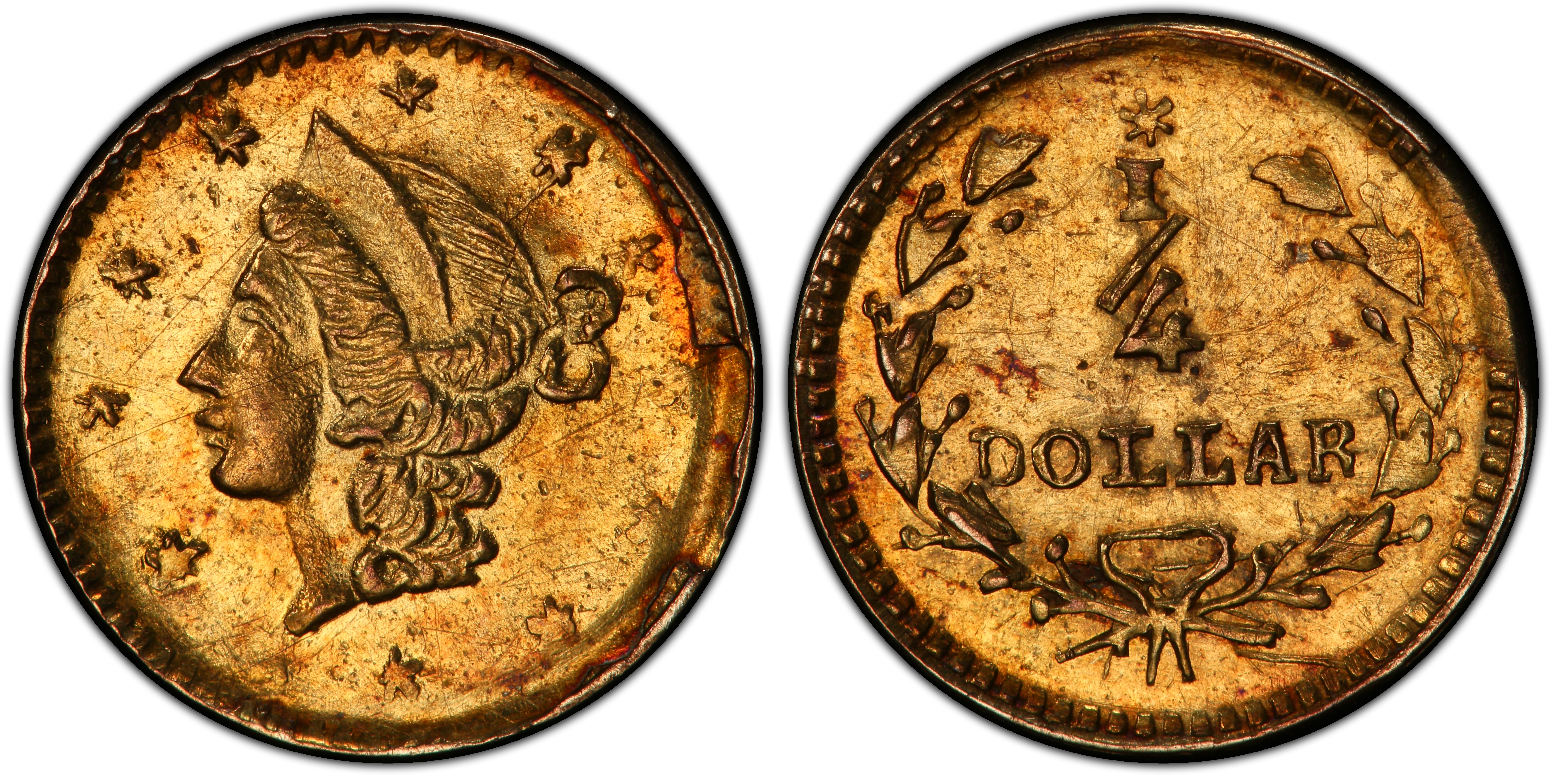
Obverse & Reverse
The BG-204A is one of the ultimate rarities within the California Fractional Gold series, a unique specimen born from the chaotic, commerce-starved crucible of the early California Gold Rush. Following the massive influx of population after the 1848 discovery of gold at Sutter's Mill, California's economy boomed, but it was crippled by a severe shortage of circulating small-denomination coinage. Gold dust, weighed imprecisely, became a common medium of exchange, but it was impractical for everyday transactions. While private mints began striking larger denomination coins ($5 to $50), the need for pocket change remained acute. In 1852, San Francisco jewelers and metalworkers stepped into this monetary void, striking their own quarter dollar, half dollar, and dollar coins from native California gold. These 'Period One' issues (1852-1857) were intended for actual circulation and, while often underweight, were accepted in local commerce out of sheer necessity. The Joseph Brothers, San Francisco jewelers and watchmakers, were among the most prolific and skilled of these private minters. They produced a series of small, Liberty Head quarter dollars that mimicked the style of the official U.S. gold coinage of the era. The BG-204A is a specific die marriage from their workshop, utilizing a known 12-star obverse die paired with a unique reverse. Its status as a 'No Date' variety is typical for many of these early issues, where expediency trumped formal adherence to minting conventions. The coin's unique status suggests it may have been a trial piece or that the reverse die failed almost immediately after its creation, resulting in only a single known example surviving. The very existence of this piece speaks to the experimental and often ephemeral nature of private coin production during this unregulated period. The most advanced collectors, such as Jay Roe, whose collection was among the most complete ever assembled, lacked an example of BG-204A, cementing its legendary status as one of the key stoppers to a complete set of Period One varieties.
Associated EventCalifornia Gold Rush
Reason For MintingTo alleviate a severe shortage of small-denomination coinage for daily commerce in Gold Rush-era San Francisco.
Minter HistoryThe Joseph Brothers (Lionel and Josephus) were watchmakers, jewelers, and opticians located on Montgomery Street in San Francisco during the 1850s. Like other jewelers of the period, such as Antoine Nouizillet and Frontier & Deviercy, they leveraged their metallurgical skills and access to raw gold to enter the lucrative business of private coinage, producing a variety of well-regarded fractional gold pieces to meet the demands of the local economy.
Historical SignificanceAs a unique Period One California Fractional Gold piece, the BG-204A represents the pinnacle of rarity in a series that is a direct, tangible link to the tumultuous economic conditions of the California Gold Rush. It is a testament to the private enterprise and ingenuity required to facilitate commerce on the American frontier before the establishment of full federal minting operations in the West.
K-Unlisted
Denomination$0.25
Minting Periodc. 1853
Assayer/MinterJoseph Brothers
Geographic OriginSan Francisco, California
Obverse DescriptionA small, delicate bust of Liberty facing left, her hair tied in a bun. The portrait is encircled by twelve five-pointed stars. This specific 12-star obverse die was also used by the Joseph Brothers to strike varieties BG-203, BG-204, BG-204B, and BG-204C.
Obverse Inscription Reverse DescriptionA simple wreath composed of two branches tied together at the bottom by a bow. Inside the wreath is the denomination 1/4. The legend CALIFORNIA GOLD encircles the wreath, separated from it by a circle of beads.
Reverse InscriptionCALIFORNIA GOLD / 1/4
CompositionGold
Stated Fineness Actual FinenessTypically .800-.880 fine for the period, alloyed with native silver.
Weight0.43 grams
Diameter10.00 mm
EdgePlain
1 (Effectively a trial or transitional piece)
Survival Estimate1
Rarity ScaleR-9 (Unique)
The BG-204A is an ultimate trophy coin, appealing only to the most advanced specialists in California Fractional Gold. Its unique status as a cataloged Breen-Gillio variety and its confirmed absence from legendary collections like that of Jay Roe make it an object of near-mythical rarity.
Key VarietiesBG-204A is itself a unique variety defined by a specific die pairing. It shares an obverse die with BG-203, BG-204, BG-204B, and BG-204C, all struck by the Joseph Brothers. The key diagnostic is the combination of the 12-star obverse with its unique reverse die. No later-date restrikes or collector issues of BG-204A are known to exist.
Authentication TipsAuthentication would rely on a direct comparison to the plate coin in the Breen-Gillio reference or other authoritative photographic records. Key diagnostics are the precise positions of the 12 stars on the obverse relative to Liberty's profile and any unique tooling marks or die characteristics on the reverse. The fabric of the planchet and the strike characteristics must be consistent with other known Joseph Brothers products from the period. Extreme caution is advised, as any unpedigreed example appearing on the market would be suspect.
Shopping ConsiderationsAcquiring this coin is not a matter of 'shopping.' It would only trade hands through a major auction or private treaty sale upon the dispersal of the single collection known to house it. A potential buyer would be focused exclusively on its existence and provenance. As the coin is unique, its specific state of preservation defines its quality absolutely. There are no other examples with which to compare strike, luster, or surfaces.
A coin's grade is its condition, rated on a 1-70 scale. For rare coins, this is the most critical factor in determining value, as a tiny difference in preservation can mean a huge difference in price.
Relevant Grade TypesAll original Period One issues, including this one, were business strikes intended for circulation. Therefore, they are found in Circulated (1-58) and Mint State (MS, 60-70) grades. No proofs were struck during the original minting period, and no later-date Proof restrikes of this variety are known.
Mint State CharacteristicsAs a unique piece, its Mint State characteristics are singular. However, based on related Joseph Brothers issues, a high-grade example would exhibit a soft, satiny luster from the native gold. The strike would likely be sharp in the center (Liberty's portrait, the fraction '1/4') but may show some weakness toward the periphery, particularly in the stars and the 'CALIFORNIA GOLD' legend, a common trait for coins produced by the manual hammer-striking method.
Circulated Wear PatternsWhile the only known example is likely Mint State or nearly so, if it were to have circulated, wear would first appear on the highest points: Liberty's cheek, hair details above the ear, and the leaves and bow of the wreath on the reverse. In lower grades, the delicate stars and peripheral lettering would begin to merge with the fields.
Key Factors For ValueFor a unique coin like BG-204A, the primary value factor is simply its existence as a confirmed, cataloged Breen-Gillio variety that is unobtainable for even the most advanced collectors. Its grade and eye appeal are secondary but would still influence the final price; original, unmolested surfaces without significant distracting marks, cleaning, or damage would be paramount. The coin's provenance, should it ever be sold, would also be a critical component of its value.
PCGS Price Guide
| Grade | Price | Population |
|---|---|---|
| 58 | $57,500.00 | 1 |