1871 G25C BG-720 (Regular Strike)
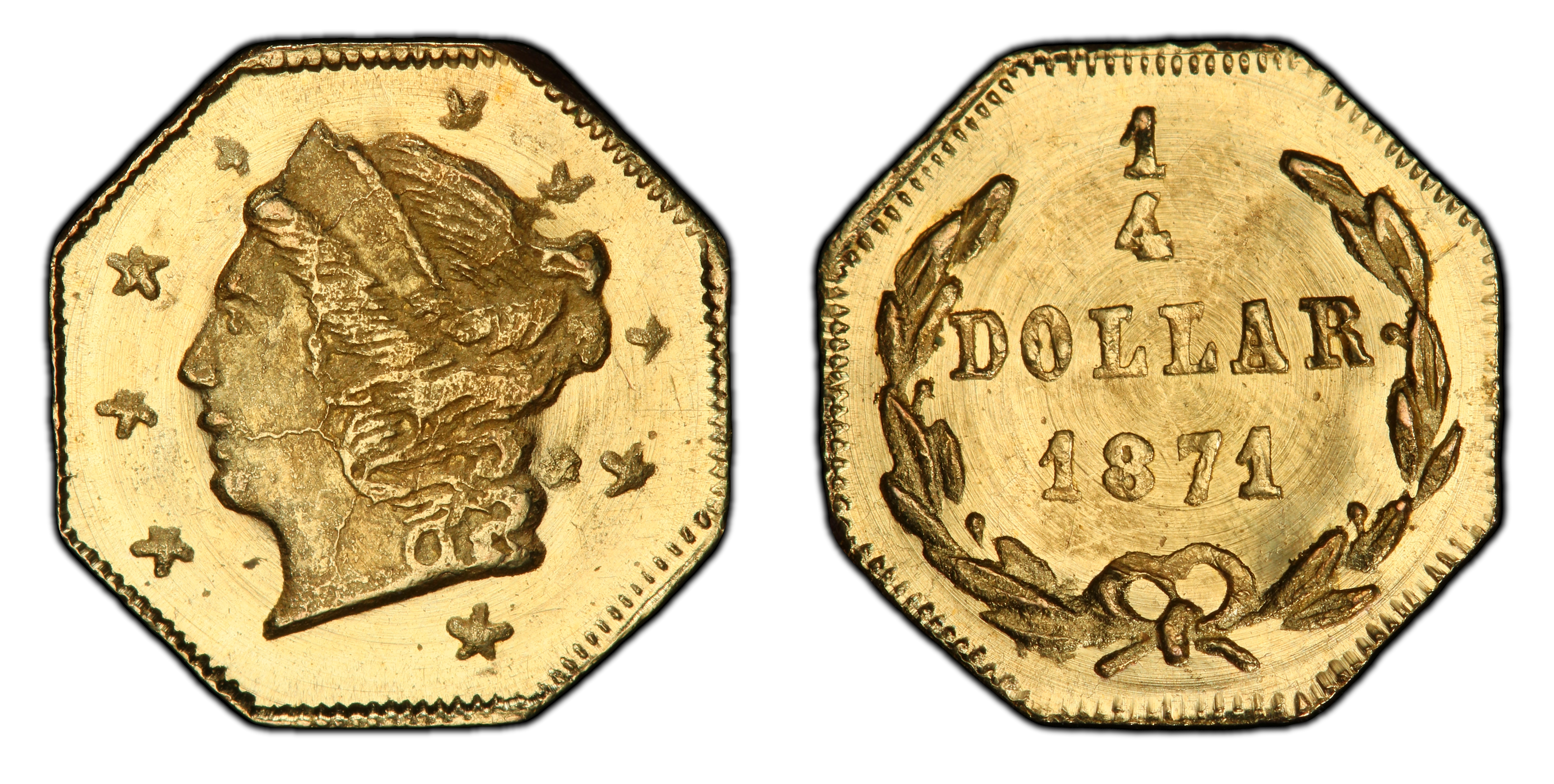
Obverse & Reverse
The 1871 BG-720 25 Cent piece belongs to the second major era of California Fractional Gold, commonly known to numismatists as 'Period Two' (1859-1882). Unlike their 'Period One' predecessors which arose from a genuine and acute shortage of small change during the initial Gold Rush frenzy, these later issues were created in a vastly different socio-economic landscape. By the 1870s, the United States Mint in San Francisco was in full operation, supplying the region with ample federal coinage and eliminating the commercial necessity for private issues. Furthermore, the Coinage Act of 1864 had explicitly outlawed the private minting of currency. However, this federal law was not aggressively enforced against small-scale producers until 1883. This legal gray area allowed a number of jewelers and artisans, primarily in San Francisco, to continue striking these miniature gold pieces. Their purpose had shifted dramatically: they were no longer indispensable tools of commerce but rather charming mementos and souvenirs for a burgeoning tourist trade and a growing class of collectors fascinated by the Gold Rush romance. Often termed 'jewelers' issues,' these pieces were typically underweight for their stated face value, their intrinsic worth being secondary to their appeal as novelties. The BG-720, struck in 1871, is a quintessential example of this phenomenon. It was created not to buy a loaf of bread, but to be tucked away in a pocketbook as a tangible, glittering reminder of California's golden promise. Its high rarity today (R-7) suggests an extremely small original production, likely hammered out in a small back-room workshop, intended for a niche market and never entering general circulation in any meaningful way. Its existence is a testament to the enduring allure of gold and the entrepreneurial spirit of craftsmen who capitalized on the legend of the Gold Rush long after its peak had passed.
Associated EventPost-Gold Rush California Tourism & Commerce
Reason For MintingPrimarily produced as collector's items and souvenirs in a legally ambiguous period after private coinage was outlawed but before the law was strictly enforced.
Minter HistoryThe specific minter of BG-720 is not definitively known, a common trait for many Period Two varieties. Production was decentralized among various San Francisco jewelers who created their own proprietary dies. Prominent Period Two makers included partnerships like Deriberpe and Nouizillet (D.N.) and Frontier and Deviercy (F.D.), but many varieties remain unattributed to a specific hand. These craftsmen were skilled metalworkers who adapted their techniques to produce these miniature, coin-like tokens for a souvenir-hungry market.
Historical SignificanceThe BG-720 is historically significant not as a coin for circulation, but as a cultural artifact representing the commercialization of the Gold Rush legacy. It marks a transition from utilitarian private coinage born of necessity to nostalgic tokens created for collectors and tourists, produced under a shadow of illegality that was, for a time, ignored by federal authorities.
N/A
Denomination25 Cents
Minting Period1871
Assayer/MinterUnknown Jeweler
Geographic OriginSan Francisco, California (presumed)
Obverse DescriptionFeatures a Liberty Head facing left, surrounded by thirteen stars representing the original colonies. The date '1871' is positioned below the bust. The specific portrait style and star arrangement are characteristic of this die pairing.
Obverse Inscription1871
Reverse DescriptionA simple wreath of leaves, open at the top, encircles the denomination. The inscription 'CALIFORNIA GOLD' would typically be present, but specific details of this variety's reverse legend are not widely published. The denomination is expressed as '1/4' within the wreath.
Reverse Inscription1/4
CompositionGold
Stated Fineness Actual FinenessVariable, but typically lower than the .900 standard of federal coinage.
EdgePlain
Unknown, but presumed to be extremely low.
Survival EstimateFewer than 12 known examples.
Rarity ScaleR-7
The BG-720 is highly sought after due to its extreme rarity (R-7) and classic octagonal Liberty Head design. It appeals to specialists in the vast and complex series of California Fractional Gold, particularly those attempting to complete a collection of Period Two varieties. Its 1871 date places it squarely in the intriguing 'jeweler's issue' era.
Key VarietiesNo major varieties, special collector restrikes, or patterns are known or recorded for the BG-720. The regular business strike is the only known issue from the period of manufacture.
Authentication TipsAuthentication requires expert examination. Key diagnostics include precise die markers (small lumps or cracks on genuine examples), the style of the numerals in the date, and the specific shape of the Liberty portrait and wreath leaves. Compare against known genuine examples. Counterfeits are common in the series and are often either cast (showing softness and porosity) or struck from modern dies with incorrect details. The weight and specific gravity should be consistent with a gold planchet, though Period Two pieces are notoriously underweight.
Shopping ConsiderationsFor a premium quality BG-720, a potential buyer should seek an example with a sharp, well-centered strike, as many fractionals are weakly or unevenly struck. Look for crisp details on Liberty's hair strands and the stars. Original, uncleaned surfaces exhibiting satiny or proof-like luster command significant premiums. Due to their small size and handling over time, many specimens are found with minor rim bumps, scratches, or evidence of having been mounted as jewelry; avoid these if possible. A specimen free of distracting marks, exhibiting original reddish-gold toning and housed in a major third-party grading service holder (PCGS or NGC) is most desirable.
A coin's grade is its condition, rated on a 1-70 scale. For rare coins, this is the most critical factor in determining value, as a tiny difference in preservation can mean a huge difference in price.
Relevant Grade TypesOriginal 1871 BG-720 issues were business strikes, although created for collectors rather than circulation. They are found in both Circulated (1-58) and, more commonly for this souvenir issue, Mint State (MS, 60-70) grades. No true Proofs were struck during the original period of manufacture, though some well-struck examples may have proof-like, reflective surfaces which should be noted by the grading services.
Mint State CharacteristicsA Mint State BG-720 is defined by the quality of its luster, which is typically satiny and sometimes semi-proof-like. Strike is a key differentiator; many are softly struck, so examples with full, sharp details on the highest points of the design (hair curls, star points) are rare and desirable. Due to the softness of the gold and the production methods, even high-grade uncirculated examples can exhibit minor planchet flaws or tiny handling marks that do not impede the grade.
Circulated Wear PatternsOn circulated examples, wear first appears on the highest points of the design. For the obverse, this includes Liberty's cheek, the hair above the ear, and the coronet. On the reverse, the highest leaves and the bow of the wreath will show initial friction and flattening. In lower grades (VF and below), the stars will begin to lose their definition and merge with the fields.
Key Factors For ValueFor the BG-720, value is driven first by its R-7 rarity. Beyond that, the primary factors are surface quality and strike. An example with pristine, original surfaces free from cleaning, hairlines, or damage is paramount. A sharp strike that renders all design elements clearly is a major premium factor. Eye appeal, enhanced by lustrous surfaces and attractive original toning, can add significantly to the value. Given the prevalence of counterfeits and cleaned coins in this series, a CAC sticker signifying premium quality for the grade provides a substantial level of market confidence and value.
PCGS Price Guide
| Grade | Price | Population |
|---|---|---|
| 55 | $1,500.00 | 1 |
| 55+ | $1,550.00 | N/A |
| 58 | $1,700.00 | N/A |
| 58+ | $1,750.00 | N/A |
| 60 | $1,900.00 | N/A |
| 61 | $2,000.00 | N/A |
| 62 | $2,200.00 | N/A |
| 62+ | $2,300.00 | N/A |
| 63 | $2,400.00 | 3 |
| 63+ | $2,500.00 | N/A |
| 64 | $2,750.00 | 4 |
| 64+ | $3,250.00 | N/A |
| 65 | $3,750.00 | 3 |
| 65+ | $4,000.00 | N/A |
| 66 | $4,250.00 | 2 |