1852 G50C BG-427 (Regular Strike)
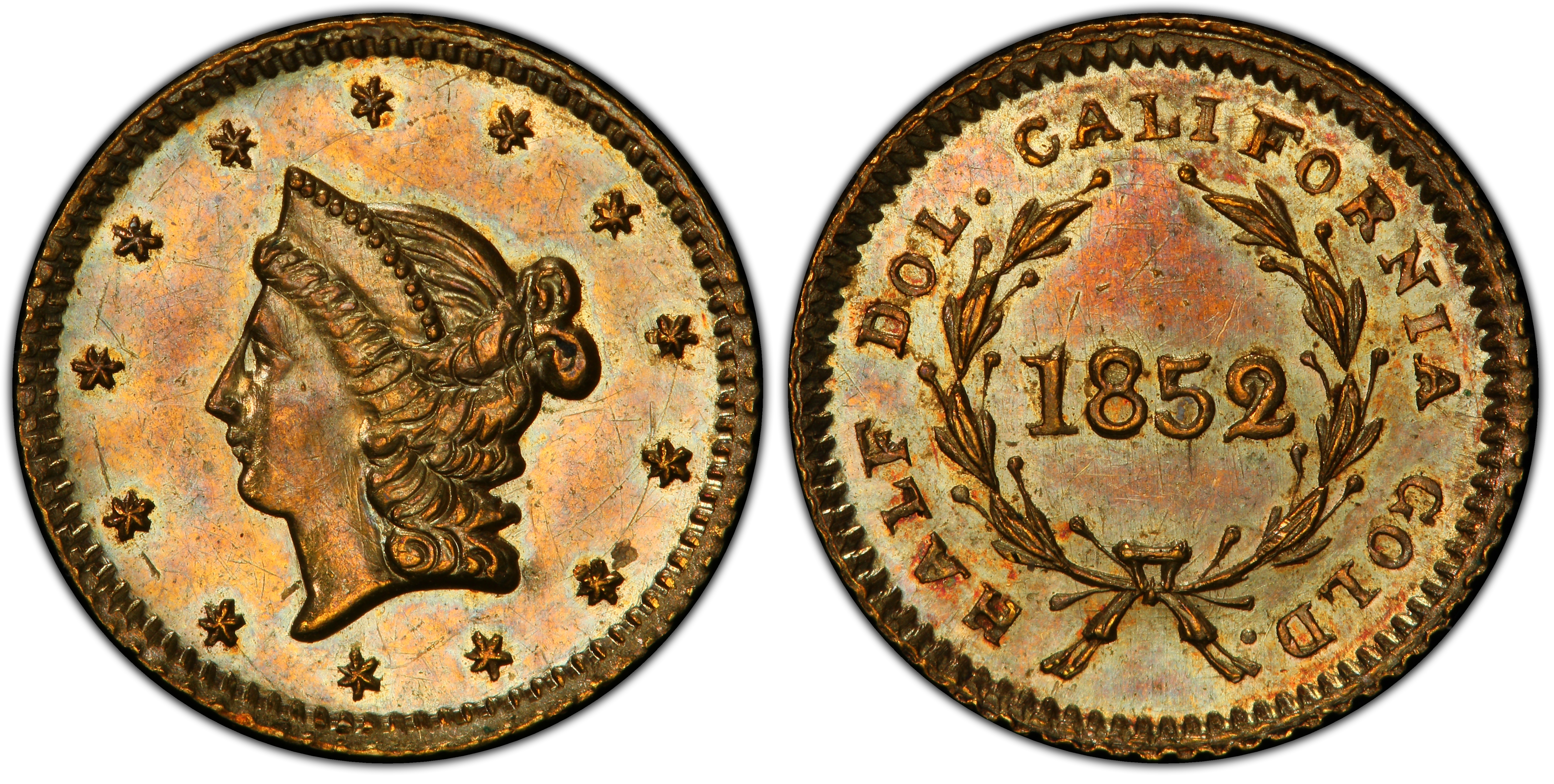
Obverse & Reverse
The BG-427 half dollar is a quintessential artifact from the chaotic, economically formative years of the California Gold Rush. Struck in 1852, it belongs to what numismatists classify as 'Period One' (1852-1857) of the California Fractional Gold series. Unlike later issues which were primarily souvenirs, Period One pieces were a direct response to a severe and crippling shortage of small denomination coinage. With the massive influx of population after 1848, San Francisco's economy boomed, but commerce was hamstrung. Gold dust, the primary medium of exchange, was imprecise and prone to theft and fraud. Large private gold coins ($5 to $50) handled major transactions, but the lack of circulating federal silver meant that everyday purchases for goods and services were exceedingly difficult. Into this void stepped jewelers and metallurgists who possessed the skills and raw materials to create a functional currency. For decades, this specific variety, BG-427, was attributed by pioneering researcher Walter Breen to the French jeweler Antoine Louis Nouizillet. However, exhaustive modern research, principally by Robert D. Leonard, Jr. for the second edition of the Breen-Gillio reference work, has convincingly re-attributed this and related issues to the Joseph Brothers, Lionel and Josephus. These English-born jewelers and watchmakers established a prominent business at 607 Montgomery Street and were among the first to recognize and fill the critical need for small change. The BG-427 is of paramount historical importance because it is one of a small handful of Period One varieties struck to a 'full weight' standard, containing nearly its face value in gold. This strongly supports the thesis that it was a utilitarian piece intended for genuine circulation, not a lightweight token or souvenir. Its existence was even noted in a June 1852 New Orleans 'Times-Picayune' article, which described a new California gold half dollar 'so much like the United States gold dollar piece, that the best judges would be completely deceived at a first glance.' This contemporary account validates its purpose and acceptance as a circulating medium in the specie-starved West, a tangible solution to an economic crisis on the American frontier.
Associated EventCalifornia Gold Rush
Reason For MintingTo alleviate a severe shortage of small-denomination coinage for daily commercial transactions in Gold Rush-era San Francisco.
Minter HistoryThe Joseph Brothers, Lionel and Josephus, were English-born jewelers, watchmakers, and importers who established a business in San Francisco during the Gold Rush. Previously attributed to Antoine Louis Nouizillet, modern numismatic scholarship by Robert D. Leonard, Jr. has firmly reassigned BG-427 to the Joseph Brothers. Their firm was one of several jewelry businesses that leveraged their metallurgical skills and access to gold to mint the fractional currency desperately needed by the local populace before the San Francisco Mint began producing sufficient quantities of federal small change.
Historical SignificanceAs a 'full weight' Period One issue, BG-427 is a rare and important example of private coinage created for actual circulation to solve a currency crisis. Its re-attribution to the Joseph Brothers represents a significant update to the numismatic understanding of this series, highlighting the role of various enterprising craftsmen in building the economic infrastructure of the American West.
BG-427
Denomination50 Cents
Minting Period1852
Assayer/MinterJoseph Brothers (Lionel and Josephus Joseph)
Geographic OriginSan Francisco, California
Obverse DescriptionA fairly crude but recognizable Liberty Head facing left, modeled after the contemporary U.S. Gold Dollar. The portrait is surrounded by thirteen small, closely spaced stars. The facial features are simply rendered, and the coronet is plain.
Obverse Inscription Reverse DescriptionThe denomination '1/2' appears in the center, surrounded by a simple wreath composed of two branches tied with a bow at the bottom. The legend 'CALIFORNIA GOLD' encircles the wreath along the periphery, separated from the wreath by a circle of beads or dots.
Reverse Inscription1/2 CALIFORNIA GOLD
CompositionGold
Stated Fineness Actual FinenessApproximately .880 fine (typical for unrefined native California gold)
Weight0.86 grams
Diameter11.00 mm
EdgePlain
Unknown
Survival Estimate13 to 30 coins
Rarity ScaleR-6
BG-427 is highly sought after as a rare (R-6) representative of the very first period of California Fractional Gold. Its status as one of the few 'full weight' issues made for actual circulation, combined with the fascinating and recently corrected attribution to the Joseph Brothers, gives it immense historical appeal for specialists in Territorial and private gold.
Key VarietiesThere are no major varieties of BG-427 from the original minting period. No known special collector issues, patterns, or restrikes exist for this specific Breen-Gillio number.
Authentication TipsGenuine examples exhibit a somewhat crude, manual strike. The stars on the obverse are often softly defined and may merge with the denticles. The reverse lettering can be uneven in spacing and depth. Counterfeits, often modern replicas, may appear too sharp, have a 'soapy' or cast-like texture, or be made of brass or thinly plated base metal. Weight is a key diagnostic; genuine pieces should be close to the 0.855-gram standard, whereas many fakes are significantly lighter.
Shopping ConsiderationsA premium quality example for its grade will show a bold, well-centered strike, which is uncommon for the issue. Look for minimal surface impairments; these tiny, soft gold coins were easily damaged. Original, uncleaned surfaces with a hint of reddish-gold toning command significant premiums. Weakness in the strike is common, especially on the high points of Liberty's hair and the details of the reverse wreath, but an example with above-average definition is highly desirable. Avoid specimens that are holed, bent, or exhibit harsh cleaning, as these significantly impair value.
A coin's grade is its condition, rated on a 1-70 scale. For rare coins, this is the most critical factor in determining value, as a tiny difference in preservation can mean a huge difference in price.
Relevant Grade TypesOriginal period issues were business strikes intended for circulation. They are found in Circulated grades (AG-3 to AU-58) and, very rarely, in Mint State (MS, 60-70). No Proofs (PR/PF) were struck during the original period of issue, and no later-date collector restrikes of this specific variety are known to exist.
Mint State CharacteristicsAn uncirculated BG-427 will exhibit soft, satiny luster, often with a slightly prooflike or reflective quality in the fields from the hand-prepared dies. The strike is characteristically weak; even on a choice MS example, the central details of Liberty's hair and the leaves of the reverse wreath may not be fully brought up. Due to the manual hammer-striking process and soft gold, expect to see some minor planchet adjustment marks or handling chatter, even on high-grade pieces.
Circulated Wear PatternsWear first appears on the highest points: Liberty's hair above the eye and ear, her cheek, and the coronet. On the reverse, the highest points of the wreath's leaves and the bow will show flatness and loss of detail first. In lower grades (VG and below), the stars will begin to blend into the rim and the reverse lettering will become faint.
Key Factors For ValueFor BG-427, value is driven by rarity and grade. Surface quality is paramount; an example with original, undisturbed luster and skin will always be worth more than a cleaned or polished coin of the same technical grade. Strike sharpness is a major factor; a coin with a crisper-than-normal strike is highly prized. Eye appeal, including attractive original toning and a lack of distracting marks, is critical. A CAC sticker for this issue provides a strong premium, as it confirms both the grade and the quality of the surfaces for that grade.
PCGS Price Guide
| Grade | Price | Population |
|---|---|---|
| 50 | $400.00 | N/A |
| 50+ | $410.00 | N/A |
| 53 | $425.00 | 1 |
| 53+ | $460.00 | N/A |
| 55 | $500.00 | 5 |
| 55+ | $550.00 | N/A |
| 58 | $650.00 | 6 |
| 58+ | $700.00 | N/A |
| 60 | $800.00 | 1 |
| 61 | $950.00 | 4 |
| 62 | $1,500.00 | 5 |
| 62+ | $1,750.00 | N/A |
| 63 | $2,250.00 | 1 |
| 63+ | $2,500.00 | N/A |
| 64 | $3,000.00 | 1 |