1854 G50C BG-403 (Regular Strike)
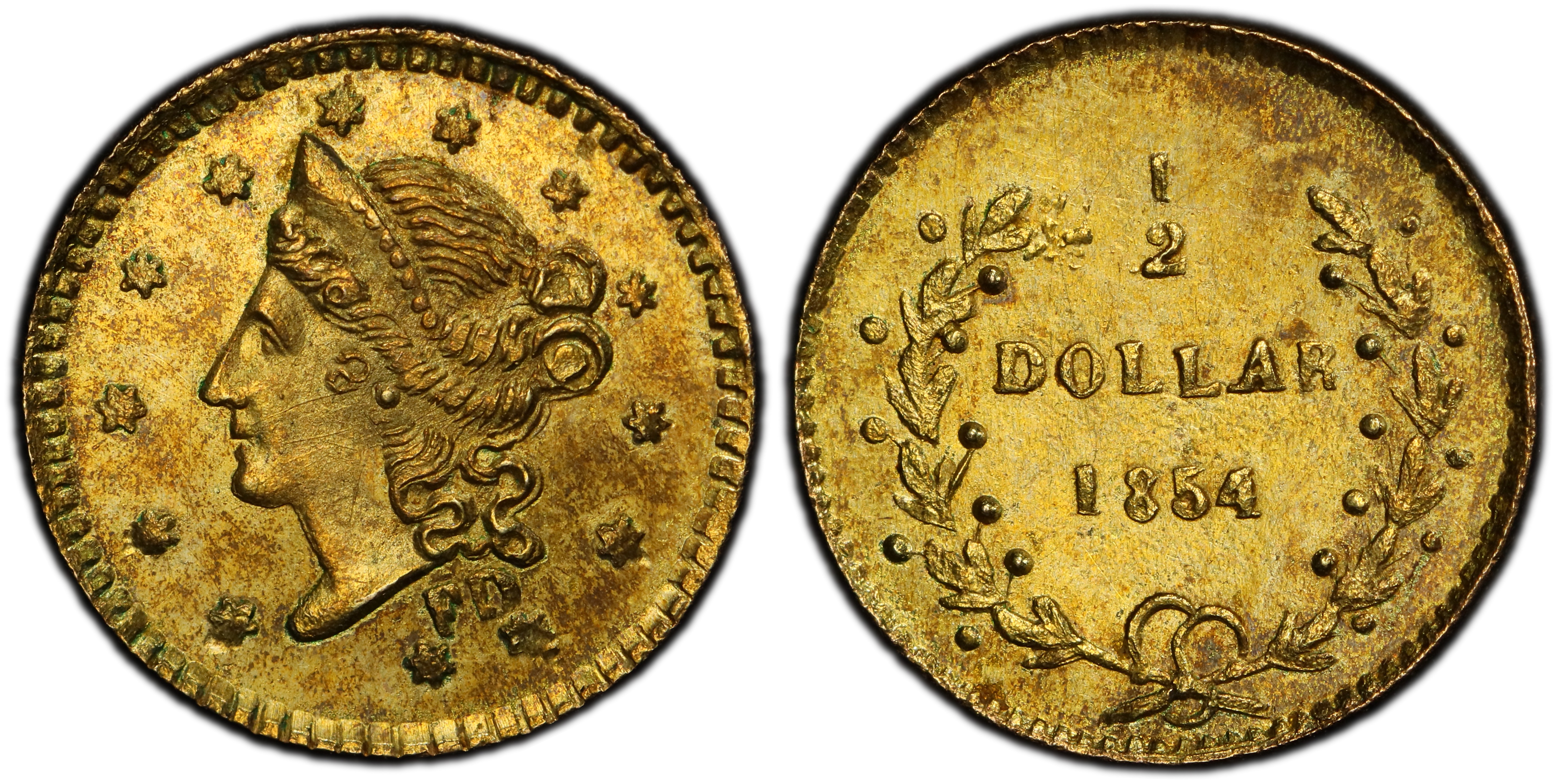
Obverse & Reverse
The 1854 BG-403 50 Cents piece is a numismatic artifact of immense rarity and historical significance, born from the chaotic, commerce-starved crucible of the California Gold Rush. Following the discovery of gold in 1848, a massive influx of population created a bizarre economic paradox: a land awash in gold dust but critically deficient in small-denomination coinage for daily transactions. A pinch of gold for a drink or a shave was an inexact and fraud-prone system. While private assayers like Moffat & Co. and Wass, Molitor & Co. ably produced large-denomination slugs and coins, the need for pocket change remained acute. This void was filled by enterprising jewelers and metalsmiths, many of them French immigrants, who began striking their own fractional gold coins in 1852. These 'Period One' issues, including the BG-403, were not mere tokens or souvenirs; they were a genuine, if unofficial, circulating medium intended to facilitate trade. Struck by the firm of Frontier, Deviercy & Co., this piece represents the pinnacle of this private minting tradition just as the tide was turning. The San Francisco Branch Mint had just opened in 1854, but its initial output of small coins was insufficient to meet demand. Frontier, Deviercy & Co. likely used a sophisticated screw press, not a simple hammer, to strike their coins, resulting in a relatively high quality of manufacture. The presence of their initials, 'FD', on the obverse was a mark of accountability and a guarantee of their fineness, which was generally honest for the period. However, the tenure of these fractional coins was brief. By 1856-1857, the Federal mint was in full production, flooding the region with official silver coinage and rendering the private gold pieces obsolete. Most were subsequently melted, contributing to the extreme rarity of survivors like the BG-403. Its existence today is a direct link to a brief, vibrant era when private enterprise literally created money to keep the wheels of a gold-fueled economy turning.
Associated EventCalifornia Gold Rush
Reason For MintingTo alleviate a severe shortage of small-denomination coinage for daily commercial transactions in Gold Rush-era San Francisco.
Minter HistoryPierre Frontier and Eugene Deviercy were French jewelers who formed the partnership Frontier, Deviercy & Co. in San Francisco around 1853. Operating during the peak of the 'Period One' fractional gold phenomenon (1852-1856), they were among the most prominent and skilled private minters. Their firm produced a variety of round and octagonal quarter-dollar and half-dollar pieces, distinguished by their quality and the presence of their 'FD' makers' mark on some varieties. Evidence suggests they employed a screw press, allowing for a sharper and more uniform strike than cruder hammer-struck contemporaries. Their coins have been recovered from contemporary shipwrecks such as the S.S. Winfield Scott, which sank in December 1853, confirming their circulation during the period. The partnership was a key player in the commercial life of the city before the San Francisco Mint's coinage became widely available.
Historical SignificanceThe BG-403 is a tangible remnant of the monetary crisis of the California Gold Rush and the private, unregulated response to it. As one of only two round half-dollar varieties bearing the 'FD' initials of its well-regarded makers, it exemplifies the high-quality private coinage that briefly served as legitimate currency before being supplanted by official U.S. Mint issues, with its extreme rarity underscoring the near-total meltage of these historic pieces.
K-N/A
Denomination50 Cents
Minting Period1854
Assayer/MinterFrontier, Deviercy & Co. (Pierre Frontier & Eugene Deviercy)
Geographic OriginSan Francisco, California
Obverse DescriptionA well-defined Liberty Head facing left, her hair tied in a bun at the back. The portrait is encircled by thirteen six-pointed stars, representing the original colonies. Below the truncation of the neck are the prominent initials 'F.D.' for Frontier, Deviercy & Co. The date, 1854, is positioned below the portrait, separated from the stars.
Obverse Inscription1854 F.D.
Reverse DescriptionThe central device is the denomination '50 CENTS' arranged in two lines. This is enclosed within a simple, continuous wreath composed of two branches tied with a bow at the bottom. The legend 'CALIFORNIA GOLD' appears around the periphery, outside the wreath, across the upper two-thirds of the coin's circumference.
Reverse InscriptionCALIFORNIA GOLD 50 CENTS
CompositionGold
Stated Fineness Actual FinenessNative California gold, typically around .880 fine, with a natural silver alloy.
Weight0.90 grams
Diameter11.50 mm
EdgePlain
Extremely low; likely only a few hundred at most.
Survival Estimate7 to 9 known examples.
Rarity ScaleR-7 (High)
This coin is a 'holy grail' for advanced specialists in California Fractional Gold. Its appeal lies in its extreme rarity (R-7), its connection to a known and respected maker (Frontier, Deviercy & Co.), its status as a 'Period One' issue intended for actual circulation, and its attractive, well-executed design.
Key VarietiesThe primary variety is the BG-403 itself. Critically, the obverse die used to strike the BG-403 was also used to strike the BG-404, another R-7 variety with a different reverse die. This die marriage provides crucial insight into the minting operations of Frontier, Deviercy & Co. No later-date restrikes, patterns, or trial pieces are known to exist for this specific variety.
Authentication TipsGenuine examples are struck, not cast, and should exhibit sharp details on a planchet of the correct, diminutive size. The 'FD' initials are a key diagnostic and should be clear and properly formed. One high-grade specimen is noted for a shallow planchet flaw (as made) near the letter 'D' in FD and the adjacent star, which can serve as a provenance marker. Replicas are common and are often poorly made, have incorrect weight or size, may be gold-plated base metal, and lack the fine details and crispness of an original screw-press strike. Authentication by a leading third-party grading service is essential.
Shopping ConsiderationsFor a coin of this rarity, any example is a major acquisition. A 'premium quality' example would be one that is well-centered and sharply struck, particularly on the 'FD' initials and the date. Look for original, uncleaned surfaces that may exhibit a soft, satiny luster; some examples are known with semi-prooflike fields. Given their use in circulation, some light, even wear is acceptable and even expected on non-Mint State examples. Avoid coins that have been harshly cleaned, exhibit rim damage, or show evidence of being mounted as jewelry (e.g., solder marks, plugging). Due to the softness of the gold, even high-grade pieces may show minor contact marks. Eye appeal is paramount.
A coin's grade is its condition, rated on a 1-70 scale. For rare coins, this is the most critical factor in determining value, as a tiny difference in preservation can mean a huge difference in price.
Relevant Grade TypesOriginal issues were business strikes intended for circulation and are found in Circulated (1-58) and Mint State (MS, 60-70) grades. Given their history, even circulated examples are highly prized. No proofs were struck during the original minting period, and there are no known later-date Proof restrikes or special collector issues of the BG-403.
Mint State CharacteristicsAn uncirculated BG-403 is defined by the absence of wear and the presence of original mint luster. These pieces were struck on a screw press, so strikes are typically sharp, especially compared to contemporary hammer-struck issues. Luster can range from soft and satiny to semi-prooflike. Due to the small size and soft planchets, even pristine examples may exhibit minuscule, as-made imperfections or tiny planchet bubbles. Marks from brief handling are common but should not be distracting.
Circulated Wear PatternsWear first appears on the highest points of the design. On the obverse, this will be Liberty's cheek, the hair above her ear, and the strands of her bun. On the reverse, the high points of the wreath's leaves and the numerals '50' will show the first traces of friction. In lower grades (VF and below), the 'FD' initials and the date will begin to lose their sharpness, and the stars will show flattening.
Key Factors For ValueFor the BG-403, rarity is the primary driver of value. Beyond that, the key factors are surface preservation and eye appeal. An example with original, lustrous surfaces will command a significant premium over one that has been cleaned, even if the latter shows less wear. Strike quality is also important; a coin with a full, sharp strike on all design elements is highly desirable. Finally, attractive, original reddish or straw-gold toning adds to the coin's appeal and value. A CAC sticker on a certified example provides third-party verification of quality for the assigned grade and is highly sought after for a rarity of this magnitude.
PCGS Price Guide
| Grade | Price | Population |
|---|---|---|
| 55 | $2,750.00 | 2 |
| 55+ | $2,900.00 | N/A |
| 58 | $3,100.00 | 3 |
| 58+ | $3,350.00 | N/A |
| 60 | $4,500.00 | N/A |
| 61 | $4,750.00 | N/A |
| 62 | $5,250.00 | 2 |
| 62+ | $5,750.00 | N/A |
| 63 | $7,000.00 | 6 |
| 63+ | $7,750.00 | N/A |
| 64 | $9,000.00 | 2 |