1853 G50C BG-301 Eagle (Regular Strike)
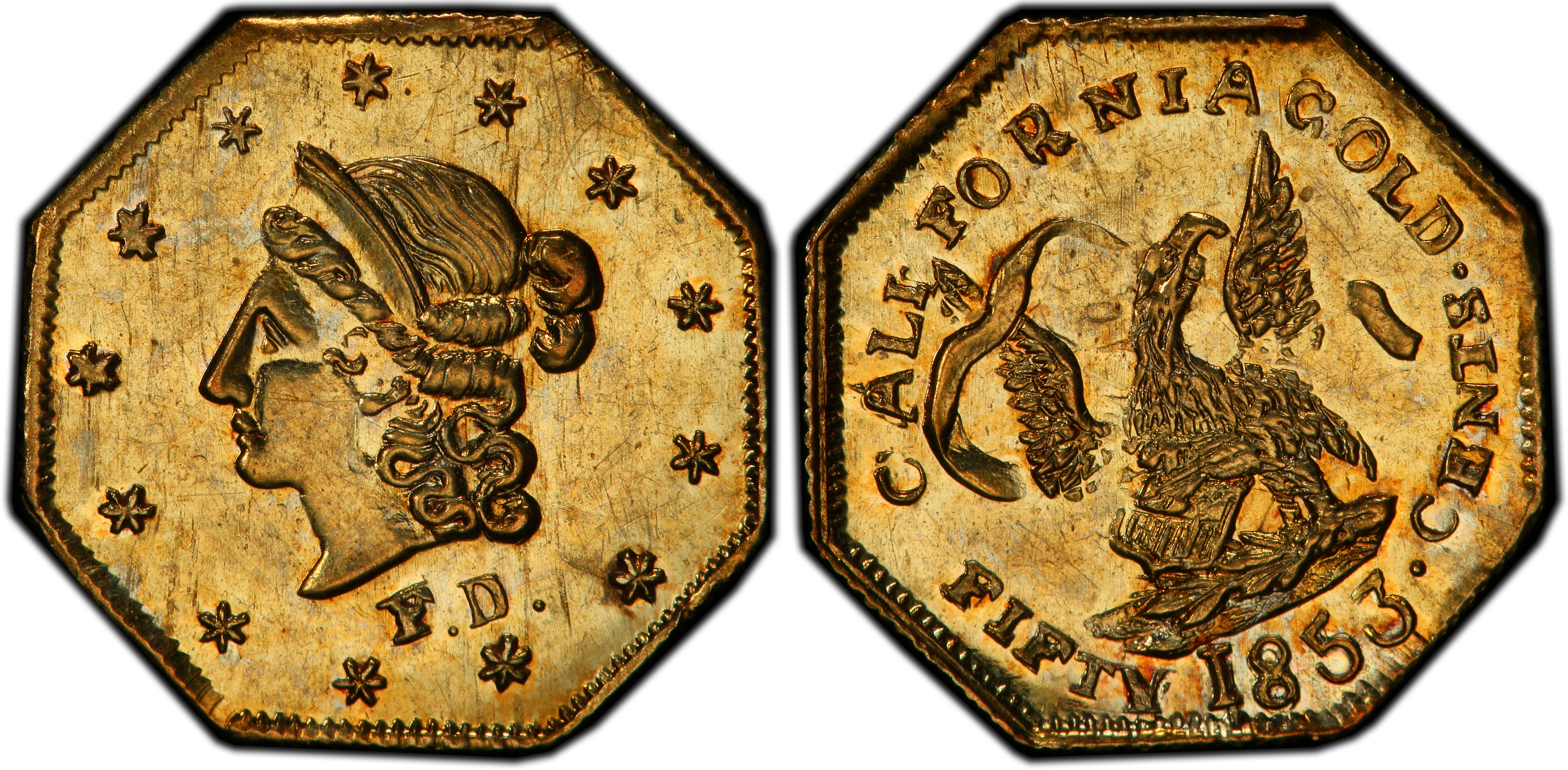
Obverse & Reverse
The 1853 BG-301 octagonal half dollar is one of the most celebrated and historically significant issues within the entire corpus of California fractional gold. Its story is inextricably linked to the chaotic, specie-starved economy of Gold Rush California. In the early 1850s, the massive influx of gold dust and nuggets created an urgent and ironic problem: a severe shortage of small-denomination coinage for daily transactions. A 'pinch' of gold dust was an imprecise and often contentious medium of exchange. While the U.S. Assay Office under Augustus Humbert was striking massive $50 gold slugs, and private firms were issuing $5, $10, and $20 coins, the need for coins valued under a dollar was unmet by official channels. Into this monetary vacuum stepped enterprising jewelers and metalworkers, who began striking their own quarter dollar, half dollar, and dollar coins in 1852. These pieces, now known as 'Period One' fractionals, were intended for actual circulation. The firm of Frontier, Deviercy & Co., believed to be run by French immigrants Pierre Frontier and Eugene Deviercy, was a key producer. Their BG-301 is a standout masterpiece of the series. Its defining feature is the reverse, which bears a stunningly detailed miniature of the heraldic eagle design used by Humbert on his iconic $50 gold pieces. This was a bold and audacious design choice, directly linking their tiny coin to the most respected and trusted symbol of bullion value in the West. This choice made the BG-301 instantly recognizable and likely enhanced its acceptability in commerce. However, the legitimacy of such private issues was always tenuous. A Sacramento Daily Union article from September 3, 1853, warned of 'Counterfeit half dollar pieces' circulating in San Francisco that had 'the appearance only of gold,' and while it's impossible to know if this referred specifically to the BG-301, it speaks to the variable quality and public skepticism surrounding some fractional issues. Despite this, the BG-301, with its impressive design and connection to Humbert's legacy, has secured its place as a numismatic icon, representing a critical solution to the coinage crisis that defined the California Gold Rush.
Associated EventCalifornia Gold Rush
Reason For MintingTo alleviate a severe shortage of small-denomination coinage for everyday commercial transactions in Gold Rush-era California.
Minter HistoryFrontier, Deviercy & Co. was a San Francisco firm of jewelers operated by Pierre Frontier and Eugene Deviercy. They were active during the height of the Gold Rush, likely arriving in 1853. Like other jewelers of the period, they recognized the critical need for small change and used their metallurgical skills to produce fractional gold coins. Their work is characterized by its distinctive, if sometimes crude, designs. The firm is most famous for producing the BG-301 half dollar, distinguished by its unique appropriation of the revered Humbert eagle design. Historical accounts suggest they, like some contemporaries, may have also produced plated counterfeits, casting a shadow of controversy over their operations.
Historical SignificanceThe BG-301 is the only octagonal half dollar to use the famed Humbert-style eagle reverse, making it a key numismatic type coin. It perfectly encapsulates the era's monetary improvisation, where private citizens bridged a critical gap left by the federal government, and serves as a tangible link between the smallest circulating currency and the largest gold ingots of the California Gold Rush.
BG-301
Denomination50 Cents
Minting Period1853
Assayer/MinterFrontier, Deviercy & Co.
Geographic OriginSan Francisco, California
Obverse DescriptionA head of Liberty facing left, stylistically similar to the contemporary U.S. gold dollars, with 'LIBERTY' inscribed on her coronet. The head is surrounded by thirteen stars, representing the original colonies. The date '1853' is below the bust.
Obverse InscriptionLIBERTY / 1853
Reverse DescriptionA heraldic eagle with outstretched wings, clutching arrows and an olive branch, with a shield on its breast. This design is a direct and detailed miniature of the eagle found on Augustus Humbert's United States Assay Office $50 gold 'slugs', a feature unique to this variety among octagonal half dollars. The denomination '50 CENTS' is inscribed above the eagle.
Reverse Inscription50 CENTS
CompositionGold
Stated Fineness Actual Fineness0
EdgePlain
Unknown
Survival EstimateFewer than 15 examples known. The Breen-Gillio census lists 15, but notes this may contain duplications.
Rarity ScaleLow R-7
The BG-301 is one of the most desirable and famous of all California fractional gold varieties. Its allure comes from the unique combination of its octagonal shape and the iconic 'Humbert Eagle' reverse, a design found on no other octagonal half dollar. Its high rarity and direct historical connection to the most famous Assay Office issue of the Gold Rush make it a centerpiece for any advanced collection.
Key VarietiesThere are no known major varieties or official restrikes of the BG-301 from its period of issue. The 'Regular Strike' is the only known format. The broader California Fractional Gold series includes 'Period Two' (1859-1882) and 'Period Three' (post-1883) issues, which were primarily made as souvenirs rather than for circulation and are distinct numismatic items. Some Period Three pieces made by Herman Kroll in the early 20th century were technically restrikes of earlier designs, sometimes using original tooling, but none are recorded for the BG-301 die pair.
Authentication TipsAuthentication requires careful comparison to high-resolution images of known genuine examples. The dies were somewhat crudely engraved, so look for specific die markers and the characteristic engraving style. The 'Humbert' eagle, while detailed for the coin's size, will not have the same fine execution as on the original $50 slugs. Counterfeits may be cast, showing a soft or porous appearance, or may be struck from modern dies that lack the precise character of the originals. Weight and specific gravity tests can help detect plated or debased examples, a contemporary concern as noted in 1853 newspaper reports.
Shopping ConsiderationsA premium quality BG-301 is defined by a bold strike, especially on the stars, date, and the details of the eagle's feathers and shield. The finest known examples exhibit moderately prooflike or semi-prooflike fields, a feature that commands a significant premium. Look for original, uncleaned surfaces with attractive reddish-gold or deep yellow-gold toning. Common problems include cleaning, jewelry mounting (look for evidence of solder or rim damage), and tooling in the fields to hide marks. Due to the high rarity and value, purchase only examples certified by a top-tier grading service like PCGS or NGC.
A coin's grade is its condition, rated on a 1-70 scale. For rare coins, this is the most critical factor in determining value, as a tiny difference in preservation can mean a huge difference in price.
Relevant Grade TypesOriginal period issues like the BG-301 were business strikes intended for circulation and are found in Circulated (1-58) and Mint State (MS, 60-70) grades. Due to their practical use, most survivors show some degree of wear. No true Proofs were struck during the original minting period, as these were utilitarian issues. Any piece described as 'Prooflike' (PL) is a business strike with reflective surfaces from polished dies, which is a desirable and rare characteristic on this issue.
Mint State CharacteristicsAn uncirculated BG-301 is exceptionally rare. Quality is defined by the strength of the strike, as the dies were somewhat crude and even Mint State examples may not be perfectly sharp. Luster on this issue is typically satiny to semi-prooflike. The finest known examples have moderately prooflike, reflective fields. Due to the softness of the gold and the coin's small size, even high-grade examples can show minor planchet flaws or small contact marks that do not impair the grade.
Circulated Wear PatternsWear first appears on the highest points of the design. On the obverse, check the hair above Liberty's eye and ear, her cheekbone, and the coronet. On the reverse, the eagle's head, the upper portions of the wings, and the high points of the shield will show the first signs of friction. On lower-grade examples (VF and below), the denomination and date will begin to lose sharpness.
Key Factors For ValueRarity is the primary driver of value. For a given grade, value is determined by surface quality and eye appeal. An example with original, undisturbed luster and attractive toning will command a significant premium over a cleaned or hairlined piece of the same grade. Strike is also critical; a sharply struck coin showing full details on the eagle is far more desirable. The presence of a CAC sticker, indicating premium quality for the grade, adds a substantial premium for an important territorial issue like this.
PCGS Price Guide
| Grade | Price | Population |
|---|---|---|
| 40 | $8,000.00 | N/A |
| 50 | $10,500.00 | N/A |
| 58 | $21,000.00 | 2 |
| 58+ | $23,500.00 | N/A |
| 60 | $26,000.00 | 1 |
| 61 | $28,000.00 | 1 |
| 62 | $30,000.00 | 2 |
| 66 | N/A | N/A |