1871 25C BG-719 (Regular Strike)
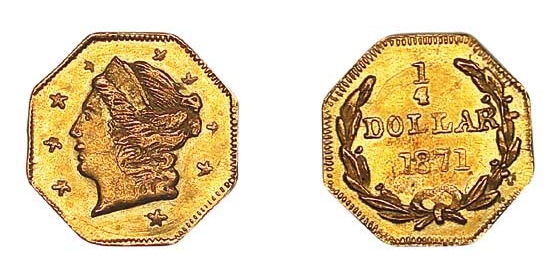
Obverse & Reverse
The 1871 25C BG-719 is a product of the second period (1859-1882) of California Fractional Gold production, a fascinating and complex chapter in American numismatics. Following the initial Gold Rush boom, California's economy continued to expand, yet it remained plagued by a chronic shortage of small denomination coinage for daily transactions. The U.S. Mint in San Francisco, established in 1854, primarily focused on larger gold and silver coins, leaving a vacuum for coins valued under a dollar. This void was filled by private minters, predominantly jewelers of French and German origin in San Francisco, who began striking diminutive gold quarter, half, and one-dollar pieces. Unlike the 'Period One' issues which were generally of good weight and intended to circulate widely, the 'Period Two' pieces, including BG-719, were often underweight relative to their face value and stylistically more diverse. They are often termed 'jeweler's issues' and their primary function evolved from filling a monetary need to serving as popular souvenirs and keepsakes for tourists and locals alike. The Act of 1864 had prohibited private coinage, but enforcement was lax, allowing these pieces to be produced until the early 1880s. The BG-719 variety, an octagonal Liberty Head quarter, is a testament to this continued production. Its extreme rarity today suggests a very small initial output, likely struck by a single jeweler using hand-cut dies and a screw press or hammer. These coins were not mass-produced; each was a semi-artisanal product. Their journey through time was perilous, with the vast majority being lost, damaged, or melted for their gold content, making any surviving example a precious link to post-Gold Rush California.
Associated EventCalifornia Gold Rush Economic Aftermath
Reason For MintingTo satisfy a continued commercial and souvenir demand for small-denomination coins in post-Gold Rush California.
Minter HistoryThe specific minter for BG-719 is unknown, a common fate for many Period Two varieties. Production was decentralized among various San Francisco jewelers who created their own dies. Unlike minters like Robert B. Gray (who marked his coins with a 'G'), the creator of BG-719 left no identifying mark. These artisans operated small workshops, and their numismatic output was often a sideline to their main business of selling jewelry and watches. Their identities are now largely lost to history, with their work only identifiable through the meticulous die-state research cataloged by Breen and Gillio.
Historical SignificanceThe BG-719, as an exemplar of the rare Period Two issues, illustrates the transition of fractional gold from a necessary circulating medium to a popular souvenir item. Its existence highlights the lingering economic autonomy of the American West and the federal government's slow extension of monetary control. For numismatists, it represents a pinnacle of collecting difficulty within a beloved and historically rich series.
BG-719
Denomination25C
Minting Period1871
Assayer/MinterUnknown San Francisco Jeweler
Geographic OriginSan Francisco, California
Obverse DescriptionA crudely rendered Liberty Head, facing left, with 13 stars surrounding the portrait. On this variety, the strike is often weak on certain features. Diagnostic die states show fine stress cracks on Liberty's neck, cheek, and crown.
Obverse Inscription[None]
Reverse DescriptionThe denomination '1/4' appears within a wreath. The wreath is composed of two branches tied with a ribbon at the bottom. The inscription 'CALIFORNIA GOLD' encircles the wreath. Known die states show three minor die cracks on the upper right, extending from the rim to the wreath. In the terminal die state, these cracks merge to form a cud.
Reverse InscriptionCALIFORNIA GOLD
CompositionGold
Stated Fineness Actual FinenessVariable, typically 14-22 karats for Period Two issues.
Weight0.24 grams
Diameter9.60 mm
EdgePlain
Extremely low, likely fewer than 50 pieces.
Survival Estimate6-10 known examples
Rarity ScaleR-7
This is a landmark rarity in the California Fractional Gold series. Its appeal lies in its extreme scarcity (R-7), octagonal shape, and the challenge it represents for advanced collectors attempting to complete a Breen-Gillio variety set. As one of the rarest dated quarters from the entire 1852-1882 period, it is a trophy coin.
Key VarietiesThis is a 'Regular Strike' business issue. The cataloged variety is BG-719. There are no known restrikes, proofs, or patterns associated with this specific die pairing. Collectors should be aware of different die states, with the terminal state showing a distinct cud on the reverse.
Authentication TipsGenuine pieces exhibit a characteristic soft, native gold luster. The design elements are often softly struck and may appear crude compared to federal issues. Look for the specific die cracks on both the obverse (stress lines on Liberty's portrait) and reverse (cracks from rim to wreath) as key diagnostics. Weight and diameter should be close to 0.24 grams and 9.6 mm, respectively. Modern counterfeits are often brassy, overweight, and have sharper, more modern-looking details. Period counterfeits exist but are often cruder still.
Shopping ConsiderationsFor a coin of this rarity, any example is a major acquisition. A 'premium quality' specimen would be one free of significant marks, cleaning, or damage (such as being holed or mounted in jewelry). Look for a sharp strike, especially on the date and stars. Eye appeal is paramount; coins with original, un-dipped, reddish-gold surfaces command significant premiums. Given the known die cracks, evidence of an earlier die state before the reverse cud formed might be preferred by some specialists. Certification by PCGS or NGC is essential for authenticity and market acceptance; PCGS has graded the few known examples.
A coin's grade is its condition, rated on a 1-70 scale. For rare coins, this is the most critical factor in determining value, as a tiny difference in preservation can mean a huge difference in price.
Relevant Grade TypesAll original examples of BG-719 were business strikes intended for commerce or sale as souvenirs, and are found in Circulated (1-58) and Mint State (MS, 60-70) grades. No Proof (PR/PF) examples were struck during the original minting period, nor are any later-date restrikes known for this specific variety. While some Period Two fractionals have prooflike surfaces from being struck on polished planchets, these are designated 'PL' and are not true Proofs.
Mint State CharacteristicsAn uncirculated BG-719 will exhibit frosty mint luster in the fields. The strike is characteristically weak in areas, particularly on the high points of Liberty's hair and the wreath. The diagnostic die cracks and clash marks are inherent to the coin's manufacture and are not considered defects. Contact marks are common due to the softness of the gold and the crude handling methods of the era, but a choice MS example will have minimal and well-hidden marks.
Circulated Wear PatternsWear first appears on the high points of Liberty's cheek, hair, and the stars on the obverse. On the reverse, the highest points of the wreath and the numbers in the fraction '1/4' will show initial friction and loss of detail. On lower grade examples, the legends will become soft and the finer details of the wreath will merge.
Key Factors For ValueRarity is the primary driver of value for BG-719. Beyond its mere existence, the grade is critical. The difference between an AU-58 and an MS-63 is immense. Key factors include the quality of the strike (a sharper-than-average strike is highly prized), the originality of the surfaces (uncleaned coins with original skin are paramount), and overall eye appeal. Problem-free surfaces without scratches, rim bumps, or planchet flaws will command a significant premium. Given the tiny population, any certified example is a major numismatic event when it appears for sale.
PCGS Price Guide
| Grade | Price | Population |
|---|---|---|
| 60 | N/A | N/A |
| 62 | $900.00 | 1 |
| 62+ | $1,150.00 | N/A |
| 63 | $1,500.00 | 1 |
| 63+ | $1,750.00 | N/A |
| 64 | $2,500.00 | 4 |
| 64+ | $2,750.00 | N/A |
| 65 | $3,500.00 | N/A |
| 65+ | $3,750.00 | N/A |
| 66 | $4,750.00 | 1 |