1854 G$1 BG-605 (Regular Strike)
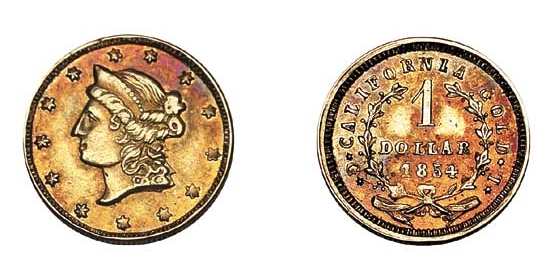
Obverse & Reverse
The 1854 BG-605 Gold Dollar is a quintessential artifact from the first phase of private California coinage, a period numismatists designate as 'Period One' (1852-1857). Its creation was a direct response to the chaotic and inflationary economic conditions of the California Gold Rush. Following the discovery of gold at Sutter's Mill in 1848, a massive influx of prospectors and merchants flooded into California, but the monetary system could not keep pace. Gold dust and nuggets, while plentiful, were impractical and often inconsistently valued for daily transactions. The U.S. Mint in Philadelphia was too distant, and the establishment of the San Francisco Mint was still in its early stages in 1854. This created a severe shortage of small-denomination circulating coinage, making it difficult to conduct everyday business, from buying a meal to paying for supplies. In this vacuum, private jewelers and metallurgists, many of whom were French immigrants, stepped in to fill the void. They began striking their own coins in denominations of 25 cents, 50 cents, and one dollar from native California gold. These 'Period One' issues were generally intended for actual commerce and were accepted, albeit sometimes reluctantly, by local merchants. Unlike later 'Period Two' issues, which were often underweight and made as souvenirs, Period One coins like the BG-605 were made with the genuine intent of facilitating trade. However, they were typically lightweight compared to their federal counterparts, a fact that eventually led to their decline in commercial acceptance as more federal coinage became available. The BG-605, with its simple Liberty Head design mimicking federal issues, represents the entrepreneurial spirit and practical necessity that defined the Gold Rush economy. Today, it is recognized as a key numismatic relic of that transformative era.
Associated EventCalifornia Gold Rush
Reason For MintingTo alleviate a severe shortage of small-denomination coinage for everyday commercial transactions in Gold Rush-era California.
Minter HistoryThe specific minter or jeweler who produced the BG-605 variety is not definitively known, a common trait for many 'Period One' California fractional gold issues which were often unmarked. Prominent San Francisco jewelers and assayers of the period known to have produced fractional gold include Antoine Louis Nouizillet, M. Deriberpe, and the firm of Frontier & Deviercy. While these individuals and firms are associated with other BG-varieties of the era, the dies used for BG-605 have not been conclusively attributed to a specific maker, leaving it as a product of an anonymous but skilled craftsman of the time.
Historical SignificanceThe BG-605 is historically significant as a tangible solution to a critical economic problem—the lack of circulating small change—during one of the most dynamic periods of American westward expansion. It represents the private enterprise and ingenuity that flourished in the semi-isolated, gold-rich economy of mid-19th century California before federal institutions were fully established in the region. Its existence is a direct testament to the daily economic struggles and resourcefulness of the merchants and citizens of the Gold Rush.
BG-605
Denomination$1
Minting Period1854
Assayer/MinterUnknown Private Minter
Geographic OriginSan Francisco, California
Obverse DescriptionA crudely rendered Liberty Head, facing left, with hair tied in a bun. The portrait is encircled by 13 five-pointed stars, representing the original colonies. The date '1854' is positioned below the truncation of the neck.
Obverse Inscription1854
Reverse DescriptionThe denomination '1 DOLLAR' is centered within a wreath composed of two branches tied with a bow at the bottom. The wreath is open at the top.
Reverse Inscription1 DOLLAR
CompositionGold
Stated Fineness Actual Fineness EdgePlain
Unknown
Survival Estimate10-15
Rarity ScaleR-7-
The BG-605 is highly sought after as a rare, historically significant 'Period One' round dollar. Its appeal lies in its direct connection to the California Gold Rush, its primitive yet charming design, and its extreme scarcity. It is considered a key type coin for collectors attempting to build a representative set of California fractional gold, which ensures persistent demand from advanced specialists.
Key VarietiesThe primary variety is the regular strike of 1854. No proof strikings or official restrikes are known from the period of issue. As these were privately and often crudely made, minor die states may exist but are not typically cataloged as major varieties. Collectors should be aware of contemporary counterfeits and later-made souvenir tokens that mimic the style but are not genuine 'Period One' issues.
Authentication TipsAuthentication requires careful examination of die characteristics. The style of the Liberty head, the specific shape and placement of the 13 stars, and the letter punches used for '1 DOLLAR' are key diagnostics. Genuine examples often exhibit a crude strike and may have planchet imperfections characteristic of private minting operations of the era. The gold color should be consistent with native California alloy, which often contains a higher percentage of silver. Many modern replicas and fantasy pieces exist; genuine BG-605s are extremely rare and should be authenticated by a major third-party grading service.
Shopping ConsiderationsFor a potential buyer, a premium quality example is one that retains strong strike details, particularly on Liberty's hair and the leaves of the reverse wreath. Given the crude manufacturing process, well-centered strikes command a premium. Original, uncleaned surfaces with some remaining luster are highly prized. Avoid examples that are holed, bent, or show signs of tooling or harsh cleaning, as these significantly impair value. Due to the coin's rarity, even problem-free circulated examples in grades like VF and XF are considered highly desirable. Focus on overall eye appeal and originality.
A coin's grade is its condition, rated on a 1-70 scale. For rare coins, this is the most critical factor in determining value, as a tiny difference in preservation can mean a huge difference in price.
Relevant Grade TypesOriginal issues were business strikes intended for circulation and are found in Circulated (1-58) and Mint State (MS, 60-70) grades. No Proof (PR/PF) examples of BG-605 were struck during the original period of issue, and no official later-date restrikes are known to exist.
Mint State CharacteristicsUncirculated examples of BG-605 are exceptionally rare. A true Mint State specimen would be defined by the absence of wear and the presence of original mint luster, which is typically soft and satiny rather than deeply prooflike. Strikes are characteristically weak in areas, particularly in the center of the obverse (Liberty's hair) and reverse. Planchets were often unrefined, so small, natural imperfections do not preclude a Mint State grade. Contact marks from handling with other coins are common due to the softness of the gold.
Circulated Wear PatternsWear first appears on the highest points of the design. On the obverse, this includes Liberty's cheek, the hair above the ear, and the tips of the stars. On the reverse, the high points of the letters in 'DOLLAR' and the leaves in the wreath will show the first signs of friction. In lower grades (Fine and below), the date and stars will become faint, and the details of the wreath will merge.
Key Factors For ValueThe primary value driver for a BG-605 is its extreme rarity, followed by its grade. A sharp strike for the issue is a major positive factor. Surface quality is paramount; an example with original, undisturbed skin and attractive reddish-gold toning is far more valuable than a cleaned or polished specimen of the same grade. Eye appeal, encompassing strike, luster, color, and centering, plays a crucial role. Given the prevalence of forgeries in the Cal Gold series, certification by PCGS or NGC is virtually required for any transaction, with an additional premium often paid for coins approved by CAC.
PCGS Price Guide
| Grade | Price | Population |
|---|---|---|
| 50 | $15,000.00 | 2 |
| 50+ | $15,500.00 | N/A |
| 53 | $16,500.00 | 2 |
| 53+ | $17,000.00 | N/A |
| 55 | $18,500.00 | 2 |
| 55+ | $22,500.00 | N/A |
| 58 | $35,000.00 | 2 |