1873 G25C BG-728 (Regular Strike)
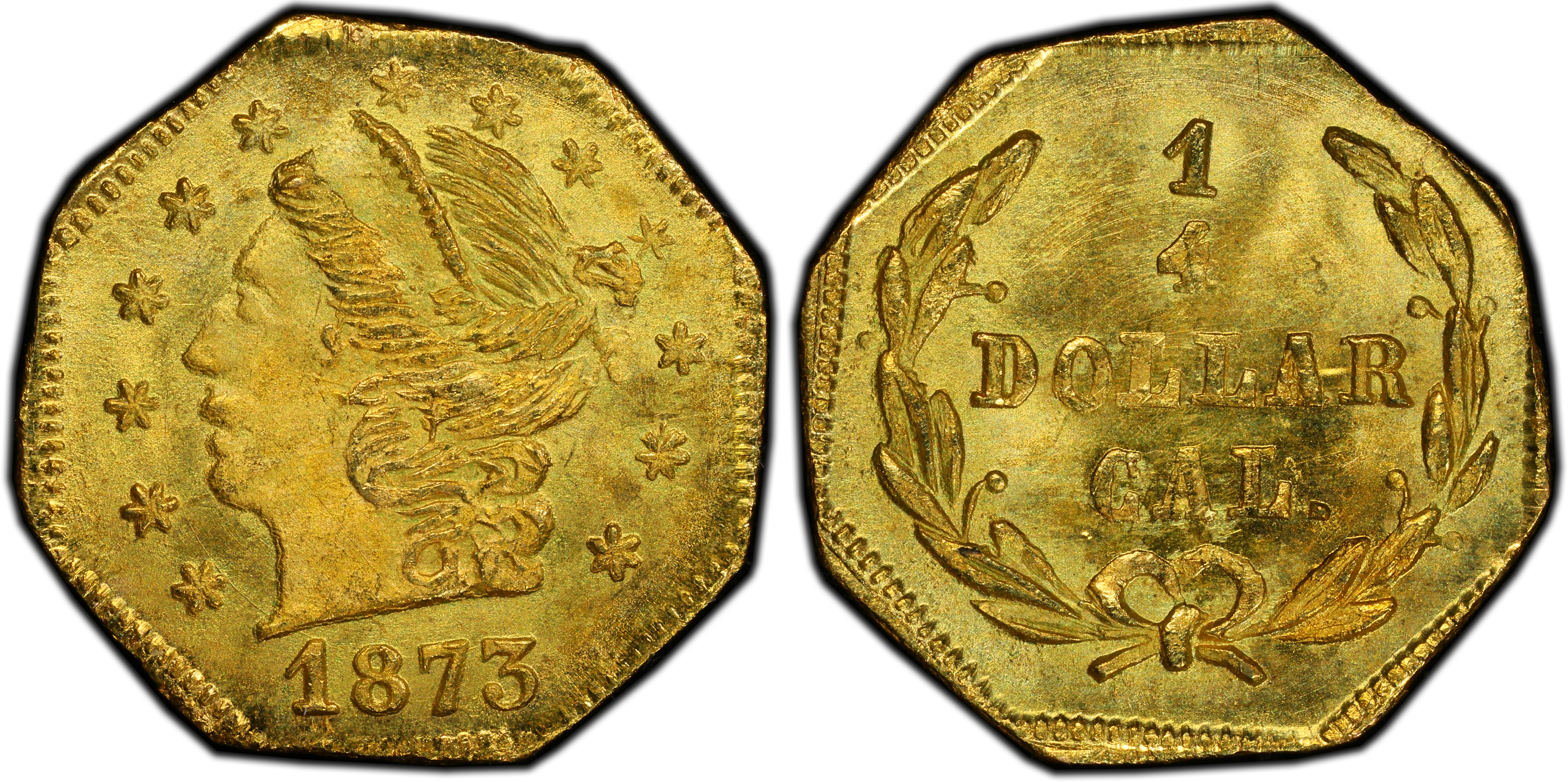
Obverse & Reverse
The 1873 G25C BG-728 is a quintessential example of 'Period Two' California Fractional Gold, a fascinating and complex series born from the lingering economic realities of the Gold Rush. By the 1870s, the initial, desperate shortage of small-denomination coinage that spurred the creation of 'Period One' (1852-1857) fractionals had largely been resolved by the output of the San Francisco Mint. However, a robust new market had emerged for these diminutive gold pieces: tourism and the souvenir trade. San Francisco had transformed from a chaotic boomtown into a major American city and a destination for travelers from the East Coast and Europe, all eager for a tangible keepsake of the romanticized Gold Rush. Local jewelers, who had been the primary producers of the earlier issues, capitalized on this demand by continuing to strike fractional gold. These Period Two issues, including the BG-728, were generally not intended for widespread circulation in the same manner as their predecessors. Instead, they were commercial products, often sold at a premium over their low intrinsic value. This shift in purpose is reflected in their physical characteristics; unlike the relatively high-purity Period One coins, Period Two pieces were often made of lower-karat gold, effectively making them valuable tokens rather than true currency. The United States government viewed these private issues with increasing suspicion. The Coinage Act of 1864 had explicitly forbidden private coinage, but enforcement in the West was inconsistent. The continued production into the 1870s and early 1880s represented a legal grey area, which producers navigated by issuing undenominated 'charms' or, more brazenly, continuing to strike denominated pieces like this one. Eventually, increased pressure from the U.S. Secret Service, which viewed the coins as a vector for fraud, brought the era of California Fractional Gold to a close by 1883. The BG-728 variety, with its classic Liberty Head design and octagonal shape, is a direct link to this unique period of numismatic history, representing the commercial ingenuity of San Francisco's jewelers and the enduring mystique of California gold.
Associated EventPost-Gold Rush California Tourism
Reason For MintingPrimarily produced to be sold as souvenirs and keepsakes to tourists in San Francisco, capitalizing on the romanticism of the Gold Rush.
Minter HistoryWhile the BG-728 is not definitively attributed to a specific maker, the most prolific producers of this era were San Francisco jewelers. Key figures included Robert B. Gray & Co., who had acquired the business of earlier minter Antoine Nouizillet. In 1871, Gray sold his interests to the California Jewelry Co., an enterprise run by the Levison Brothers. These firms were not clandestine operations but respected local businesses that produced fine jewelry and watches, with fractional gold being a profitable sideline. They employed skilled engravers and had the machinery to produce these tiny, intricate pieces. Their operations continued until federal enforcement of anti-private coinage laws became unavoidable in the early 1880s.
Historical SignificanceThe coin is a key representative of the 'souvenir' phase of fractional gold production, illustrating the transition of these pieces from quasi-circulating currency to commercial keepsakes. It highlights a period of lax federal oversight on private minting and the robust tourism-driven economy of late 19th-century San Francisco.
N/A
Denomination25 Cents
Minting Period1873
Assayer/MinterAttributed to San Francisco jewelers, possibly Robert B. Gray & Co. or their successors.
Geographic OriginSan Francisco, California
Obverse DescriptionA beaded border encloses a Liberty Head facing left, modeled after the contemporary U.S. gold coinage designed by James B. Longacre. The portrait is surrounded by thirteen stars.
Obverse Inscription[No Inscription - imagery only]
Reverse DescriptionWithin a wreath of two olive branches tied with a bow at the bottom, the denomination '1/4 DOLLAR' and the date '1873' are displayed. The word 'CAL.' for California appears at the bottom, just inside the wreath.
Reverse Inscription1/4 DOLLAR 1873 CAL.
CompositionGold
Stated Fineness Actual FinenessVariable, but generally lower than official U.S. coinage of the era, often ranging from 14 to 22 karats.
Diameter9.50 mm
EdgePlain
Unknown
Survival Estimate201-500 known (per PCGS population data)
Rarity ScaleR-3 (Breen-Gillio)
This variety is popular due to its classic and recognizable Liberty Head design, octagonal shape, and its status as a tangible, affordable artifact from the post-Gold Rush era. It is a key date in the widely collected 25 Cents octagonal series.
Key VarietiesThe BG-728 itself is a specific die marriage and considered a 'Regular Strike' business issue for the period. No major sub-varieties, patterns, or official restrikes are recorded for this specific BG number. The broader series of 1873 fractional gold includes numerous other BG varieties with different design details, mintmarks (or lack thereof), and round or octagonal shapes.
Authentication TipsGenuine examples often exhibit a slightly crude, handmade quality. The strike may be uneven, with some areas weaker than others due to the hammer-striking process. Look for die characteristics matching known genuine specimens cataloged in the Breen-Gillio reference. Counterfeits are rampant; many are brass tokens sold as novelties, often featuring a bear on the reverse (no genuine fractionals do). Be wary of pieces with an unnaturally uniform, mushy appearance or a soapy luster. Authentication by a major third-party grading service (PCGS or NGC) is highly recommended.
Shopping ConsiderationsA premium quality example for its grade will possess a sharp strike, especially on the high points of Liberty's hair and the digits of the date. Seek out coins with minimal distracting contact marks and original, uncleaned surfaces, which may exhibit a deep, reddish-gold or mellow 'old gold' patina. Avoid examples that have been harshly cleaned, polished, or previously mounted in jewelry, as evidenced by rim damage, solder marks, or excessive scratching. Given the hammer-striking method, some weakness on peripheral elements can be expected, but the central details should be as bold as possible. Prooflike (PL) or Deep Mirror Prooflike (DMPL) examples command a significant premium for their exceptional eye appeal.
A coin's grade is its condition, rated on a 1-70 scale. For rare coins, this is the most critical factor in determining value, as a tiny difference in preservation can mean a huge difference in price.
Relevant Grade TypesOriginal issues were business strikes intended for sale, not circulation in the traditional sense, and are found in both Circulated (1-58) and Mint State (MS, 60-70) grades. While some high-grade examples have reflective, prooflike surfaces from being struck with polished dies, no true Proof (PR/PF) examples were struck during the original period of issue. Any coin labeled 'Proof' would refer to a later, non-contemporary striking or a misattribution.
Mint State CharacteristicsUncirculated examples of BG-728 typically display a soft, satiny luster. The strike can be variable; well-struck pieces show clear details in Liberty's hair curls and the wreath leaves on the reverse. It is common, however, to find examples with some softness on the peripheral stars or lettering due to the striking process. Small planchet flaws or adjustment marks are not uncommon and are generally accepted by collectors if they are not visually distracting. The tiny size makes them susceptible to contact marks, which are often found on the high points of the design like Liberty's cheek and the '1/4'.
Circulated Wear PatternsWear first appears on the highest points of the design. On the obverse, this includes Liberty's hair above the ear and the cheekbone. On the reverse, the high points of the wreath leaves and the bow will show initial friction and flattening. In lower grades (VF and below), the stars will begin to merge with the fields, and the date and denomination will become progressively weaker.
Key Factors For ValueBeyond the numerical grade, value is driven by strike and surface quality. A sharply struck coin with minimal marks will always command a premium over a weakly struck or heavily marked coin of the same grade. Eye appeal is paramount; coins with attractive, original color and luster are highly prized over those that are dull, cleaned, or spotted. For this issue, a CAC sticker indicating premium quality for the grade adds a significant premium, as it confirms the coin's strong visual appeal and originality to sophisticated buyers.
PCGS Price Guide
| Grade | Price | Population |
|---|---|---|
| 53 | $215.00 | 1 |
| 53+ | $220.00 | N/A |
| 55 | $225.00 | 1 |
| 55+ | $230.00 | N/A |
| 58 | $235.00 | 3 |
| 58+ | $240.00 | N/A |
| 60 | $250.00 | 3 |
| 61 | $260.00 | 4 |
| 62 | $275.00 | 10 |
| 62+ | $285.00 | N/A |
| 63 | $325.00 | 31 |
| 63+ | $350.00 | N/A |
| 64 | $400.00 | 55 |
| 64+ | $475.00 | 2 |
| 65 | $675.00 | 46 |
| 65+ | $750.00 | 1 |
| 66 | $950.00 | 20 |
| 66+ | $1,050.00 | 2 |
| 67 | $1,950.00 | 5 |
| 67+ | $2,600.00 | 2 |
| 68 | $3,750.00 | N/A |