No Date G25C BG-205 (Regular Strike)
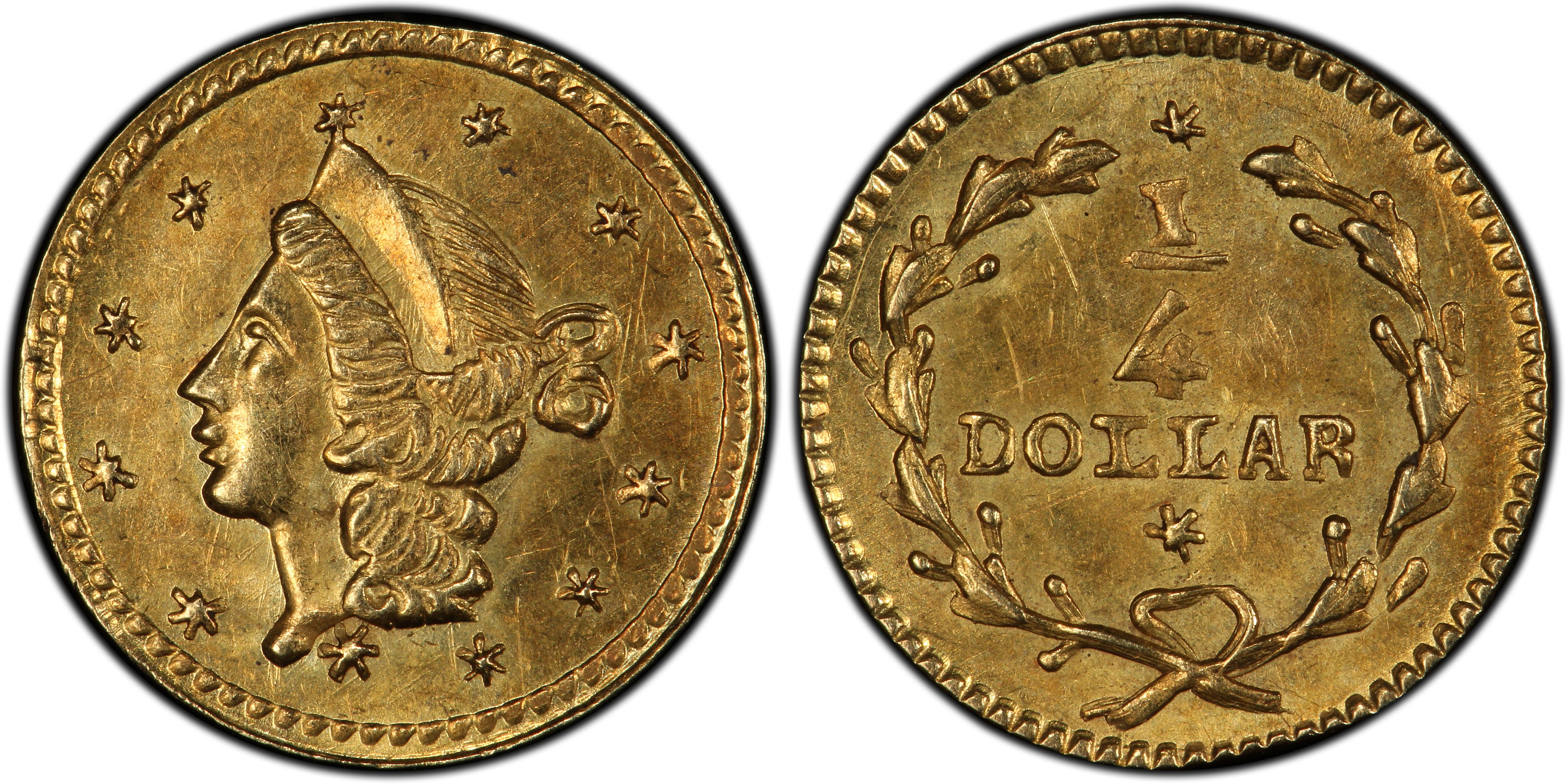
Obverse & Reverse
The BG-205 25 Cent piece is a quintessential artifact of the California Gold Rush, a period of dramatic economic upheaval and numismatic innovation. Following the discovery of gold at Sutter's Mill in 1848, a massive influx of prospectors and merchants descended upon California, creating a vibrant economy almost overnight. This rapid growth, however, was not matched by a sufficient supply of official United States coinage. Gold dust and nuggets became a common medium of exchange, but this was imprecise and inconvenient for small, everyday transactions. A 'pinch' of gold for a drink at a saloon varied wildly depending on the bartender's thumb and forefinger. Large denomination private gold coins from assayers like Moffat & Co. and Wass, Molitor & Co. addressed the need for substantial payments, but a severe shortage of small change persisted. Into this numismatic vacuum stepped a number of entrepreneurial jewelers and craftsmen who began striking their own small-denomination gold coins in 1852. Among the most significant of these early 'Period One' minters were Lionel and Josephus Joseph, English-born silversmiths who had established 'Joseph Brothers' in San Francisco as jewelers, importers, and watchmakers. By June 1852, their fractional gold pieces were already known, with one New Orleans newspaper remarking that their half dollar was so similar to the U.S. gold dollar 'that the best judges would be completely deceived at a first glance.' The BG-205, an undated 25-cent piece attributed to 1853, was a product of this initial wave of production intended to function as circulating currency. These tiny gold coins, struck by hand using the 'hammer method,' were not official legal tender but were accepted in local commerce out of sheer necessity. Their intrinsic value was often close, but not exactly equal, to their face value. As the new San Francisco Mint began ramping up production of official silver and gold coinage by 1856-1857, the practical need for these fractional pieces waned. They transitioned from being instruments of commerce to popular souvenirs of the Gold Rush, mailed back east as curiosities. This shift also led to the 'Period Two' issues (1859-1882), which were often underweight and more fanciful in design, produced explicitly for the jewelry and souvenir trade. The BG-205, however, stands as a testament to the initial, functional period, a tangible solution to a critical economic problem on the American frontier.
Associated EventCalifornia Gold Rush
Reason For MintingTo alleviate a severe shortage of small-denomination coinage for everyday commercial transactions in Gold Rush-era San Francisco.
Minter HistoryJoseph Brothers was a firm established in San Francisco circa 1852 by Lionel and Josephus Joseph, brothers from a family of English silversmiths. They operated as jewelers, watchmakers, importers of diamonds, and opticians. Their business was one of the very first to produce 'Period One' fractional gold coinage, with their issues known as early as June 1852. While their primary business was jewelry, their role as pioneer minters was crucial in providing a medium of exchange for small transactions before the San Francisco Mint became fully operational. The attribution of specific varieties like BG-205 to them is based on extensive numismatic research by scholars like Walter Breen and Ronald Gillio, who identified their distinct manufacturing style.
Historical SignificanceAs a 'Period One' issue, the BG-205 represents the earliest and most historically important phase of California Fractional Gold production, when these pieces were genuinely intended to circulate and facilitate commerce. It is a direct link to the chaotic and innovative economy of the Gold Rush, showcasing the private enterprise that filled a void left by the federal government. Its rarity and association with a prominent early maker make it a key numismatic artifact of American westward expansion.
N/A
Denomination25 Cents
Minting Period(1853)
Assayer/MinterJoseph Brothers
Geographic OriginSan Francisco, California
Obverse DescriptionA Liberty Head, facing left, with hair tied in a bun at the back. The portrait is somewhat crude, typical of the early private issues. The head is surrounded by thirteen six-pointed stars arranged in an arc around the periphery.
Obverse Inscription Reverse DescriptionA simple wreath, open at the top, encircles the denomination. The wreath is composed of two branches with leaves and berries. Within the wreath, the denomination is expressed as the fraction '1/4'.
Reverse Inscription1/4
CompositionGold
Stated Fineness Actual FinenessVaries, but typically between .800 and .900 for Period One issues.
Weight0.25 grams
Diameter9.50 mm
EdgePlain
Unknown
Survival EstimateApproximately 22 examples known in all grades, with 14 estimated to be Mint State.
Rarity ScaleR-6 (13-30 Known)
The BG-205 is highly sought after for being a scarce 'Period One' issue, struck for circulation by the important Joseph Brothers firm. Its simple, classic design, extreme rarity, and direct connection to the height of the Gold Rush make it a prized possession for specialists in Territorial gold and Western Americana.
Key VarietiesNo major varieties or later-date restrikes are known for the BG-205. The primary variations among surviving examples are differences in strike quality, planchet preparation, and die state, which are characteristic of the crude hammer-striking process used. No proof or special presentation strikings were made during its period of issue.
Authentication TipsGenuine BG-205 specimens exhibit a characteristic fabric from the hammer-striking process, often resulting in a slightly uneven or wavy planchet and a strike that may be weak in areas. The details, while crude, should match the known die characteristics of the issue. The gold color is often a slightly lighter, brassy yellow due to the natural silver content in California gold. Be wary of pieces that appear perfectly flat, have mushy or cast-looking details, or exhibit a modern, uniform yellow-gold color. Modern replicas are common and are often thicker and heavier than genuine pieces. Authentication by a major third-party grading service is highly recommended.
Shopping ConsiderationsA premium quality BG-205 is defined by a bold, well-centered strike, which is rare for the issue. Look for sharpness on Liberty's hair details and the numerals of the fraction. The surfaces should be clean and free of significant, distracting marks; small planchet flaws or adjustment marks are common and often acceptable. High-end examples, particularly those in Mint State, may exhibit prooflike or semi-prooflike fields, sometimes with attractive rose or orange-gold toning, which command a significant premium. Avoid examples with evidence of cleaning, tooling, or jewelry mounting (such as solder marks or holes), as these drastically reduce numismatic value. A sharp strike and pleasing, original surfaces are paramount.
A coin's grade is its condition, rated on a 1-70 scale. For rare coins, this is the most critical factor in determining value, as a tiny difference in preservation can mean a huge difference in price.
Relevant Grade TypesAll original BG-205 coins were business strikes intended for circulation and are found in Circulated grades (AG-3 to AU-58) and Mint State grades (MS-60 to 70). The vast majority of survivors are in circulated condition. No Proof (PR/PF) examples were struck during the original minting period, and no later-date Proof restrikes are known to exist.
Mint State CharacteristicsAn uncirculated BG-205 will display full original mint luster, which can range from satiny to semi-prooflike. Strike quality varies, but a high-grade example should show clear details on Liberty's hair strands and the wreath leaves. Due to the crude manufacturing process, even Mint State examples may exhibit minor planchet irregularities or a slightly uneven strike. Small, light contact marks are expected, but numerous or heavy marks will lower the grade. Examples with reflective, prooflike surfaces and attractive natural toning are exceptionally rare and desirable.
Circulated Wear PatternsWear first appears on the highest points of the design. On the obverse, friction will first be evident on Liberty's cheek, the upper portion of her hairline, and the coronet. On the reverse, the high points of the wreath's leaves and the fraction's numerals will show the first signs of smoothing. In lower grades (VG and below), the stars on the obverse will begin to merge with the rim, and the finer details of the wreath will become obliterated.
Key Factors For ValueFor the BG-205, value is driven primarily by rarity and grade. Given its R-6 status, any example is valuable. Key factors differentiating value within grades are strike quality and surface preservation. A sharply struck coin can be worth significantly more than a weakly struck coin of the same numerical grade. Original, uncleaned surfaces with attractive luster or toning command a substantial premium. Coins certified by top-tier services (PCGS, NGC) and those approved by CAC for their superior quality for the grade are the most sought-after by serious collectors.
PCGS Price Guide
| Grade | Price | Population |
|---|---|---|
| 55 | $2,100.00 | 3 |
| 55+ | $2,250.00 | N/A |
| 58 | $2,500.00 | 3 |
| 58+ | $2,750.00 | N/A |
| 60 | $3,250.00 | N/A |
| 61 | $3,500.00 | 3 |
| 62 | $3,750.00 | 7 |
| 62+ | $4,750.00 | N/A |
| 63 | $8,500.00 | 2 |
| 63+ | $9,500.00 | N/A |
| 64 | $12,500.00 | 1 |