1860 G25C BG-732 (Regular Strike)
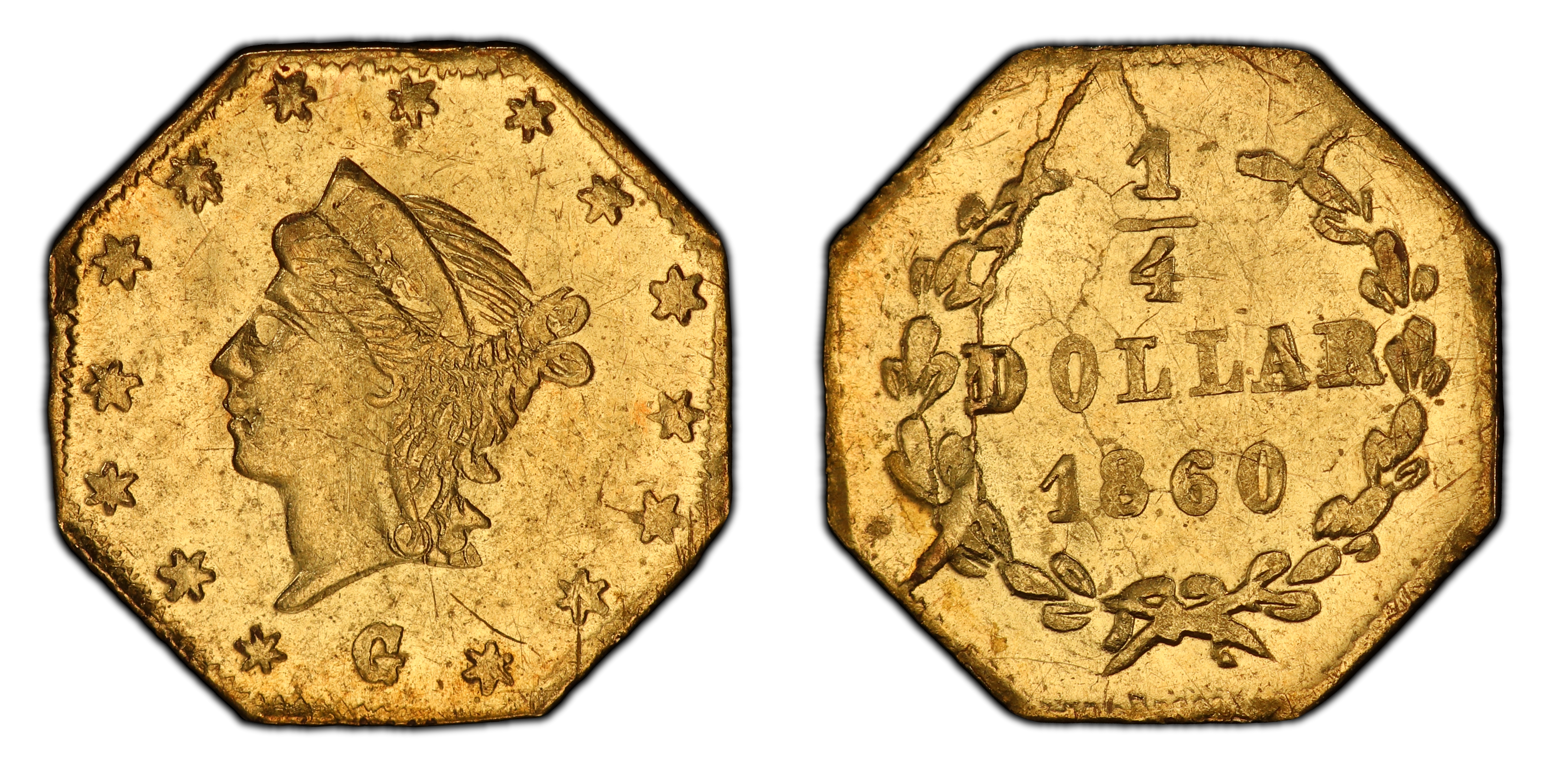
Obverse & Reverse
The 1860 G25C, cataloged as Breen-Gillio 732, is a product of the second major phase of California's private gold coinage. By 1860, the initial acute shortage of small change that drove the creation of the 'Period One' (1852-1857) issues had somewhat abated with the full-scale operation of the San Francisco Mint. However, the public's fascination with gold and the convenience of these tiny pieces sustained a new market. This second period, from 1859 to 1882, is often termed the 'Jeweler's Period,' as the pieces were primarily manufactured by jewelers and metalsmiths less for circulation and more as souvenirs, keepsakes, and items for adornment. They were tangible, affordable mementos of the great Gold Rush, popular with tourists and locals alike. Robert B. Gray & Co. was a significant producer during this era. In late 1858 or 1859, Gray acquired the business of another prominent French jeweler and minter, Antoine Louis Nouizillet, inheriting his dies and equipment. Gray then began producing his own distinctive issues, marked with a characteristic 'G' on the obverse, as seen on this variety. These 'Period Two' issues were typically lighter than their stated face value would imply in gold content, and quality varied widely among minters. However, the work of Robert B. Gray is often noted by numismatists as being of higher quality, with his coins being among the heaviest and most intrinsically valuable of the period. The BG-732 is particularly notable for its catastrophic reverse die failure. The die shattered early in its use, creating prominent breaks that are a key diagnostic of the variety. This premature failure is the primary reason for the coin's extreme rarity, as it sharply limited the number of pieces that could be struck. The passage of the Coinage Act of 1864, which outlawed private coinage, began the end for these fascinating pieces, although the law wasn't strictly enforced until the early 1880s.
Associated EventCalifornia Gold Rush (Jeweler's Period)
Reason For MintingPrimarily struck to satisfy commercial demand for souvenirs and keepsakes of the Gold Rush, rather than to alleviate a major currency shortage.
Minter HistoryRobert B. Gray & Co. was a prominent firm of jewelers and private minters active in San Francisco during the second period of fractional gold production. In late 1858 or early 1859, Gray purchased the business of Antoine Louis Nouizillet, a 'Period One' minter, acquiring his dies and equipment. Gray initially used some of Nouizillet's old dies before creating his own, which were hallmarked with a 'G' to identify his work. His products are generally considered superior in weight and quality compared to many of his contemporaries. The firm struck a variety of octagonal and round 25-cent, 50-cent, and one-dollar gold pieces until 1871, when Gray sold his interests to the California Jewelry Company (Levison Bros.).
Historical SignificanceThe BG-732 is a quintessential example of a 'Period Two' California fractional gold coin, representing the shift from utilitarian coinage to commercial souvenir production. Its high rarity, a direct result of a dramatic die failure, makes it a significant numismatic artifact that tells a story of the physical limitations of private minting technology during the era.
BG-732
Denomination25 Cents
Minting Period1860
Assayer/MinterRobert B. Gray & Co.
Geographic OriginSan Francisco, California
Obverse DescriptionLiberty Head facing left, her hair tied in a bun. She wears a coronet or tiara which, on this variety, is only partially inscribed with the letters 'LIBE'. The head is surrounded by thirteen stars. The date '1860' is below the bust.
Obverse InscriptionLIBE / 1860
Reverse DescriptionThe denomination '1/4 DOLLAR' is centered within a wreath of leaves and berries tied by a bow at the bottom. The reverse of this variety is defined by a shattered die, showing prominent, heavy die breaks, particularly a crack running through the left branch of the wreath.
Reverse Inscription1/4 DOLLAR
CompositionGold
Stated Fineness Actual FinenessVaries, but generally lower than U.S. Mint standard. Robert B. Gray's issues are considered to be of higher intrinsic value than many other Period Two pieces.
EdgePlain
Very Low
Survival Estimate13-20 coins
Rarity ScaleHigh R-6
This variety is highly sought after by specialists in California fractional gold due to its extreme rarity and dramatic, visible production flaw. The shattered reverse die makes it a fascinating study piece and a key variety from the respected minter Robert B. Gray & Co. Its status as a 'High R-6' makes any appearance at auction a significant event.
Key VarietiesThe regular strike from the shattered die is the only variety known for BG-732. There are no known patterns, trial pieces, or restrikes associated with this specific Breen-Gillio number. It is closely related to BG-731, which uses a similar obverse design but lacks the specific diagnostics of BG-732. Key diagnostics for BG-732 are the coronet reading only 'LIBE', a repunched 'O' in DOLLAR, a repunched '8' in the date, and the massive reverse die breaks.
Authentication TipsAuthentication requires careful die study. A genuine BG-732 must exhibit the prominent reverse die breaks, particularly the major crack through the left side of the wreath. The obverse must match the known die characteristics, including the specific 'LIBE' inscription on the coronet. The overall fabric, including the style of the strike and planchet quality, should be consistent with known Robert B. Gray & Co. issues. Be wary of modern replicas or pieces lacking a denomination, which are typically tokens or souvenirs. The standard reference, 'California Pioneer Fractional Gold' by Breen and Gillio, is an essential tool.
Shopping ConsiderationsFor a potential buyer, the primary consideration is the visibility and state of the die breaks on the reverse; well-defined breaks confirm the variety and add to the coin's appeal. Look for examples with minimal surface impairments, as the small size makes any scratch or ding very prominent. Luster is a key value driver; specimens with semi-prooflike or reflective fields command a significant premium. The obverse is often weakly struck opposite the severe reverse die failure, which is a characteristic of the issue, not a flaw. A premium quality example would have a sharp strike on the central obverse details despite this inherent weakness, attractive original color, and problem-free surfaces.
A coin's grade is its condition, rated on a 1-70 scale. For rare coins, this is the most critical factor in determining value, as a tiny difference in preservation can mean a huge difference in price.
Relevant Grade TypesOriginal issues of BG-732 were business strikes, although produced more as souvenirs than for circulation. They are found in Circulated grades (AU-50 to AU-58 are most common for the series) and, more frequently for this less-circulated type, in Mint State (MS, 60-70). No true Proofs were struck during the original period of issue, and there are no known later-date Proof restrikes for this specific variety.
Mint State CharacteristicsUncirculated examples of BG-732 often possess a semi-prooflike or reflective finish, a common trait for many 'Jeweler's Period' issues. Luster can range from satiny to flashy. The strike is a key diagnostic; the obverse is characteristically weak in the area opposite the reverse die break. High-end examples will show sharp detail on Liberty's coronet and hair, despite this inherent striking issue. Due to the small, thin planchet, even Mint State examples may show minor planchet striations or handling marks that can affect the grade.
Circulated Wear PatternsOn circulated examples, wear first appears on the highest points of the design. For the obverse, this includes Liberty's cheek, the hair above her ear, and the coronet. On the reverse, the high points of the wreath's leaves and the numerals of the fraction '1/4' will show the first signs of friction and flattening. In lower grades (VF and below), the fine details of the hair and leaves will merge, and the legends will begin to soften.
Key Factors For ValueThe primary value driver for BG-732 is its extreme rarity. After that, grade and eye appeal are paramount. Surface quality is critical; a coin with original, undisturbed luster and rich golden or olive-gold toning will be worth significantly more than a cleaned or harshly polished example. The clarity and prominence of the reverse die breaks are important for attribution and appeal. Strike sharpness on the obverse, given the inherent weakness, is a major differentiating factor. A CAC sticker, verifying premium quality for the grade, adds a substantial premium for this rare issue.
PCGS Price Guide
| Grade | Price | Population |
|---|---|---|
| 53 | $300.00 | 1 |
| 53+ | $325.00 | N/A |
| 55 | $500.00 | 5 |
| 55+ | $525.00 | N/A |
| 58 | $650.00 | 3 |
| 58+ | $675.00 | N/A |
| 60 | $850.00 | 1 |
| 61 | $1,000.00 | 1 |
| 62 | $1,750.00 | 6 |