1853 G50C BG-435, Arms of California (Regular Strike)
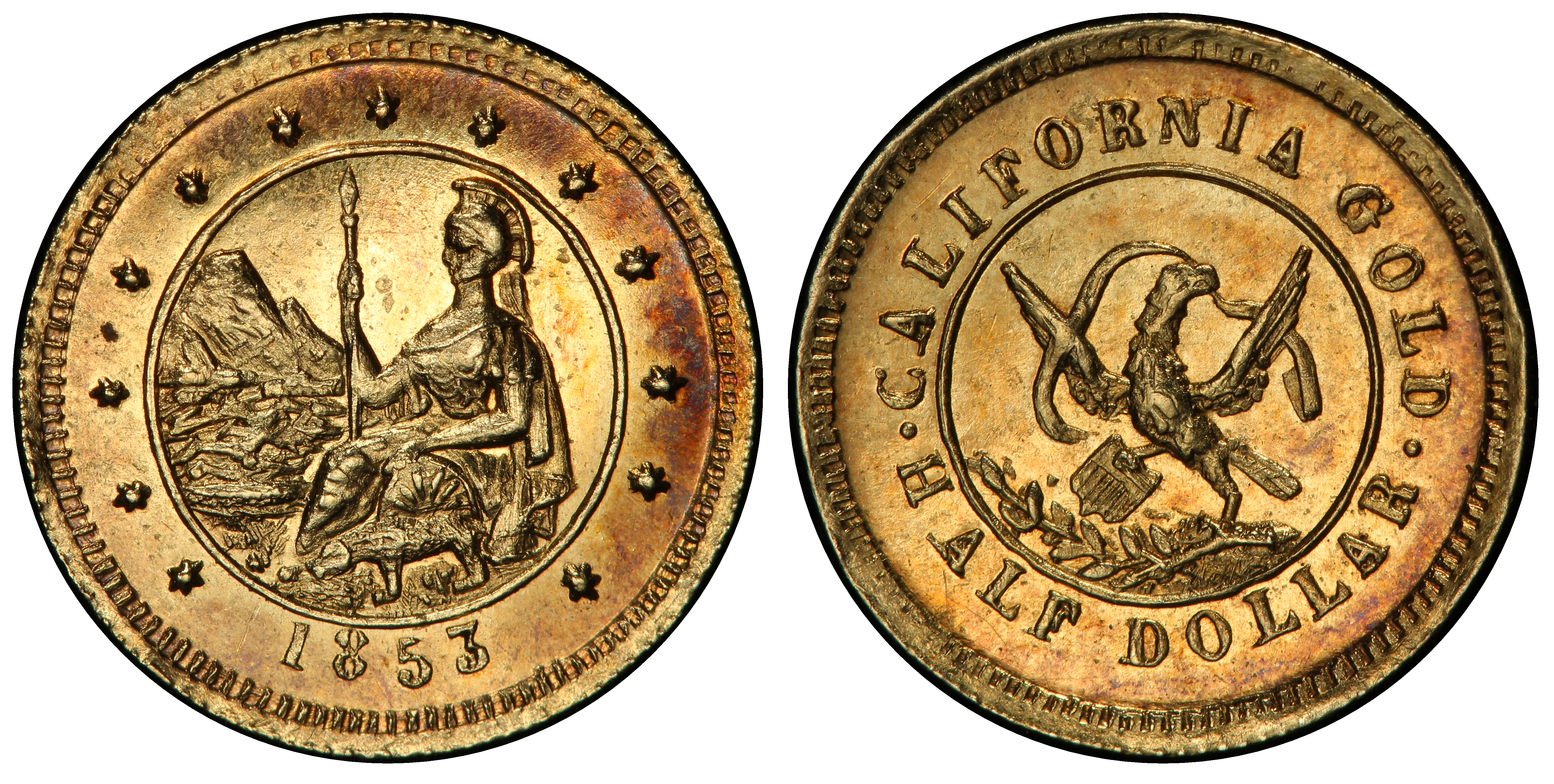
Obverse & Reverse
The 1853 'Arms of California' 50 Cents piece, cataloged as Breen-Gillio 435, is a quintessential artifact from the first phase of private fractional gold production in California. These diminutive coins, born of necessity, addressed a critical deficiency in the booming Gold Rush economy: a severe lack of small denomination coinage for daily transactions. While miners extracted vast quantities of gold, and private assayers like Moffat & Co. and Wass, Molitor & Co. produced large denomination ingots and coins, the man on the street struggled to make minor purchases. Gold dust, traded by the 'pinch,' was an imprecise and often contentious medium. Into this void stepped numerous jewelers and metalsmiths, primarily in San Francisco, who began striking their own quarter, half, and one-dollar gold pieces starting in 1852. These 'Period One' issues (1852-1857) were accepted in local commerce and intended for circulation, unlike the later 'Period Two' issues which were primarily souvenirs. The BG-435 is arguably the most artistically ambitious and historically significant of all fractional issues. Its manufacturer remains unknown, a common trait for these often-unmarked necessity pieces, though some researchers have tentatively suggested the firm of Braverman & Levy. The coin's design is entirely unique within the series; neither the obverse nor the reverse die was used for any other variety. The obverse proudly displays a miniature rendering of the Great Seal of the State of California, a patriotic and legitimizing choice. The reverse features a defiant eagle reminiscent of the design used on the massive fifty-dollar 'slugs' of the U.S. Assay Office, a clear visual link to the most trusted and substantial gold coins of the day. This combination of sophisticated, locally relevant designs elevates the BG-435 from a simple trade token to a true numismatic treasure, reflecting the civic pride and economic realities of Gold Rush San Francisco before the U.S. Branch Mint, which opened in 1854, could fully supply the region's coinage needs.
Associated EventCalifornia Gold Rush
Reason For MintingTo alleviate a severe shortage of small-denomination coinage for everyday commercial transactions in Gold Rush-era California.
Minter HistoryThe identity of the minter is unknown. The engraving quality is exceptionally high for the series, suggesting a skilled artisan or established jewelry firm. Some numismatic researchers have suggested the San Francisco jewelers Braverman & Levy as possible makers, though no definitive evidence has surfaced. The unique lettering, numerals, and stars, which match no other variety, point to a single, distinct manufacturing source.
Historical SignificanceThe BG-435 is a key type coin for the entire California Fractional Gold series. Its unique obverse and reverse designs, which were never used on any other issue, make it a one-of-a-kind representation of this fascinating period of private coinage. The choice of the California State Arms and the Humbert-style eagle connects it directly to the civic identity and economic landscape of the Gold Rush, making it a powerful historical artifact.
BG-435
Denomination50 Cents
Minting Period1853
Assayer/MinterUnknown
Geographic OriginSan Francisco, California
Obverse DescriptionThe obverse features a detailed depiction of the Arms of California. The Roman goddess Minerva, helmeted, is seated holding a spear and a shield emblazoned with a gorgon's head. At her feet to her right is a grizzly bear. In the background are mountains and a body of water with a ship. The scene is enclosed within a plain circle, surrounded by the date 1853 below and thirteen small, elongated stars above along the periphery.
Obverse Inscription1853
Reverse DescriptionThe reverse displays a defiant eagle, reminiscent of the design on the U.S. Assay Office $50 slugs produced by Augustus Humbert. The eagle has its wings spread and clutches a large olive branch in one talon and a shield in the other. A scroll is held in its beak. This central device is enclosed in a plain circle, with the legend around the periphery.
Reverse InscriptionCALIFORNIA GOLD / HALF DOLLAR
CompositionGold
Stated Fineness Actual FinenessPeriod One fractionals were generally made from native California gold, which was alloyed with silver. While the exact fineness varies and is not documented for this specific issue, it was typically of a lower karat than federal issues but intended to be of high quality for circulation.
Weight0.55 grams
Diameter11.10 mm
EdgePlain
Unknown
Survival Estimate20-30 known
Rarity ScaleR-6
The BG-435 is one of the most coveted and historically significant issues in the entire California Fractional Gold series. Its appeal stems from its status as a stand-alone type coin with unique, beautifully engraved obverse and reverse designs that are directly tied to California's identity. It is a key piece for advanced type collectors and specialists.
Key VarietiesThere are no major varieties struck for circulation. The BG-435 is a single, distinct issue defined by its unique die pairing. No known patterns, trial pieces, or restrikes exist.
Authentication TipsGenuine BG-435s are distinguished by their high-quality, sharp engraving. The lettering and stars are fine and well-formed. Unlike many later souvenirs and fakes, genuine Period One issues like the BG-435 are denominated with 'HALF DOLLAR'. Be suspicious of pieces with crude details, incorrect weight or diameter, or a soapy, cast-like appearance. Modern replicas, often gold-plated brass, frequently feature a bear on the reverse and lack a denomination; the BG-435 has an eagle reverse and a clear denomination.
Shopping ConsiderationsA premium quality example for its grade will show a balanced strike, though some minor weakness on the highest points of Minerva's figure or the eagle's head is not uncommon. Look for pleasing, original surfaces with some remaining mint luster. The fields are sometimes semi-prooflike. Avoid examples that have been harshly cleaned, which strips the original skin and imparts a dull or hairlined appearance. Also, inspect carefully for evidence of having been mounted in jewelry, such as rim filing, solder, or tooling marks, as these tiny coins were frequently used as adornments. A specimen with attractive, original reddish-gold or coppery toning is highly desirable.
A coin's grade is its condition, rated on a 1-70 scale. For rare coins, this is the most critical factor in determining value, as a tiny difference in preservation can mean a huge difference in price.
Relevant Grade TypesAll original examples of the BG-435 are business strikes intended for circulation and are found in Circulated (1-58) and Mint State (MS, 60-70) grades. Due to their immediate popularity and unique design, many were saved as keepsakes, resulting in a higher-than-average survival rate in uncirculated grades for a Period One fractional. No Proofs were struck during the original minting period, and no later-date Proof restrikes are known to exist.
Mint State CharacteristicsIn Mint State, the BG-435 should exhibit frosty to semi-prooflike luster. The strike is typically average for the issue, with full details on Minerva's shield and the eagle's feathers being areas to scrutinize for sharpness. The highest-grade examples are well-centered and free of distracting contact marks, which are common given the softness of the gold. The planchets were hand-made and can show some minor irregularities.
Circulated Wear PatternsWear first appears on the highest points of the design. On the obverse, check Minerva's helmet, knee, and the upper portion of her shield. The grizzly bear's shoulder and head are also early wear points. On the reverse, the eagle's head, the upper edges of its wings, and the shield on its breast will show the first signs of friction. In lower grades (VF and below), the finer details of the background mountains and the individual feathers will become indistinct.
Key Factors For ValueFor the BG-435, value is driven by four key factors: grade, surface quality, strike, and eye appeal. A sharp, well-struck specimen showing clear details on the bear and eagle's head will command a significant premium over a softly struck example of the same grade. Original, uncleaned surfaces are paramount; a coin with honest wear is far more valuable than a cleaned or polished uncirculated piece. Eye appeal is crucial; examples with smooth, lustrous fields and attractive original color will always be in high demand. A CAC sticker is a significant value-add for this issue, confirming both the grade and the quality of the coin's surfaces.
PCGS Price Guide
| Grade | Price | Population |
|---|---|---|
| 15 | $3,000.00 | N/A |
| 20 | $3,200.00 | N/A |
| 25 | $3,400.00 | N/A |
| 30 | $3,600.00 | N/A |
| 35 | $3,800.00 | N/A |
| 40 | $4,150.00 | N/A |
| 45 | $4,500.00 | N/A |
| 50 | $5,500.00 | N/A |
| 53 | $6,000.00 | 2 |
| 55 | $6,500.00 | 3 |
| 55+ | $7,000.00 | N/A |
| 58 | $8,000.00 | 6 |
| 58+ | $8,400.00 | N/A |
| 60 | $9,000.00 | 2 |
| 61 | $9,750.00 | N/A |
| 62 | $10,500.00 | 7 |
| 62+ | $11,000.00 | N/A |
| 63 | $11,750.00 | 19 |
| 63+ | $12,500.00 | N/A |
| 64 | $13,250.00 | 8 |
| 64+ | $15,000.00 | N/A |
| 65 | $18,000.00 | 4 |
| 65+ | $20,000.00 | N/A |
| 66 | $23,500.00 | 1 |