1853 G50C BG-304 (Regular Strike)
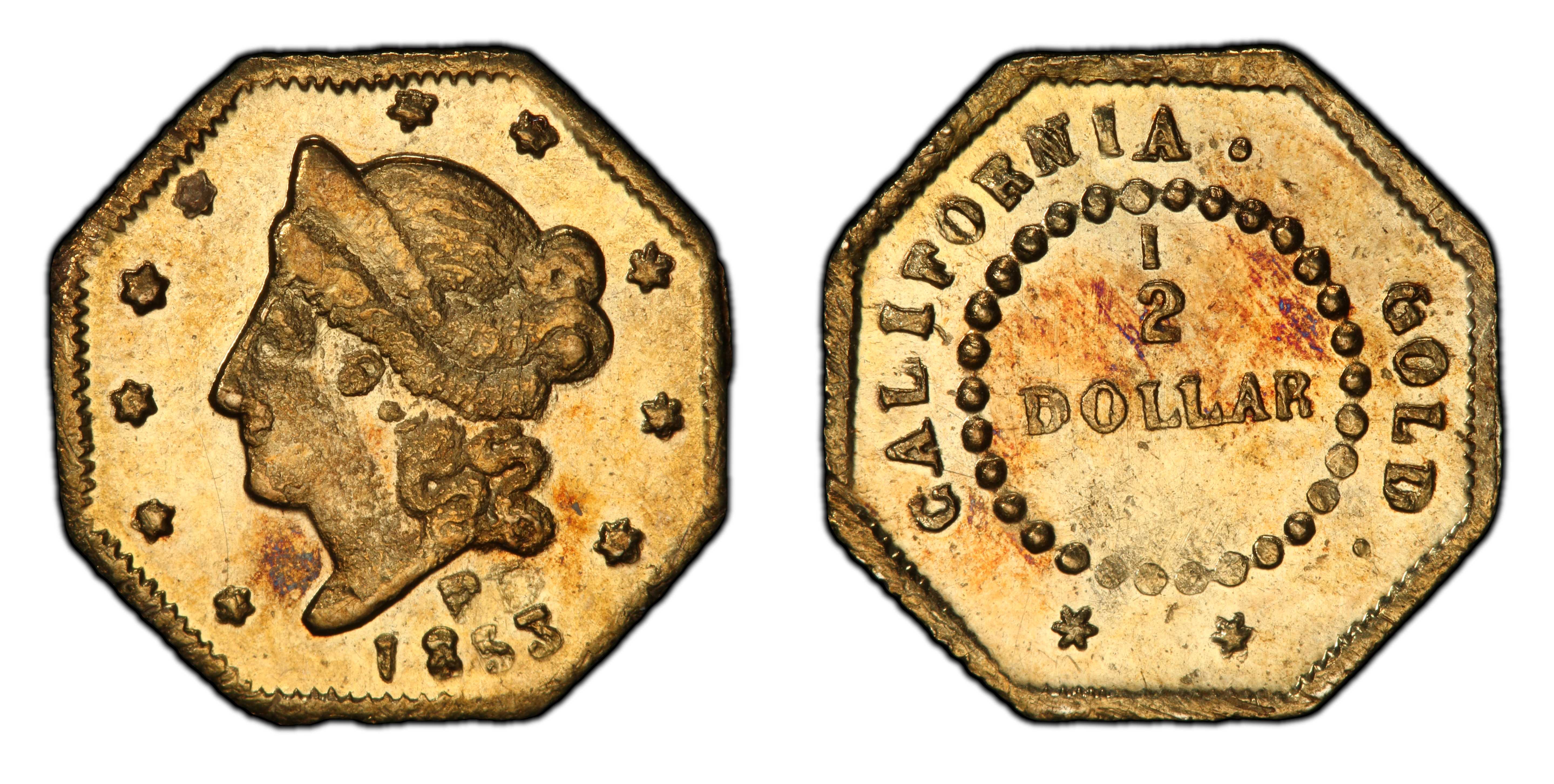
Obverse & Reverse
The 1853 Octagonal Liberty Head 50 Cents, cataloged as Breen-Gillio 304, is a quintessential artifact from the first period of California's private gold coinage. Born from the acute economic necessity of the Gold Rush, these tiny gold pieces sought to alleviate a severe shortage of small-denomination currency. In the early 1850s, the massive influx of 'Forty-Niners' and the immense wealth extracted from the gold fields created a booming economy, yet the smallest officially circulating U.S. coin was often the silver dime, and even those were scarce on the West Coast. Larger private and federal assay office gold coins worth $5 to $50 handled major transactions, but daily commerce was crippled. Settlers and miners resorted to the imprecise system of paying for small goods and services with a 'pinch' of gold dust, a method ripe for inconsistency and dispute. In response to this commercial vacuum, jewelers and metalsmiths in San Francisco began striking fractional gold coins in 25-cent, 50-cent, and one-dollar denominations starting in 1852. These 'Period One' issues (1852-1857) were genuinely intended to circulate. Though technically underweight compared to their face value in federal coinage, they were accepted in trade out of sheer necessity and convenience. The BG-304, like its contemporaries, was produced crudely, most likely by the 'hammer method,' where dies were struck by hand. This resulted in frequent weak strikes and imperfections. By late 1853, these charming miniatures also gained immense popularity as souvenirs, easily mailed back East as a tangible piece of the California dream. The opening and scaling of production at the San Francisco Mint in 1854 gradually introduced sufficient federal coinage, rendering the fractional gold pieces obsolete for commerce. Later issues ('Period Two' and 'Period Three') were produced almost exclusively as souvenirs and jewelry items.
Associated EventCalifornia Gold Rush
Reason For MintingTo provide a circulating medium for small-change transactions due to a severe shortage of federal coinage in Gold Rush-era California.
Minter HistoryThe specific minter for the BG-304 variety is unknown. Many 'Period One' fractional gold pieces were struck anonymously by various jewelers and metalsmiths located in San Francisco who possessed the requisite skills and equipment. Prominent known makers of other fractional gold varieties of the period included Antoine Louis Nouizillet, M. Deriberpe, and the firm of Frontier, Deviercy & Co., but no identifying marks or records link BG-304 to a specific maker.
Historical SignificanceThe BG-304 is a tangible link to the chaotic and innovative economy of the California Gold Rush, representing a private, localized solution to a systemic monetary failure. It demonstrates the transition from gold dust as a medium of exchange to a more standardized, albeit unofficial, coinage. As a 'Period One' issue, it is among the pieces most likely to have seen actual commercial use, making it a historically significant coin rather than just a souvenir token.
BG-304
Denomination50 Cents
Minting Period1853
Assayer/MinterUnknown
Geographic OriginSan Francisco, California
Obverse DescriptionFeatures a Liberty Head facing left, similar in style to the contemporary U.S. gold dollars. The portrait is surrounded by thirteen five-pointed stars, with the date 1853 below. A key diagnostic for the BG-304 variety is that the obverse die was heavily rusted during striking, lending a characteristic 'fuzzy' or granular texture to Liberty's portrait and the surrounding fields.
Obverse Inscription1853
Reverse DescriptionA simple design featuring the denomination '1/2' in the center, surrounded by a wreath. The legend 'CALIFORNIA GOLD' is inscribed around the wreath. The wreath is composed of two branches tied with a bow at the bottom.
Reverse InscriptionCALIFORNIA GOLD 1/2
CompositionGold
Stated Fineness Actual FinenessVaries, typically .800 to .880 fine, containing a natural alloy of silver which gives the coins a lighter color than federal issues.
EdgePlain
Unknown
Survival Estimate46-60 coins known
Rarity ScaleR-5
The BG-304 is sought after as an iconic 'Period One' octagonal half dollar. Its appeal lies in its direct connection to the commerce of the Gold Rush, its distinctive shape, and the affordability of this specific variety relative to rarer fractional issues. The known die characteristic of a rusted obverse offers a clear attribution point for specialists.
Key VarietiesThe primary issue is the regular business strike from the rusted obverse die. There are no major, intentionally created varieties from the original minting period. The reference 'California Pioneer Fractional Gold' by Breen and Gillio also identifies two related but exceptionally rare varieties, BG-304A and BG-304B, which are dated 1854 and use a different reverse die. These are considered separate, Rarity-9 issues. No later-date proof restrikes or special collector strikings of BG-304 are known to exist.
Authentication TipsGenuine BG-304s are very thin and small. A key diagnostic is the 'fuzzy' or granular texture on the obverse portrait, a result of the rusted die. This should not be confused with corrosion or environmental damage. Replicas and fakes are often thicker, have a more modern, 'soapy' look to the luster, and may feature incorrect details like a bear on the reverse. All genuine 'Period One' issues are denominated (e.g., '1/2', 'HALF DOL.'). Pieces marked 'CAL GOLD' without a denomination are typically later souvenirs.
Shopping ConsiderationsA premium quality example of BG-304 for its grade will show a relatively sharp strike for the issue, though some weakness is expected due to the crude manufacturing process. Look for pleasing, original surfaces with some remaining luster. The 'fuzzy' texture from the rusted die is characteristic and should be present, but severe granularity that obscures all detail is less desirable. Many specimens are weakly struck on the stars or the wreath. Avoid coins that have been harshly cleaned, which strips the original patina and imparts hairline scratches. Also, check for evidence of having been mounted in jewelry, such as solder marks or rim damage.
A coin's grade is its condition, rated on a 1-70 scale. For rare coins, this is the most critical factor in determining value, as a tiny difference in preservation can mean a huge difference in price.
Relevant Grade TypesAll original 1853 BG-304 examples are business strikes intended for circulation and are found in Circulated grades (AG-3 to AU-58) and Mint State grades (MS-60 to 70). No proofs were struck during the original period of issue, and there are no known later-date proof restrikes of this specific variety. While many examples survived in high grades because they were kept as souvenirs, circulated specimens that saw genuine commercial use are also extant and historically important.
Mint State CharacteristicsAn uncirculated BG-304 typically exhibits a soft, satiny luster, often with a slightly prooflike or reflective field. The strike is a key determinant of quality; many are softly struck, especially in the center of the obverse and on the wreath details of the reverse. A well-struck example with full definition on Liberty's hair and the individual leaves of the wreath is highly desirable. The characteristic 'fuzzy' texture from the rusted die should be evident but not overwhelming. Small planchet flaws or adjustment marks are not uncommon given the primitive minting technology.
Circulated Wear PatternsWear first appears on the highest points of the design. On the obverse, this includes Liberty's cheek, the hair above her eye, and the coronet. On the reverse, the high points of the wreath and the fraction '1/2' will show the first signs of smoothing. In lower grades (Fine and below), the stars, date, and legends will begin to merge with the fields.
Key Factors For ValueFor the BG-304, value is primarily driven by grade and surface quality. An example with original, uncleaned surfaces and some remaining luster will command a significant premium over a cleaned or damaged coin of the same grade. Strike quality is paramount; a sharply struck coin is always preferred. Eye appeal, including attractive original reddish or greenish-gold toning from the natural silver alloy, adds value. Certification by a major grading service (PCGS or NGC) is standard for this series, and a CAC sticker indicating premium quality for the grade will bring a strong premium.
PCGS Price Guide
| Grade | Price | Population |
|---|---|---|
| 45 | $275.00 | N/A |
| 45+ | $300.00 | N/A |
| 50 | $350.00 | 2 |
| 50+ | $360.00 | N/A |
| 53 | $375.00 | 4 |
| 53+ | $380.00 | N/A |
| 55 | $400.00 | 8 |
| 55+ | $410.00 | N/A |
| 58 | $425.00 | 9 |
| 58+ | $450.00 | N/A |
| 60 | $470.00 | N/A |
| 61 | $500.00 | 4 |
| 62 | $525.00 | 16 |
| 62+ | $600.00 | N/A |
| 63 | $800.00 | 14 |
| 63+ | $975.00 | N/A |
| 64 | $2,000.00 | 5 |
| 66 | N/A | N/A |