1853 G25C BG-208 (Regular Strike)
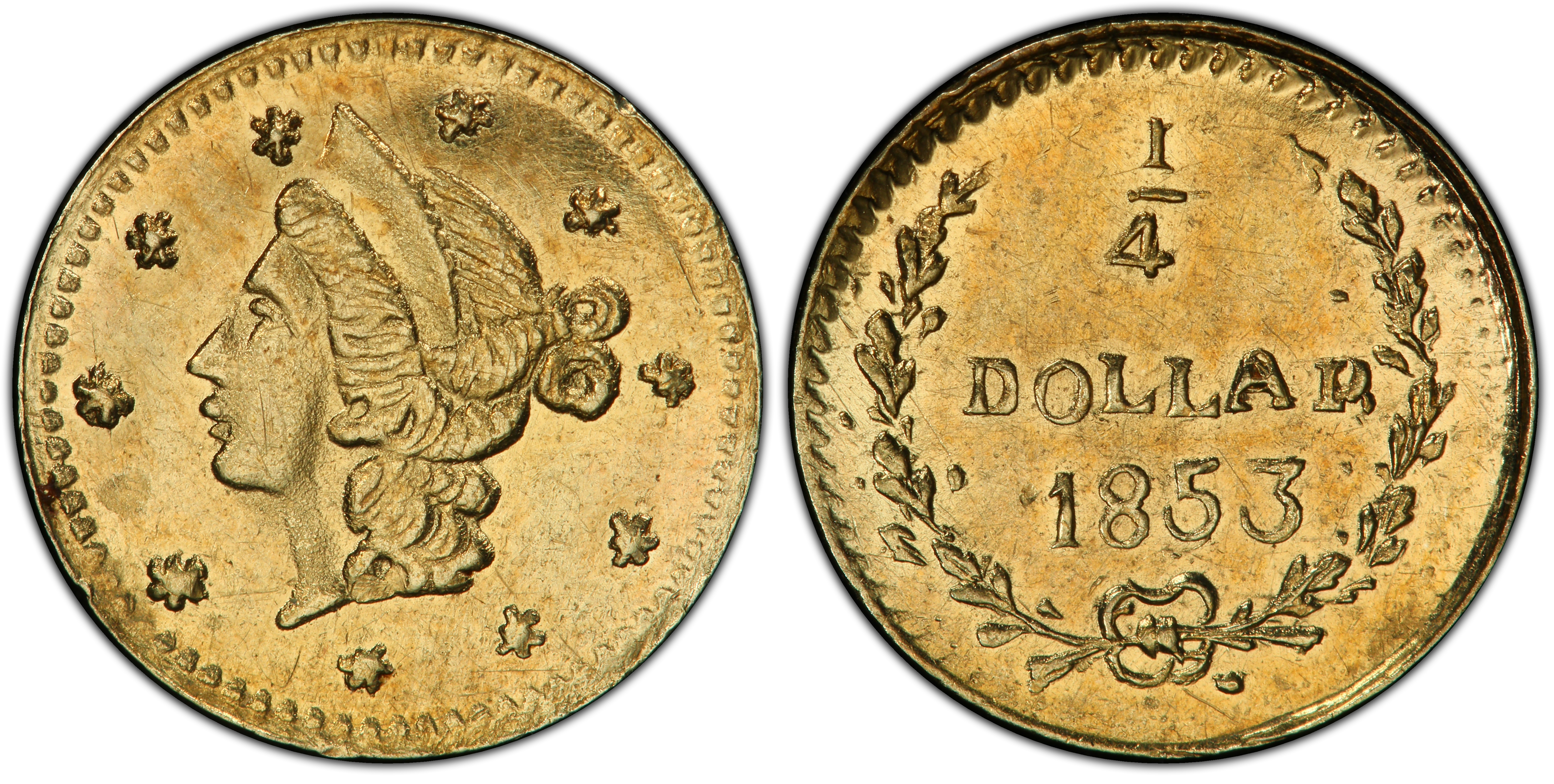
Obverse & Reverse
The 1853 G25C BG-208 is a tangible relic from the most frantic and formative era of the California Gold Rush. Following the discovery of gold at Sutter's Mill in 1848, a massive influx of over 300,000 people descended upon California, transforming it from a sparsely populated territory into a burgeoning economic powerhouse. This explosive growth created an acute crisis in commerce: a severe shortage of circulating small-denomination coinage. Gold dust, weighed in 'pinches,' became a clumsy and often inaccurate medium of exchange for everyday transactions. While several private assayers like Moffat & Co. and Wass, Molitor & Co. struck large-denomination gold coins ($5 to $50), these were impractical for buying a drink, a meal, or other minor necessities. The United States government was slow to respond; the San Francisco Mint would not be fully operational until 1854, and even then, its initial output of small coins was woefully inadequate. Into this numismatic void stepped a number of San Francisco jewelers and metalsmiths who, beginning in 1852, began striking their own fractional gold coins in 25-cent, 50-cent, and dollar denominations. These issues are categorized by numismatists into three periods. The BG-208 is a 'Period One' (1852-1857) issue, a critical distinction signifying that it was produced with the genuine intent to circulate and alleviate the coin shortage. Unlike the later 'Period Two' and 'Period Three' issues, which were often underweight and primarily made as souvenirs, Period One pieces were generally made of good quality gold and were accepted, albeit unofficially, in local trade. The BG-208 variety, struck in 1853, represents the peak of this necessity-driven coinage. The 'G' on the reverse remains an enigma, attributed by some researchers to Giacomo Gelli, a known San Francisco jeweler of the era, though definitive proof is lacking for these early issues. These tiny coins were typically produced by the hammer method, where dies were struck by hand, resulting in significant variations in strike quality. Their small size made them easy to lose and difficult to handle, which ultimately limited their practicality. However, their existence was essential for the day-to-day functioning of California's gold-based economy until federal coinage became plentiful. Today, the BG-208 is recognized as an extreme rarity, a survivor of a chaotic period that represents the ingenuity and ad-hoc solutions that defined the American West.
Associated EventCalifornia Gold Rush
Reason For MintingTo alleviate a severe shortage of small-denomination coinage for daily commerce in Gold Rush-era San Francisco.
Minter HistoryThe minter of the BG-208 is identified only by the initial 'G' on the reverse. This is often speculatively attributed to Giacomo Gelli, an Italian jeweler and watchmaker located on Montgomery Street in San Francisco during the 1850s. Gelli is more concretely associated with later souvenir issues, and while the attribution for this Period One piece is plausible, it remains unconfirmed by primary source documents. Lacking definitive records, numismatic scholarship refers to the minter simply as 'G'.
Historical SignificanceAs a 'Period One' issue, this coin is not merely a token but a piece of functional, privately issued money created to solve a critical economic problem. It stands as a testament to the private sector's response to the failure of government infrastructure to keep pace with the rapid expansion of the American frontier. Its extreme rarity today underscores the heavy use and high attrition rate of these essential but ephemeral coins.
N/A
Denomination25 Cents
Minting Period1853
Assayer/MinterUnknown, attributed only as 'G'
Geographic OriginSan Francisco, California
Obverse DescriptionA Liberty Head, facing left, with hair tied in a bun. The portrait is stylistically similar to the contemporary federal gold dollars of Christian Gobrecht. The field is surrounded by thirteen six-pointed stars.
Obverse Inscription Reverse DescriptionThe denomination '1/4' and the word 'DOLLAR' appear within a simple wreath of two branches tied by a bow at the bottom. Below the bow is the date '1853'. The minter's initial 'G' is located between the upper tips of the wreath branches.
Reverse InscriptionG 1/4 DOLLAR 1853
CompositionGold
Stated Fineness Actual FinenessTypically .880 to .900 fine, consistent with native California gold which contained naturally occurring silver.
Weight0.25 grams
Diameter9.50 mm
EdgePlain
Unknown; extremely small.
Survival EstimateFewer than 10 known.
Rarity ScaleR-8 (3-4 known) to High R-7 (5-8 known)
The 1853 G25C BG-208 is a quintessential prize for the advanced collector of pioneer gold. Its appeal is multi-faceted: it is a genuine 'Period One' circulating issue, it is a product of the legendary California Gold Rush, it is of the highest rarity, and it remains an unsolved mystery regarding its minter. Acquiring a BG-208 is considered a major numismatic achievement.
Key VarietiesThe BG-208 is itself a distinct die variety and no major sub-varieties are known from the original minting period. No known patterns, trial pieces, or later-date restrikes exist for this specific variety.
Authentication TipsGenuine Period One fractionals like the BG-208 must have a stated denomination (e.g., 'DOLLAR'). The vast majority of fakes and modern souvenirs lack this. Replicas often feature a bear on the reverse, a design element never used on authentic 19th-century issues. The strike on genuine pieces is often uneven or weak in spots due to manual hammer striking; a perfectly struck, sharply detailed coin should be viewed with suspicion. The planchets are typically very thin. Fakes are often thicker and may show a coppery core where plating has worn away. The style of the 'G' and the wreath on BG-208 should be carefully compared to known genuine examples.
Shopping ConsiderationsFor a coin of this rarity, any example that is not seriously damaged is a major find. A premium quality specimen would be one free of jewelry mounting, holes, or harsh cleaning. Look for honest, even wear and some remaining original luster in the protected areas around the stars and legends. Given the production method, a relatively sharp strike on the central Liberty Head and the date is highly desirable and commands a significant premium. The surfaces of these small gold coins are very soft and prone to marks; a coin with minimal distracting abrasions is a prize. Certification by PCGS or NGC is virtually mandatory for a coin of this caliber to ensure authenticity and accurate grading.
A coin's grade is its condition, rated on a 1-70 scale. For rare coins, this is the most critical factor in determining value, as a tiny difference in preservation can mean a huge difference in price.
Relevant Grade TypesAll original BG-208 examples are business strikes, produced for circulation. They are found in Circulated grades (AG-3 to AU-58) and, very rarely, in Mint State (MS-60 to 70). No Proof examples were struck during the original period of issue, and no later-date Proof restrikes are known to exist for this variety.
Mint State CharacteristicsAn uncirculated BG-208 is exceptionally rare. Quality is defined by the strength of the strike; a full strike would show clear definition in Liberty's hair details and the leaves of the wreath. Luster is typically of a soft, satiny texture rather than a deep, frosty glow. Due to the crude manufacturing and storage methods, even Mint State examples are expected to have some light contact marks or planchet imperfections. A well-centered strike is also a key attribute of quality.
Circulated Wear PatternsWear first appears on the highest points of the design. On the obverse, this includes Liberty's cheek, the hair above the ear, and the eyebrow. On the reverse, the high points are the bow of the wreath and the fraction '1/4'. In lower grades (Fine and below), the stars on the obverse will begin to merge with the field, and the date and legends will become weak but should still be identifiable.
Key Factors For ValueRarity is the primary driver of value. Given that all known examples are rare, the key differentiators are grade and eye appeal. An example with minimal marks, no evidence of cleaning or tooling, and a sharp strike will command a massive premium over a lower-grade or impaired specimen. Coins with attractive, original reddish-gold toning that has developed over time are highly prized. A CAC sticker on a certified example would provide a further significant premium, indicating top quality for the assigned grade.
PCGS Price Guide
| Grade | Price | Population |
|---|---|---|
| 55 | $3,500.00 | 2 |
| 55+ | $3,750.00 | N/A |
| 58 | $4,100.00 | 3 |
| 58+ | $4,500.00 | N/A |
| 60 | $5,500.00 | N/A |
| 61 | $6,000.00 | N/A |
| 62 | $7,000.00 | 5 |
| 62+ | $7,500.00 | N/A |
| 63 | $8,250.00 | N/A |
| 63+ | $9,500.00 | N/A |
| 64 | $12,000.00 | 1 |