1855 G$1 BG-533 (Regular Strike)
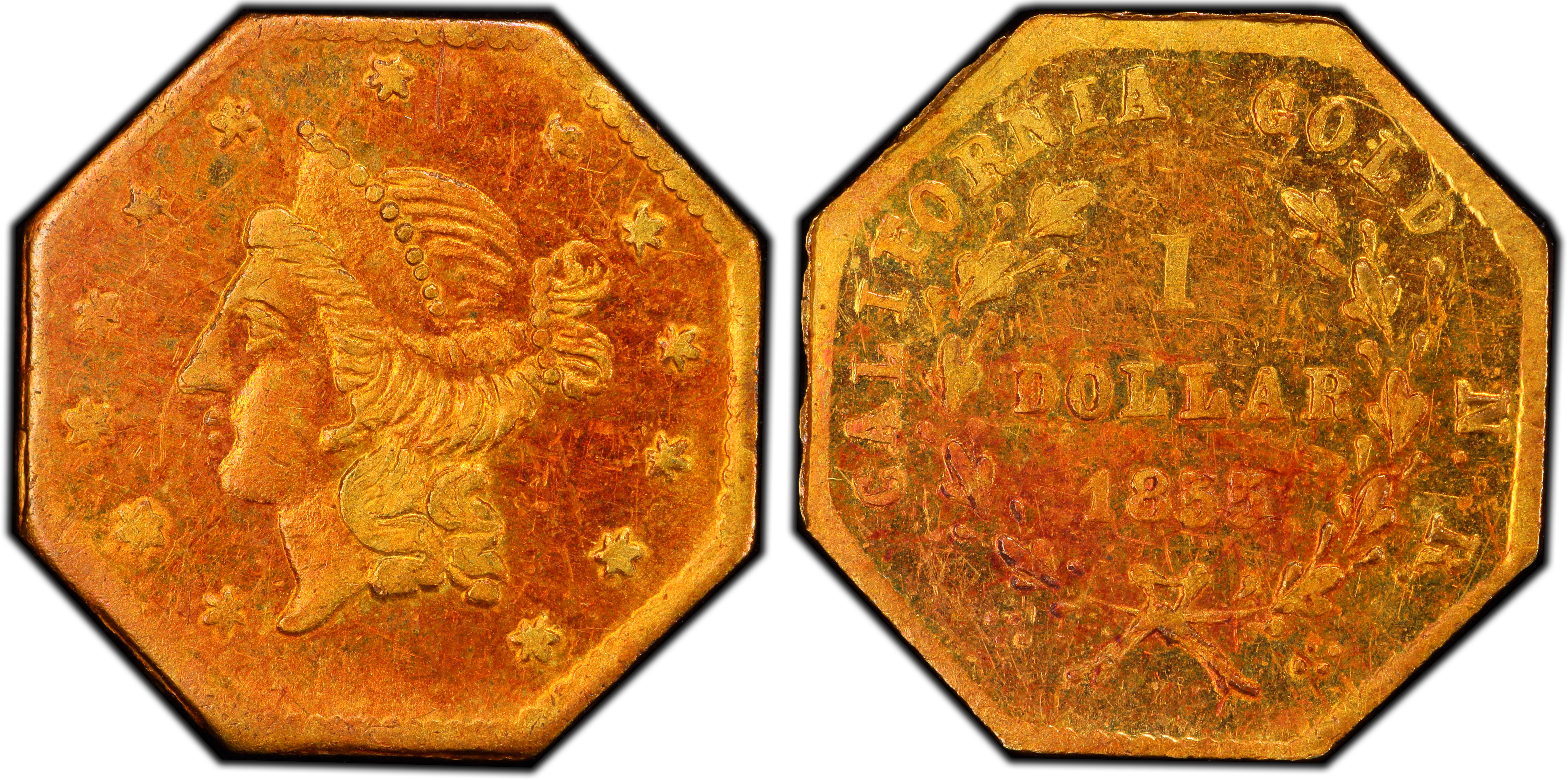
Obverse & Reverse
The 1855 Octagonal Gold Dollar, cataloged as BG-533 in the authoritative Breen-Gillio reference, stands as a tangible artifact of the socio-economic turmoil and ingenuity of the California Gold Rush. Following the discovery of gold at Sutter's Mill in 1848, a massive influx of prospectors and merchants descended upon California, creating a vibrant but chaotic economy. While gold dust was plentiful, official United States coinage was exceptionally scarce, creating a severe impediment to daily commerce. Transactions were often conducted with pinches of gold dust, a notoriously inaccurate and cumbersome method, or with a confusing array of foreign coins. To fill this critical void, private jewelers and metallurgists in San Francisco began striking their own small-denomination coins in 1852. These pieces, known as 'California Fractional Gold,' were issued in quarter dollar, half dollar, and dollar denominations in both round and octagonal shapes. The BG-533 is a prime example of a 'Period One' (1852-1857) issue, a class of fractional gold struck with the genuine intent of serving as a circulating medium of exchange. Unlike the later 'Period Two' and 'Period Three' issues, which were often underweight and produced primarily as souvenirs, Period One pieces were generally of higher gold content and were vital to the region's economy until the San Francisco Mint began producing sufficient quantities of federal small-denomination coins in the mid-1850s. The octagonal shape was not merely a novelty; it helped distinguish these private issues from the round federal gold dollars, a subtle nod to their unofficial yet necessary status. The production of these tiny coins was a testament to the period's resourcefulness, but their small size and the variable quality of their manufacture meant they were often lost or damaged, contributing to their present-day rarity.
Associated EventCalifornia Gold Rush
Reason For MintingTo alleviate a severe shortage of small-denomination coinage for everyday commercial transactions in Gold Rush-era California.
Minter HistoryGaime, Guillemot & Co. was a firm of French jewelers and watchmakers operating in San Francisco during the 1850s. Like several other entrepreneurial French artisans in the city, they recognized the critical need for small change and leveraged their metallurgical skills to produce fractional gold pieces. These 'jeweler's issues' were an integral part of the Period One coinage landscape. While their primary business was watches and jewelry, their numismatic output, though not as extensive as some other private minters, filled a crucial economic niche. Their coins are noted for their distinctive style, often featuring a unique rendition of the Liberty head, which distinguishes their work from that of other contemporary private minters.
Historical SignificanceThe BG-533 is a historically significant representation of private enterprise stepping in to fulfill a core governmental function—the creation of currency—during a period of rapid and chaotic expansion. It embodies the economic realities of the American West before federal institutions were fully established and serves as a key example of the 'Period One' issues that actually circulated as money.
N/A
Denomination$1
Minting Period1855
Assayer/MinterGaime, Guillemot & Co.
Geographic OriginSan Francisco, California
Obverse DescriptionA slightly crude but charming depiction of a Liberty Head, facing left. The portrait is surrounded by thirteen five-pointed stars, representing the original colonies. The date '1855' is prominently displayed below the bust.
Obverse Inscription1855
Reverse DescriptionThe reverse features the denomination '1 DOLLAR' within a wreath of two olive branches tied with a bow at the bottom. The legend 'CALIFORNIA GOLD' is inscribed above the wreath, following the octagonal contour of the coin.
Reverse InscriptionCALIFORNIA GOLD 1 DOLLAR
CompositionGold
Stated Fineness Actual FinenessVariable, but generally of a higher purity for Period One issues, often from locally sourced gold which contained natural silver alloys.
Weight1.10 grams
Diameter12.00 mm
EdgePlain
Unknown
Survival EstimateApproximately 46 to 60 coins known to exist.
Rarity ScaleR-5
The BG-533 appeals to collectors of Territorial gold, Gold Rush history, and early private coinage. Its octagonal shape, 1855 date, and status as a genuine 'Period One' circulating issue make it highly desirable. The crude yet historic aesthetic offers a direct connection to the rugged conditions of 1850s San Francisco.
Key VarietiesThe primary variety noted by specialists is 'Die State II,' which is characterized by specific die cracks, most notably a bold crack running through the '5' in the date and resulting in the appearance of separated lips on the Liberty portrait. No later-date restrikes or proof issues are known to exist for this specific variety.
Authentication TipsGenuine BG-533 examples have a distinct strike character. They are often weakly struck in areas, a feature not typically seen on modern replicas. The surface fabric should show signs of originality, not a modern, overly uniform, or cast-like texture. The lettering style and the specific shape of the Liberty portrait are key diagnostics that should be compared to known genuine examples. Modern counterfeits are plentiful in the fractional gold series; many are gold-plated base metal and can be detected by weight and specific gravity tests. Any piece that lacks a denomination (e.g., just says 'CALIFORNIA GOLD' without 'DOLLAR' or a fraction) is highly suspect and likely a later souvenir token.
Shopping ConsiderationsWhen acquiring an 1855 BG-533, a potential buyer should prioritize surface originality over a high numerical grade. A choice, problem-free AU example with original 'skin' is often more desirable than a harshly cleaned or polished Mint State specimen. Look for a sharp strike on the date and the word 'DOLLAR'. Weakness is common, but well-defined examples command a premium. Check for common problems such as tooling in the fields to hide marks, smoothing, or evidence of having been mounted in jewelry, which was a common fate for these small gold pieces. Attractive, original reddish-gold or greenish-gold toning is highly prized. Given the prevalence of fakes, purchasing a coin certified by a major third-party grading service (PCGS or NGC) is strongly recommended.
A coin's grade is its condition, rated on a 1-70 scale. For rare coins, this is the most critical factor in determining value, as a tiny difference in preservation can mean a huge difference in price.
Relevant Grade TypesOriginal BG-533 dollars were struck as business strikes for circulation and are found in Circulated (1-58) and Mint State (MS, 60-70) grades. The vast majority of surviving examples are circulated. No Proof (PR/PF) examples were struck during the original minting period, and no later-date Proof restrikes are known.
Mint State CharacteristicsUncirculated examples of BG-533 typically exhibit a soft, satiny luster rather than a hard, frosty one. The strike is a key determinant of quality; many were weakly struck, particularly on the highest points of Liberty's hair and the leaves of the wreath. A well-struck MS example with full details is exceptionally rare. Small planchet flaws or adjustment marks are not uncommon and should be assessed for their impact on eye appeal. Due to the soft nature of the gold, even high-grade specimens often show minor contact marks from handling or storage with other coins.
Circulated Wear PatternsWear first appears on the highest points of the design: Liberty's cheek, the hair above her eye, and the coronet. On the reverse, the high points of the wreath's leaves and the bow will show the first signs of friction. On moderately circulated examples (VF-XF), the individual hair strands will begin to merge, and the smaller details of the wreath will soften. In lower grades, the stars on the obverse and the letters in the legends will become faint and start to merge with the fields.
Key Factors For ValueThe primary driver of value for an 1855 BG-533 is problem-free originality. An example with original surfaces and attractive eye appeal will always command a significant premium over a cleaned, polished, or damaged coin of the same grade. Strike quality is the next most important factor; a sharply struck coin is rare and highly sought after. The specific die state can also influence value among specialists. Finally, for certified coins, a sticker from CAC (Certified Acceptance Corporation) indicating premium quality for the grade will add a substantial premium, as it confirms the coin's superior surface quality and eye appeal.
PCGS Price Guide
| Grade | Price | Population |
|---|---|---|
| 35 | $575.00 | 1 |
| 40 | $625.00 | 2 |
| 45 | $640.00 | 10 |
| 45+ | $650.00 | N/A |
| 50 | $675.00 | 8 |
| 50+ | $700.00 | N/A |
| 53 | $745.00 | 10 |
| 53+ | $765.00 | N/A |
| 55 | $785.00 | 28 |
| 55+ | $825.00 | N/A |
| 58 | $900.00 | 33 |
| 58+ | $950.00 | N/A |
| 60 | $1,000.00 | 2 |
| 61 | $1,100.00 | 9 |
| 62 | $1,350.00 | 16 |
| 62+ | $1,500.00 | N/A |
| 63 | $2,750.00 | 6 |
| 63+ | $3,000.00 | N/A |
| 64 | $3,750.00 | N/A |
| 64+ | $4,250.00 | N/A |
| 65 | $5,000.00 | N/A |
| 65+ | $6,000.00 | N/A |
| 66 | $7,750.00 | 1 |