1869 25C BG-712 (Regular Strike)
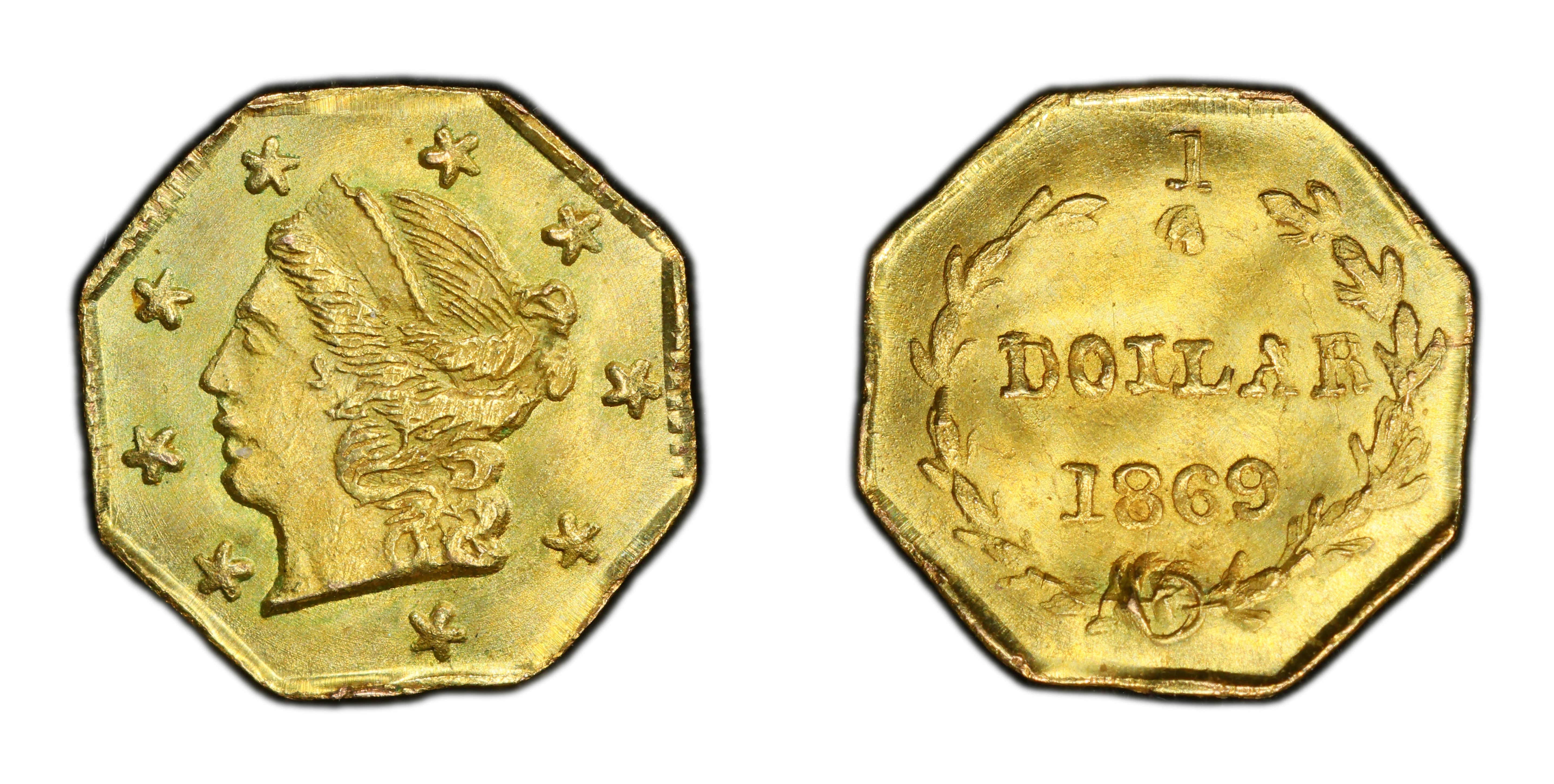
Obverse & Reverse
The 1869 BG-712 25 Cent piece is a quintessential example of 'Period Two' California Fractional Gold. The initial wave of fractional gold, struck from 1852 to 1857, arose from a genuine and severe shortage of small denomination coinage in Gold Rush California. Gold dust was an impractical medium for daily transactions, and the output of the new San Francisco Mint had yet to fully saturate the regional economy. Enterprising jewelers, many of French origin, filled this void by privately minting quarter dollar, half dollar, and dollar coins from native gold. These 'Period One' issues were generally of good weight and intended for circulation, gaining a degree of public acceptance. However, by the late 1850s, the pressing need for these tiny coins had subsided as official U.S. coinage became plentiful. The nature of fractional gold production subsequently shifted. The pieces struck from 1859 to 1882, classified as 'Period Two,' were primarily created not for circulation, but as souvenirs and keepsakes for tourists, locals, and those wishing to send a small, tangible piece of the 'Golden State' to relatives back East. The BG-712, dated 1869, falls squarely into this era. Though the Coinage Act of 1864 expressly forbade private coinage, enforcement in the West was lax until the early 1880s, allowing numerous jewelers in San Francisco to continue production. These Period Two issues are often characterized by more varied designs, lighter weights, and occasionally lower fineness compared to their Period One predecessors. Their value was primarily in their novelty and material, not their function as currency. The very existence of BG-712 is a testament to the enduring romanticism of the Gold Rush and the clever marketing of San Francisco's artisans who capitalized on it long after the initial fever had passed. Today, these pieces are not just historical footnotes; they are cherished collectibles that represent the fascinating transition of a region from a chaotic frontier economy to a burgeoning commercial and cultural center.
Associated EventPost-Gold Rush California Commerce
Reason For MintingPrimarily produced as a souvenir or novelty item for the jewelry trade rather than for monetary circulation.
Minter HistoryThe specific minter of the BG-712 die pair is not definitively known, a common trait for many Period Two issues where makers often remained anonymous. However, it was almost certainly struck by one of the prominent San Francisco manufacturing jewelers active in the trade during this period, such as the firms of Robert B. Gray & Co. or the Levison Brothers. These firms had the skill and equipment for die-sinking and coining, producing a wide array of tokens, medals, and fractional gold pieces for sale as keepsakes.
Historical SignificanceThe BG-712 represents the evolution of California Fractional Gold from a necessary circulating medium to a popular souvenir. It highlights the continued economic and cultural impact of the Gold Rush on San Francisco and the ongoing demand for tangible mementos of the era, even after the original economic necessity for private coinage had vanished. Its production during a period of legal ambiguity also speaks to the independent character of commerce on the American frontier.
BG-712
Denomination25C
Minting Period1869
Assayer/MinterUnknown San Francisco Jeweler
Geographic OriginSan Francisco, California
Obverse DescriptionOctagonal planchet. Features a Liberty Head design, facing left, inspired by the contemporary U.S. gold coinage of James B. Longacre. The portrait is surrounded by thirteen six-pointed stars, with the date '1869' positioned below the bust truncation.
Obverse Inscription1869
Reverse DescriptionOctagonal planchet. The denomination '1/4' appears in the center, with 'DOLLAR' inscribed directly below it. The entire central inscription is enclosed within a wreath of two olive branches, tied with a bow at the bottom.
Reverse Inscription1/4 DOLLAR
CompositionGold
Stated Fineness Actual Fineness EdgePlain
Unknown
Survival Estimate76-200
Rarity ScaleR-4+
The BG-712 is sought after for its classic octagonal shape, which evokes the iconic larger-denomination territorial 'slugs,' and its status as a scarce Period Two variety. Its appeal lies in its affordability relative to Period One issues, historical connection to the Gold Rush romance, and the challenge of collecting the many Breen-Gillio varieties. High-grade, lustrous examples possess a distinct jewel-like quality.
Key VarietiesThe primary variety is the BG-712 regular business strike. No known proof strikings or major die variations from the original period of issue have been cataloged. Unlike some larger U.S. gold series, there are no known official restrikes. All genuine BG-712 examples are considered vintage private issues from the 1869-era.
Authentication TipsAuthentic pieces must have the word 'DOLLAR' on the reverse; many modern replicas or tokens will say 'CAL GOLD' or have a bear motif, which is not found on genuine period issues. The strike is often uneven, with some softness on the high points (Liberty's hair, wreath leaves) and occasionally slightly irregular planchets, which is characteristic of private minting methods. Modern fakes are often sharply and uniformly struck, with tool marks or a casting granularity not seen on originals. Weight and specific gravity tests are crucial, as many fakes are gold-plated base metal. Reference the Breen-Gillio guide for specific die markers.
Shopping ConsiderationsA premium quality example for its grade will exhibit strong luster, minimal distracting marks, and a sharp strike for the variety, particularly on the date and Liberty's coronet. Surfaces should be original and free from cleaning, which will often manifest as fine, parallel hairlines. The natural gold color, sometimes with a touch of greenish or reddish toning from original alloy impurities, is highly desirable. Check for planchet flaws or laminations, which are common but should not be severe. Avoid examples that have been used in jewelry, evidenced by solder marks or heavy rim damage.
A coin's grade is its condition, rated on a 1-70 scale. For rare coins, this is the most critical factor in determining value, as a tiny difference in preservation can mean a huge difference in price.
Relevant Grade TypesAll original 1869 BG-712 pieces were produced as business strikes, intended for sale as souvenirs. They are found in Circulated grades (About Good-3 to About Uncirculated-58) and, more commonly, in Mint State grades (MS-60 to MS-70), as many were saved as keepsakes. There were no Proof (PR/PF) examples struck during the original minting period, and no later-date Proof restrikes are known to exist.
Mint State CharacteristicsUncirculated examples of BG-712 are characterized by their mint luster, which can range from satiny to semi-prooflike. The strike can be inconsistent; a well-struck example will show clear details in Liberty's hair curls and the individual leaves of the reverse wreath, but some central softness is common for the issue. Due to the softness of the gold, even high-grade specimens may exhibit tiny planchet marks or ticks from handling and storage over 150 years. A coin with exceptional luster and minimal contact marks is considered a premium gem.
Circulated Wear PatternsOn circulated examples, wear first appears on the highest points of the design. On the obverse, this includes Liberty's cheek, the hair above the ear, and the coronet. On the reverse, the high points of the wreath leaves and the bow will show initial friction and flattening. In lower grades (VF and below), the stars on the obverse and the letters in 'DOLLAR' will start to become weak and merge with the fields.
Key Factors For ValueThe primary drivers of value are grade and surface preservation. An example with original, lustrous surfaces will command a significant premium over one that has been cleaned or polished. Sharpness of strike is also key; coins with a bold strike on the portrait and wreath are more desirable. Eye appeal, including attractive natural toning and a lack of distracting marks or planchet flaws, is paramount. Certification by a top-tier grading service (PCGS or NGC) is standard, and a CAC sticker for this issue indicates premium quality for the grade and will typically result in a higher market value.
PCGS Price Guide
| Grade | Price | Population |
|---|---|---|
| 62 | $300.00 | 6 |
| 62+ | $315.00 | N/A |
| 63 | $350.00 | 11 |
| 63+ | $375.00 | N/A |
| 64 | $500.00 | 16 |
| 64+ | $650.00 | N/A |
| 65 | $900.00 | 18 |
| 65+ | $1,050.00 | N/A |
| 66 | $1,350.00 | 11 |
| 66+ | $1,750.00 | N/A |
| 67 | $3,000.00 | 2 |