1853 G$1 BG-503 Eagle (Regular Strike)
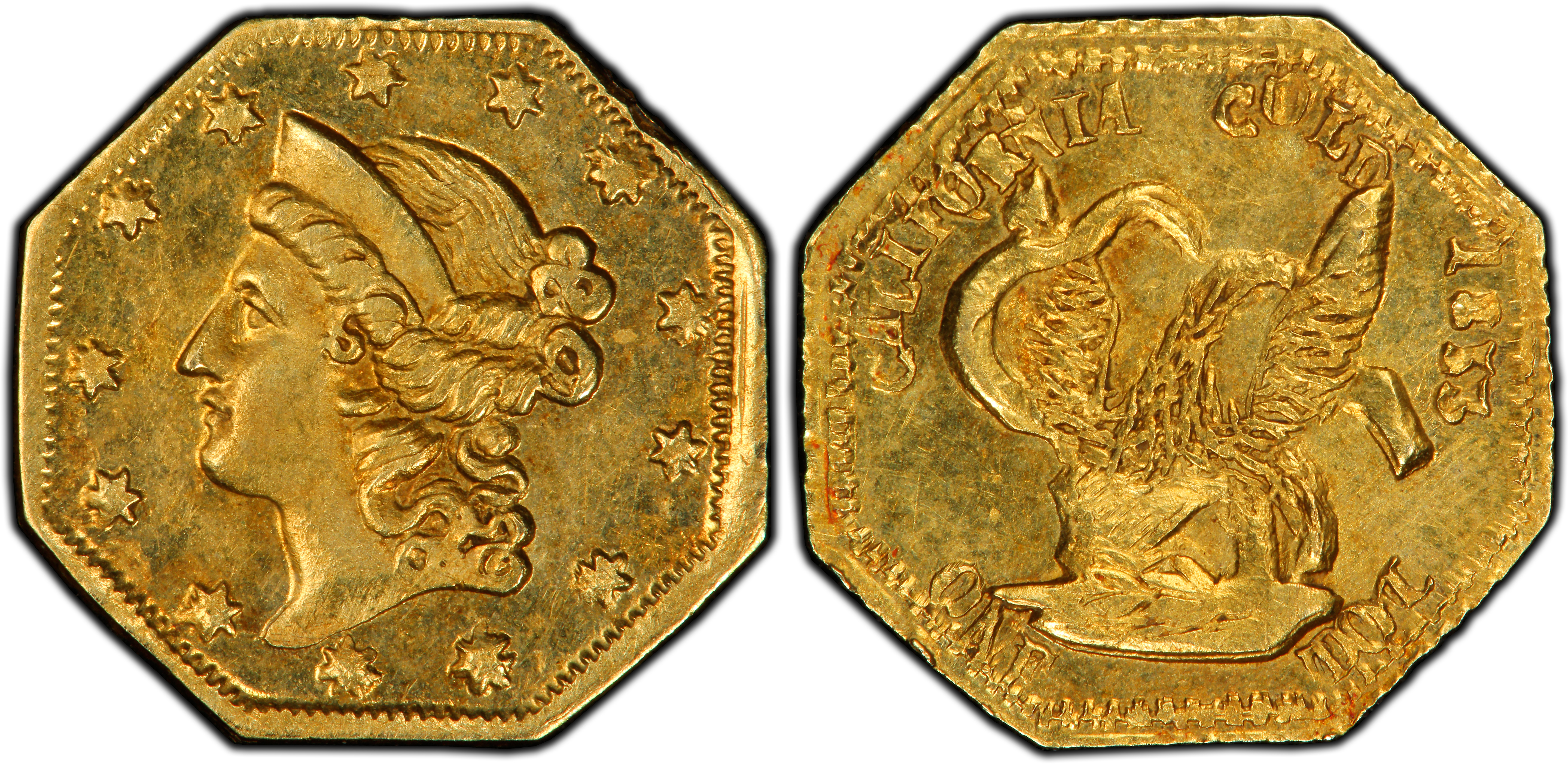
Obverse & Reverse
The 1853 BG-503 One Dollar piece emerges from the chaotic, formative years of the California Gold Rush, a period defined by immense wealth in gold dust but a crippling scarcity of official circulating coinage. Following the discovery of gold in 1848, hundreds of thousands of prospectors and merchants flooded into California, creating a vibrant but monetarily starved economy. Daily transactions were often conducted with pinches of gold dust, a cumbersome and inaccurate system. While larger private assayers like Moffat & Co. and Wass, Molitor & Co. produced substantial $5 to $50 gold coins, a dire need for small change persisted. The federal government was slow to respond; the San Francisco Mint would not open until 1854, and even then, its initial output of small-denomination coins was woefully inadequate. Into this void stepped a number of manufacturing jewelers, primarily French immigrants in San Francisco, who began striking their own fractional gold coins in quarter-dollar, half-dollar, and dollar denominations starting in 1852. These 'Period One' issues, including the BG-503, were created with the genuine intent of facilitating commerce. Struck by the firm of Frontier, Deviercy & Co., the BG-503 was produced using primitive methods, likely a screw press or even a hammer-and-anvil technique, resulting in coins of varying strike quality. These tiny, often underweight gold pieces circulated for a time, but their small size made them easy to lose, and they were never officially accepted by banks. By the mid-1850s, as the San Francisco Mint's production increased, the practical need for fractional gold waned, and they transitioned from instruments of commerce to popular souvenirs and keepsakes. The BG-503 is numismatically famous for its prominent and amusing reverse die blunder, where the engraver spelled 'GOLD' as 'COLD.' This error, combined with its extreme rarity, elevates it from a mere economic artifact to a celebrated numismatic treasure, offering a direct and tangible link to the ingenuity and ad-hoc solutions that defined Gold Rush-era San Francisco.
Associated EventCalifornia Gold Rush
Reason For MintingTo alleviate a severe shortage of small-denomination circulating coinage for daily commercial transactions in Gold Rush-era San Francisco.
Minter HistoryFrontier, Deviercy & Co. was a partnership of Pierre Frontier and Eugene Deviercy, San Francisco jewelers and engravers active in the production of 'Period One' California Fractional Gold. Like many such firms, they were likely French immigrants who applied their trade skills to meet the region's desperate need for coinage. Their initials, 'F.D.', are sometimes found on other fractional gold varieties. The firm was a key contributor to the small-denomination private coinage of 1853 before the establishment of the federal branch mint in San Francisco began to supplant their necessity.
Historical SignificanceThe BG-503 is a prime example of 'Period One' fractional gold, struck with the intent to circulate and fill a critical economic need. Its existence highlights the federal government's failure to provide adequate coinage for its rapidly expanding western territories. The famous 'COLD' error provides a charming glimpse into the often-crude manufacturing processes of these private minters. As one of the great rarities in the series, it stands as a testament to the ephemeral nature of these privately issued coins and the vibrant, makeshift economy of the Gold Rush.
N/A
Denomination$1
Minting Period1853
Assayer/MinterFrontier, Deviercy & Co.
Geographic OriginSan Francisco, California
Obverse DescriptionA Liberty Head, facing left, with 'LIBERTY' inscribed on her coronet. The portrait is encircled by 13 six-pointed stars, representing the original colonies. The date, 1853, is positioned below the bust.
Obverse InscriptionLIBERTY 1853
Reverse DescriptionAn eagle with outstretched wings, clutching an olive branch and arrows in its talons. The eagle is surrounded by the inscription 'CALIFORNIA COLD' above and the denomination 'ONE DOL.' below. This is an octagonal coin.
Reverse InscriptionCALIFORNIA COLD ONE DOL.
CompositionGold
Stated Fineness Actual FinenessVaries, typically 14k to 22k for Period One issues.
Weight0.97 grams
Diameter12.70 mm
EdgePlain
Unknown
Survival EstimateFewer than 10 known
Rarity ScaleR-7 (Very Rare)
The BG-503 is a legendary rarity in American numismatics, sought after for its direct connection to the Gold Rush, its status as a 'Period One' issue made for circulation, and especially its famous and unambiguous 'CALIFORNIA COLD' spelling error. Its octagonal shape and extreme rarity make it a centerpiece in any advanced collection of territorial or private gold.
Key VarietiesThe primary variety is the regular strike with the 'COLD' error. No other significant varieties from the original minting period are known. No known restrikes or patterns exist for this specific Breen-Gillio number.
Authentication TipsAuthentication requires expert examination. Look for the correct die characteristics, including the precise shape and placement of letters and stars. The 'COLD' error itself is a key diagnostic, but counterfeiters will replicate it. Genuine examples have a crude, hand-struck appearance, often with weak areas. The gold should have the characteristic color of unrefined California placer gold, which contains a natural silver alloy. Modern fakes are often made of brass or gold plate and may have a soapy or tool-marked appearance under magnification. Third-party certification by PCGS or NGC is essential.
Shopping ConsiderationsFor a coin of this rarity, any example is a major acquisition. A 'premium quality' specimen would be one that is well-centered and has an unusually sharp strike, especially on the Liberty's coronet and the eagle's feathers. Look for pleasing, original surfaces with a warm, reddish-gold or orange-gold luster. Many survivors have been cleaned, damaged, or previously mounted as jewelry; avoid examples with significant scratches, tooling, or rim damage. Given the small population, even a problem-free circulated example in a grade like AU-58 is considered a trophy. Pay close attention to the die state, as any visible die cracks or markers can help confirm its authenticity.
A coin's grade is its condition, rated on a 1-70 scale. For rare coins, this is the most critical factor in determining value, as a tiny difference in preservation can mean a huge difference in price.
Relevant Grade TypesAll known examples of the BG-503 are business strikes, originally intended for circulation. They are found in Circulated (1-58) and, very rarely, in Mint State (MS, 60-70) grades. No original Proofs were ever struck. Any later-made 'proof' would be a modern counterfeit or fantasy piece and not a numismatically significant restrike.
Mint State CharacteristicsMint State examples of the BG-503 are exceptionally rare. A true MS specimen would exhibit original, frosty or satiny luster. The strike is a critical factor; due to the primitive hammer or screw press minting, even uncirculated pieces are often weakly struck in the centers or on peripheral legends. Contact marks are to be expected due to the softness of the gold and crude handling, but large, distracting marks will detract from the grade. The 'look' of the coin should be that of a freshly, if crudely, minted 19th-century gold piece, not a modern, sterile reproduction.
Circulated Wear PatternsWear first appears on the highest points: Liberty's cheek, hair above the ear, and the coronet. On the reverse, the eagle's head, the upper parts of the wings, and the talons will show the first signs of friction. On lower grade examples, the stars and the letters in the legends, particularly the very shallowly engraved 'CALIFORNIA COLD', will begin to fade into the fields.
Key Factors For ValueRarity is paramount for the BG-503. Beyond that, value is driven by the sharpness of the strike and surface preservation. An example with a bold strike on both the Liberty head and the eagle is highly desirable. Surface quality is key; a coin with original, uncleaned 'skin' and attractive eye appeal commands a significant premium over a cleaned or polished specimen. The clarity of the famous 'COLD' error is also a factor. A CAC sticker on an already-graded coin would provide further confirmation of quality for the assigned grade and would be highly valued by discerning collectors.
PCGS Price Guide
| Grade | Price | Population |
|---|---|---|
| 50 | $17,500.00 | 1 |
| 50+ | $18,000.00 | N/A |
| 53 | $18,500.00 | 1 |
| 53+ | $19,000.00 | N/A |
| 55 | $20,000.00 | N/A |
| 55+ | $21,000.00 | N/A |
| 58 | $22,500.00 | 2 |
| 58+ | $25,000.00 | N/A |
| 60 | $30,000.00 | N/A |
| 61 | $37,500.00 | 1 |
| 62 | N/A | N/A |