1854 G$1 BG-601 (Regular Strike)
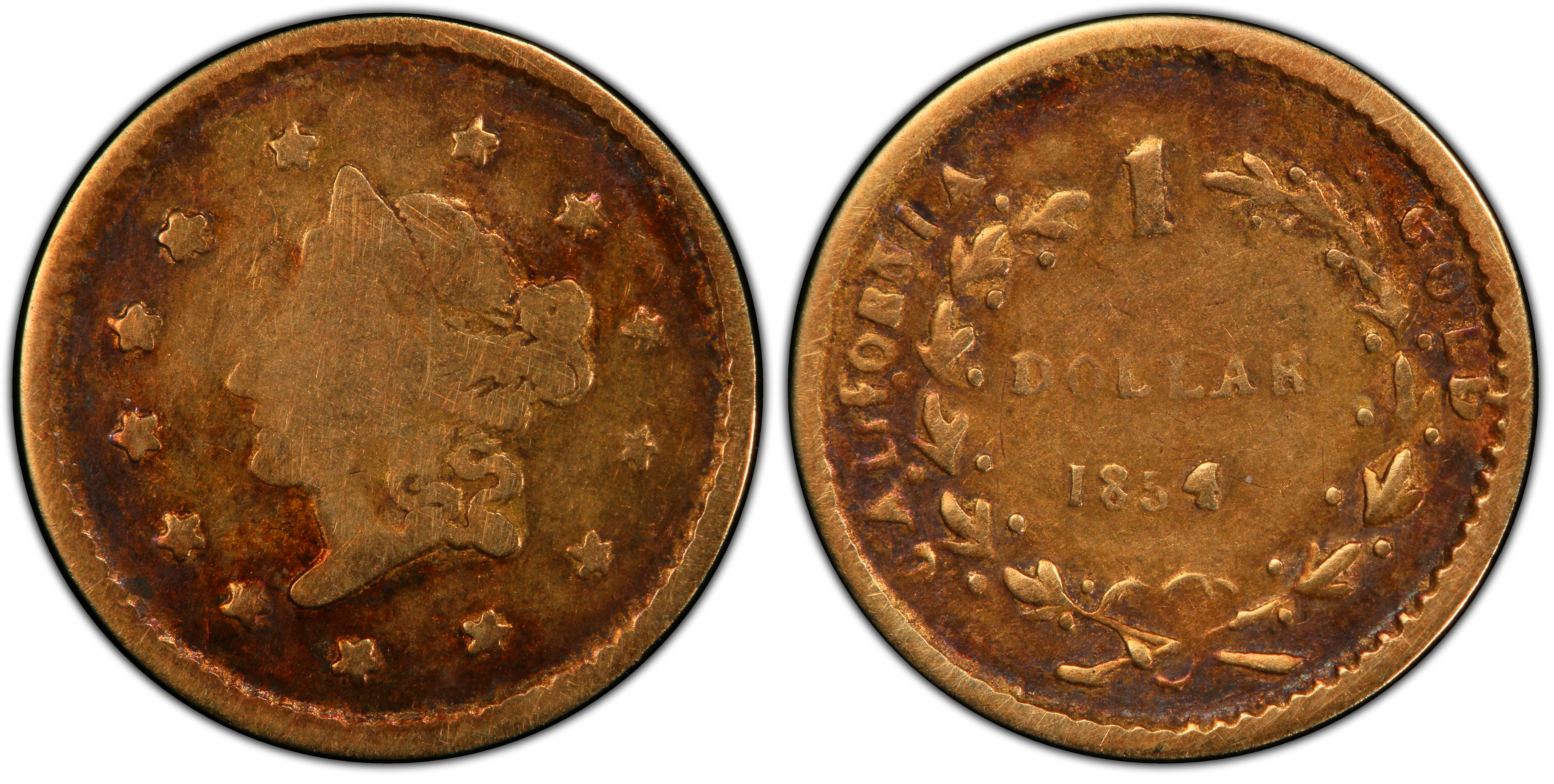
Obverse & Reverse
The 1854 BG-601 One Dollar piece emerged from the chaotic and economically vibrant crucible of the California Gold Rush. Following the discovery of gold in 1848, a massive influx of prospectors and merchants created a severe shortage of circulating small-denomination coinage. Gold dust and nuggets, while plentiful, were impractical for daily transactions, leading to a reliance on private minters to fill the monetary void. These private issues, now known as California Fractional Gold, served as a vital substitute for federal coinage, which was scarce on the West Coast. The BG-601 was struck by Gaime, Guillemot & Co., a prominent firm of French jewelers and importers located at 148 Clay Street in San Francisco. Unlike government-issued coins, these privately struck pieces were often underweight for their stated value, functioning more as tokens or trade pieces whose acceptance relied on the reputation of the issuer. They were intended to facilitate commerce, allowing for precise payments for goods and services in a society awash with raw gold but starved for convenient currency. The 'Period One' pieces, struck from 1852 to 1857, are particularly significant as they were produced during the height of the Gold Rush's economic necessity before state laws began to crack down on private minting. The BG-601, with its crude but charming execution, is a direct artifact of this unique period, representing a private solution to a public economic problem. Its existence was short-lived in circulation, as the establishment of the San Francisco Mint in 1854 and subsequent federal coinage production gradually rendered these private issues obsolete. Most were eventually melted for their gold content, contributing to their high rarity today.
Associated EventCalifornia Gold Rush
Reason For MintingTo alleviate a severe shortage of small-denomination coinage for everyday commerce in Gold Rush-era California.
Minter HistoryGaime, Guillemot & Co. was a partnership of French jewelers, watchmakers, and importers operating in San Francisco during the 1850s. They were one of several jewelers, alongside figures like Antoine Louis Nouizillet, who leveraged their metallurgical skills to produce small-denomination gold tokens. Their business was not primarily a mint, but like other artisans of the time, they met a market demand by striking these fractional pieces, which also served as a form of advertising for their main enterprise. Their work is characteristic of 'Period One' California fractionals: often stylistically crude, struck with hand-cut dies, and reflecting the urgent, unregulated nature of the time.
Historical SignificanceThe BG-601 is a tangible remnant of the private monetary system that underpinned the economy of the California Gold Rush. It exemplifies the ingenuity and ad-hoc solutions required in a frontier economy lacking federal infrastructure. As a 'Period One' issue, it represents the earliest and most historically important phase of this fascinating series, struck out of necessity before legal pressures and the establishment of the San Francisco Mint ended the practice.
N/A
Denomination$1
Minting Period1854
Assayer/MinterGaime, Guillemot & Co.
Geographic OriginSan Francisco, California
Obverse DescriptionA crudely rendered bust of Liberty facing left, with thirteen stars of varying quality encircling the portrait. The portrait details are often soft, with a simple, almost naive artistic style. The stars are irregularly spaced and punched.
Obverse Inscription[None, only stars]
Reverse DescriptionThe denomination '1' and 'DOLLAR' are enclosed within a wreath of simple design. The date '1854' is located below the wreath. The lettering is often irregular in placement and strength.
Reverse Inscription1 DOLLAR 1854
CompositionGold
Stated Fineness Actual FinenessVariable, but generally around .800 to .850 fine.
Weight0.59 grams
Diameter13.50 mm
EdgePlain
Unknown
Survival Estimate25-35
Rarity ScaleR-6
The BG-601 is highly sought after as a representative 'Period One' California Fractional Gold dollar. Its appeal lies in its direct connection to the peak of the Gold Rush, its crude and unique artistry, and its extreme rarity. Collectors value these pieces as historical artifacts rather than perfectly minted coins, appreciating the story they tell of frontier economics.
Key VarietiesNo major varieties are cataloged for BG-601 itself, as is typical for a single die pair issue. The primary variations among surviving examples relate to strike quality and planchet characteristics. No known restrikes or patterns exist for this specific variety. The broader series includes many different die pairings and minters, but BG-601 is a distinct issue.
Authentication TipsAuthentication requires careful examination of die characteristics. The specific crude style of the Liberty head and the irregular placement of the stars and reverse lettering are key diagnostics. Look for a small die crack often present at the top of the reverse. Counterfeits are common and often appear too well-made or have incorrect lettering fonts and weight. True BG-601s have a distinct fabric and often show planchet irregularities consistent with rudimentary production methods. Authentication by a leading third-party grading service is highly recommended.
Shopping ConsiderationsWhen acquiring an BG-601, focus on originality of the surfaces and the clarity of the design elements, however crude they may be. A premium quality example for this issue would exhibit minimal marks, an even strike (though full strikes are virtually unknown), and original, uncleaned surfaces that may show a reddish or deep yellow-gold patina. Avoid examples that have been harshly cleaned, polished, or used as jewelry, as this is common for the type. Pay close attention to the areas around the date and denomination, as these are often weakly struck. A strong, clear date is a significant plus. An example with a 'CAC' sticker would indicate superior quality for the assigned grade.
A coin's grade is its condition, rated on a 1-70 scale. For rare coins, this is the most critical factor in determining value, as a tiny difference in preservation can mean a huge difference in price.
Relevant Grade TypesOriginal period issues of BG-601 were business strikes intended for circulation, and are found in Circulated (AU-58 and below) and, very rarely, Mint State (MS, 60-70) grades. No Proofs were struck during the original period of issue. Any piece described as a 'Proof' would be a modern copy or fantasy piece, not an original 1854 striking.
Mint State CharacteristicsA true Mint State BG-601 is exceptionally rare. Such a piece would exhibit some original mint luster, likely with a soft, slightly satiny texture rather than a brilliant cartwheel effect. The strike is characteristically weak, especially on the highest points of Liberty's hair and the center of the wreath. Small planchet flaws, laminations, or adjustment marks made prior to striking are common and do not preclude a Mint State grade if no circulation wear is present. Contact marks are to be expected due to the softness of the gold alloy.
Circulated Wear PatternsWear first appears on the high points of Liberty's cheek, hair details above the ear, and the leaves and bow of the wreath on the reverse. On moderately circulated examples, the stars will begin to lose their definition, and the 'DOLLAR' inscription will show flatness. In lower grades (VG and below), the date may become faint or partially illegible, and the portrait will be significantly flattened.
Key Factors For ValueFor the BG-601, rarity and historical importance are paramount. The key value drivers are grade, surface originality, and eye appeal. An example with undisturbed, original skin is far more valuable than one that has been cleaned or polished, even if the latter is technically in a higher grade. Sharpness of strike is a major consideration; a coin with a bold date and clear denomination commands a significant premium. Finally, given the extreme rarity, any example, even those with problems, is considered highly desirable, but problem-free, attractively patinated coins will realize the highest prices. A CAC sticker confirming quality for the grade adds a substantial premium.
PCGS Price Guide
| Grade | Price | Population |
|---|---|---|
| 12 | $32,500.00 | 1 |
| 50 | $47,500.00 | 1 |