(1853) G25C BG-223 (Regular Strike)
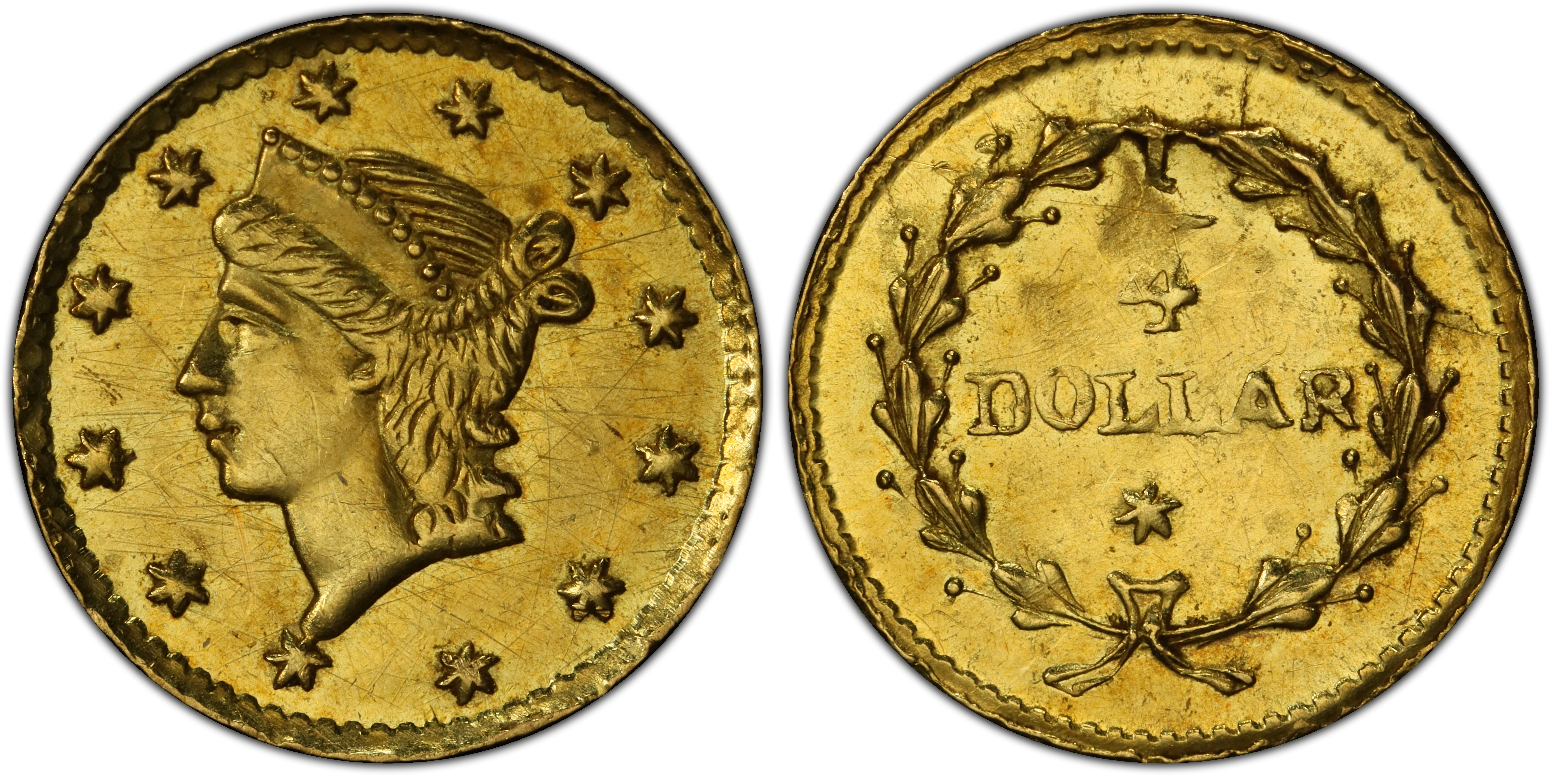
Obverse & Reverse
The BG-223 25 Cent piece is a quintessential artifact from the first period of private California coinage, born directly from the chaotic and economically starved environment of the Gold Rush. Following the discovery of gold at Sutter's Mill in 1848, an unprecedented wave of over 300,000 prospectors and entrepreneurs descended upon California. This population explosion created instant cities and booming commerce, but the region was geographically isolated and suffered from a chronic, debilitating shortage of circulating small-denomination coinage. The United States Mint in Philadelphia was thousands of miles away, and shipments of federal coins were insufficient and slow to arrive. The San Francisco Mint would not be fully operational until 1856. In this monetary vacuum, daily transactions for necessities like food, drink, and lodging were conducted with gold dust, often measured imprecisely by a 'pinch,' a system ripe for dispute and inefficiency. To solve this problem, private jewelers and metallurgists in San Francisco began striking their own coins in 1852. These 'Period One' issues (1852-1856), including the BG-223, were not souvenirs but were intended to and did function as a crucial medium of exchange. They were generally made with a high gold content, closely mirroring the weight and value of federal coinage to inspire public trust. The BG-223, with its familiar Liberty Head motif mimicking federal gold dollars, was a direct and successful attempt to provide a reliable form of fractional currency. These coins were typically produced by hand, using a hammer-striking method where a planchet was placed between two dies and struck with a sledgehammer, resulting in considerable variation in strike quality. By 1856, with the San Francisco Mint producing ample federal silver and gold coinage, the necessity for these private issues waned, and their production ceased, marking the end of the most historically significant era of California fractional gold.
Associated EventCalifornia Gold Rush
Reason For MintingTo alleviate a severe shortage of small-denomination coinage for everyday commercial transactions in Gold Rush-era California.
Minter HistoryThe specific minter of the BG-223 variety is unknown, a common trait for many Period One California fractionals. The work is attributed to one of the many private firms, often operated by French or German immigrant jewelers and metallurgists, active in San Francisco during the 1852-1856 period. These craftsmen, such as Antoine Nouizillet, possessed the requisite skills for die-sinking and coining. They operated outside of federal authority but provided an essential service to the regional economy. Their operations were typically small-scale, using hand-operated presses or simple hammer-and-anvil techniques to produce coins on demand to facilitate local trade.
Historical SignificanceThe BG-223 is a 'Period One' issue, making it highly significant as it was created out of necessity for actual circulation. Unlike later fractional gold pieces (Period Two and Three) which were often underweight and intended as souvenirs or jewelry items, Period One coins represent a genuine, albeit private, solution to a critical failure in the nation's monetary supply. They are tangible relics of the Gold Rush economy and the ingenuity of pioneers in establishing a functioning commercial system on the American frontier.
BG-223
Denomination25 Cents
Minting Period1853
Assayer/MinterUnknown Private Minter
Geographic OriginSan Francisco, California
Obverse DescriptionA Liberty Head facing left, similar in style to the contemporary U.S. gold dollar (Type 1). The hair is tied in a bun at the back. 'LIBERTY' is inscribed on the coronet. The head is surrounded by 13 six-pointed stars, representing the original colonies.
Obverse InscriptionLIBERTY
Reverse DescriptionThe denomination '25 CENTS' is located in the center, enclosed by an ornamental wreath. The wreath is composed of two branches tied with a bow at the bottom. Diagnostic for the BG-223 variety are the five pairs of berries on each branch of the wreath.
Reverse Inscription25 CENTS
CompositionGold
Stated Fineness Actual FinenessWhile not precisely documented for this variety, Period One issues were typically struck from native California gold with high purity, often around .880 to .900 fine, sometimes with a significant natural silver alloy, giving them a lighter color than federal coinage.
Weight0.43 grams
Diameter10.50 mm
EdgePlain
Unknown
Survival Estimate76-200
Rarity ScaleR-4
The BG-223 is highly sought after by collectors as a representative 'Period One' type. Its appeal lies in its direct connection to the commerce of the California Gold Rush, its classic federal-style design, and its status as a tangible piece of pioneer history. Being an undated type adds to its mystique, representing the urgency of the period over strict adherence to convention.
Key VarietiesThe BG-223 is itself a distinct die variety and has no major sub-varieties from its original minting period. No proofs were struck, nor are there any known authorized restrikes of this specific variety. Collectors focus on die states, but the primary form is the regular business strike.
Authentication TipsAuthentic examples will show the precise die characteristics of BG-223, including the specific Liberty head portrait and the five pairs of berries on each reverse wreath branch. Look for the soft, lustrous fabric of genuine gold and evidence of manual striking, which may include slight off-centering or strike weakness. Counterfeits are common and may be cast (showing a porous or soapy surface) or struck from modern dies that fail to replicate the exact details of the original. Weight and specific gravity tests are also crucial.
Shopping ConsiderationsA premium quality example for its grade will exhibit a sharp, well-centered strike, particularly on the stars, the word 'LIBERTY' on the coronet, and the details of the wreath. Due to the hammer-striking process, many examples are weakly struck in areas, so a full strike is a significant value driver. Look for clean surfaces with minimal distracting marks or hairlines. The original, slightly brassy or reddish-gold luster, often described as 'skin,' is highly desirable. Avoid examples that have been harshly cleaned, polished, or used as jewelry, as this severely impairs their value and historical integrity.
A coin's grade is its condition, rated on a 1-70 scale. For rare coins, this is the most critical factor in determining value, as a tiny difference in preservation can mean a huge difference in price.
Relevant Grade TypesAll original BG-223 coins are business strikes intended for circulation. They are graded on the standard 70-point scale and found in Circulated grades (AG-3 to AU-58) and Mint State grades (MS-60 to MS-70). No Proof examples of this variety were struck during the original period of issue, and there are no known later-date Proof restrikes. Any piece described as a 'Proof' should be regarded with extreme skepticism and is likely a modern fantasy piece or a heavily polished Mint State coin.
Mint State CharacteristicsIn uncirculated condition, the BG-223 should exhibit original mint luster, which can range from satiny to semi-prooflike. High-grade examples are known for being well-struck, though some minor weakness from the hammer-striking process is common and acceptable. The fields may show minor planchet striations or adjustment marks original to the minting process. Due to the softness of the gold, even high-grade specimens often have scattered hairlines or tiny contact marks from brief handling or storage with other coins.
Circulated Wear PatternsWear first appears on the highest points of the design. On the obverse, this includes Liberty's cheek, the hair above the eye and ear, and the coronet. On the reverse, the highest points of the wreath leaves, the berries, and the bow will show initial friction. In lower grades (VF and below), the word 'LIBERTY' will become indistinct, and the stars will lose their sharpness.
Key Factors For ValueThe primary value drivers for a BG-223 are grade and surface quality. A sharply struck coin with minimal marks and vibrant original luster will command a significant premium over a weakly struck or heavily abraded example of the same grade. Eye appeal is paramount; coins with a pleasing, original reddish-gold color are prized over those that are dull or have been cleaned. Certification by a top-tier grading service (PCGS or NGC) is essential for market acceptance, and a sticker from CAC (Certified Acceptance Corporation) indicating premium quality for the grade will add a further substantial premium.
PCGS Price Guide
| Grade | Price | Population |
|---|---|---|
| 53 | $230.00 | 1 |
| 53+ | $230.00 | N/A |
| 55 | $240.00 | 5 |
| 55+ | $240.00 | N/A |
| 58 | $265.00 | 11 |
| 58+ | $270.00 | N/A |
| 60 | $280.00 | 2 |
| 61 | $300.00 | 12 |
| 62 | $335.00 | 46 |
| 62+ | $350.00 | N/A |
| 63 | $375.00 | 38 |
| 63+ | $425.00 | N/A |
| 64 | $525.00 | 21 |
| 64+ | $600.00 | N/A |
| 65 | $1,125.00 | 4 |
| 65+ | $1,250.00 | N/A |
| 66 | $1,750.00 | 1 |