1853 G50C BG-430 (Regular Strike)
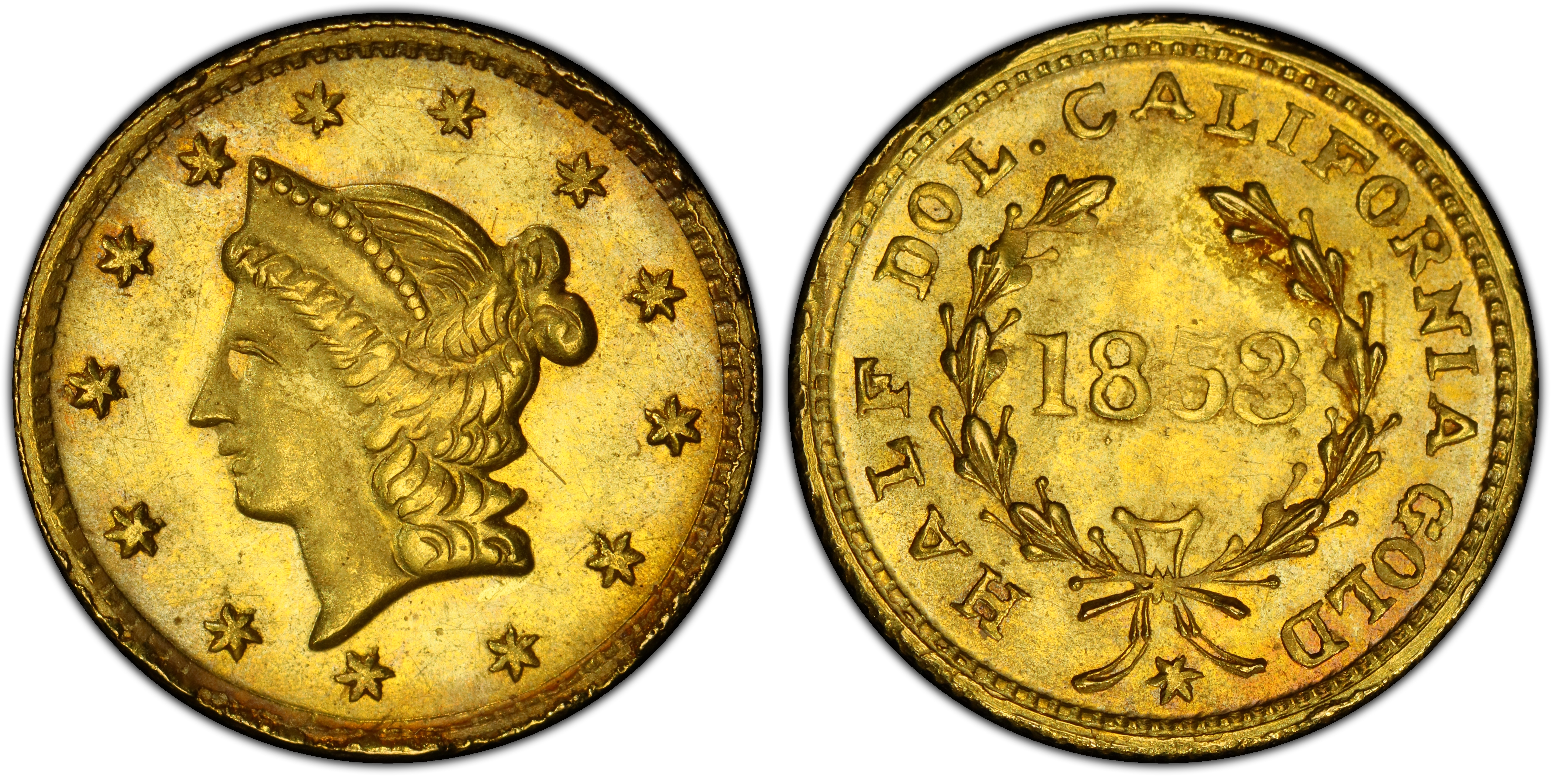
Obverse & Reverse
The 1853 Gold 50 Cents, cataloged as Breen-Gillio 430, is a quintessential artifact from the chaotic and economically vibrant era of the California Gold Rush. Following the discovery of gold at Sutter's Mill in 1848, a massive influx of over 300,000 prospectors and merchants descended upon California, creating an instant and severe shortage of circulating coinage for daily transactions. Gold dust, weighed crudely and often inequitably, served as a temporary medium of exchange, but its impracticality for small purchases was a constant source of friction. The nearest United States Mint was in Philadelphia, an arduously long and dangerous journey away. While several private firms began issuing larger denomination gold coins ($5 and up) by 1849, the desperate need for 'pocket change' remained unmet. Into this monetary vacuum stepped a number of enterprising jewelers and metallurgists in San Francisco. Among the most prolific was Antoine Louis Nouizillet, a French immigrant who applied his fine metalworking skills to the production of small-denomination gold pieces. These 'Period One' fractional gold coins, struck from 1852 to 1857, were not official U.S. tender but were generally accepted in local commerce out of sheer necessity. They were crudely produced, often by hand-hammering dies onto blank planchets, resulting in inconsistent strike quality. The BG-430 was one such product of Nouizillet's unofficial mint. Struck from locally sourced gold, which had a naturally high silver content giving it a lighter color, these coins were intrinsically worth less than their face value, making them a profitable venture for their makers but a form of token coinage for the public. Despite their technical illegality and underweight nature, they played a vital role in lubricating the gears of California's booming economy. The establishment of the San Francisco Mint in 1854 spelled the beginning of the end for these private issues. As official U.S. silver and gold coins became readily available, the fractional gold pieces were gradually withdrawn, with most eventually being melted down. This history of utility followed by widespread destruction is the primary driver of their modern-day rarity and numismatic significance.
Associated EventCalifornia Gold Rush
Reason For MintingTo alleviate a severe shortage of small-denomination coinage for everyday commercial transactions in Gold Rush-era California.
Minter HistoryAntoine Louis Nouizillet was a French jeweler and watchmaker who was active in San Francisco during the 1850s. Capitalizing on the region's acute lack of small change, he became one of the most significant private minters of 'Period One' California fractional gold. His pieces are identified by their distinct die work, often featuring a Liberty head motif stylistically similar to, but distinct from, the contemporary federal gold coinage. Nouizillet's operations were prolific but ultimately short-lived, ceasing production around 1856 as the new San Francisco Mint's coinage saturated the market. He sold his business, including his dies and punches, to another jeweler, Robert B. Gray, around 1859-60.
Historical SignificanceThe BG-430 is a tangible link to the tumultuous formation of California's economy, representing a private, market-based solution to a critical failure in the supply of official government money. It embodies the entrepreneurial spirit of the Gold Rush and serves as a key example of the 'Period One' fractional gold pieces that actually circulated in commerce before being supplanted by federal coinage.
N/A
Denomination50 Cents
Minting Period1853
Assayer/MinterAntoine Louis Nouizillet
Geographic OriginSan Francisco, California
Obverse DescriptionA small, crudely rendered Liberty Head faces left, her hair tied in a bun at the back. She is surrounded by 13 five-pointed stars, representing the original colonies. The date, 1853, is below the truncation of the neck. On this variety, the lowest star on the left is positioned very close to the bust. The denticles around the rim are distinctive, having been recut into small squares rather than the more common sawtooth pattern.
Obverse Inscription1853
Reverse DescriptionA simple wreath composed of two branches tied together with a bow at the bottom. Inside the wreath, the denomination is expressed on two lines. The periphery is surrounded by a circle of lettering.
Reverse InscriptionCALIFORNIA GOLD / HALF DOL.
CompositionGold
Stated Fineness Actual Fineness Diameter11.50 mm
EdgePlain
Unknown
Survival Estimate76-200 (R-3)
Rarity ScaleR-3
This coin is highly sought after as an authentic, circulating artifact of the California Gold Rush. Its appeal lies in its direct connection to this pivotal moment in American history, its status as a privately-minted territorial issue, and the challenge presented by its overall rarity and the scarcity of high-grade, problem-free examples. It is a key variety for specialists in the extensive California fractional gold series.
Key VarietiesThe BG-430 is a specific die marriage and is not known to have major, distinct varieties from its original minting period. No officially sanctioned restrikes or Proof issues are known. Collectors should be aware of the vast number of contemporary counterfeits and later-made souvenir tokens, which often have bears on the reverse or lack a specific denomination.
Authentication TipsAuthenticity is paramount. Genuine BG-430 examples are identified by specific die markers: the lowest left star is extremely close to the bust, and the denticles are characteristically square-shaped. The fabric of the coin should feel correct for hammered gold of the era, often showing a slightly irregular planchet and strike. Counterfeits are common; many are brass or gold-plated and often have a soapy, cast-like appearance. Any piece with a bear on the reverse is a souvenir token, not a genuine fractional coin. Authentication by a major grading service (PCGS or NGC) is highly recommended.
Shopping ConsiderationsA premium quality example of BG-430 is defined by a strong strike, particularly on Liberty's hair details and the leaves of the reverse wreath, which are often weak. Original, uncleaned surfaces with some remaining luster command a significant premium. The native gold used often imparts an attractive reddish or greenish-gold hue, which is prized by collectors. Avoid examples that have been harshly cleaned, exhibit rim damage, or show signs of having been mounted in jewelry, as these issues dramatically reduce value. Look for coins with minimal distracting contact marks and good overall eye appeal for the assigned grade.
A coin's grade is its condition, rated on a 1-70 scale. For rare coins, this is the most critical factor in determining value, as a tiny difference in preservation can mean a huge difference in price.
Relevant Grade TypesAll original BG-430 coins were struck as business strikes intended for circulation. They are found in Circulated grades (AG-3 to AU-58) and, very rarely, in Mint State (MS-60 to MS-70). No Proof (PR/PF) examples were struck during the original minting period, and no later-date Proof restrikes are known to exist for this variety. Any coin described as a 'Proof' should be regarded with extreme skepticism and is likely a modern fantasy piece.
Mint State CharacteristicsAn uncirculated BG-430 will exhibit full mint luster, though this luster is often soft and satiny rather than bright and flashy. The strike is a critical factor; many examples were weakly struck, particularly in the centers. A top-tier specimen will show sharp detail in Liberty's hair curls and the central elements of the reverse wreath. Due to the crude minting process and soft gold, even high-grade Mint State examples will typically show some minor planchet flaws or light contact marks from handling at the time of issue.
Circulated Wear PatternsWear first appears on the highest points of the design. On the obverse, this includes Liberty's cheek, the hair above her eye, and the top of the ear. On the reverse, the high points of the leaves in the wreath and the ribbon bow will show initial friction and smoothing. In lower grades (VG and below), the stars on the obverse and the lettering on the reverse will become faint and begin to merge with the fields.
Key Factors For ValueThe primary value driver is grade, followed closely by surface quality. An example with original, undisturbed surfaces and attractive coloration is far more valuable than a cleaned or polished coin of the same grade. Strike quality is also key; a sharply struck coin is always preferred over one with weak details. Eye appeal is crucial for this series—a well-centered strike on a clean planchet will always command a premium. Finally, certification by PCGS or NGC is standard for the market, and a CAC sticker indicating premium quality for the grade adds a significant price advantage.
PCGS Price Guide
| Grade | Price | Population |
|---|---|---|
| 45 | $210.00 | 1 |
| 45+ | $220.00 | N/A |
| 50 | $230.00 | 2 |
| 50+ | $240.00 | N/A |
| 53 | $250.00 | 3 |
| 53+ | $260.00 | N/A |
| 55 | $275.00 | 26 |
| 55+ | $290.00 | N/A |
| 58 | $315.00 | 47 |
| 58+ | $340.00 | N/A |
| 60 | $375.00 | 7 |
| 61 | $400.00 | 29 |
| 62 | $450.00 | 74 |
| 62+ | $500.00 | N/A |
| 63 | $625.00 | 48 |
| 63+ | $700.00 | 1 |
| 64 | $775.00 | 22 |
| 64+ | $950.00 | 1 |
| 65 | $1,350.00 | 7 |
| 65+ | $1,650.00 | N/A |
| 66 | $2,250.00 | 1 |