1854 G50C BG-424 (Regular Strike)
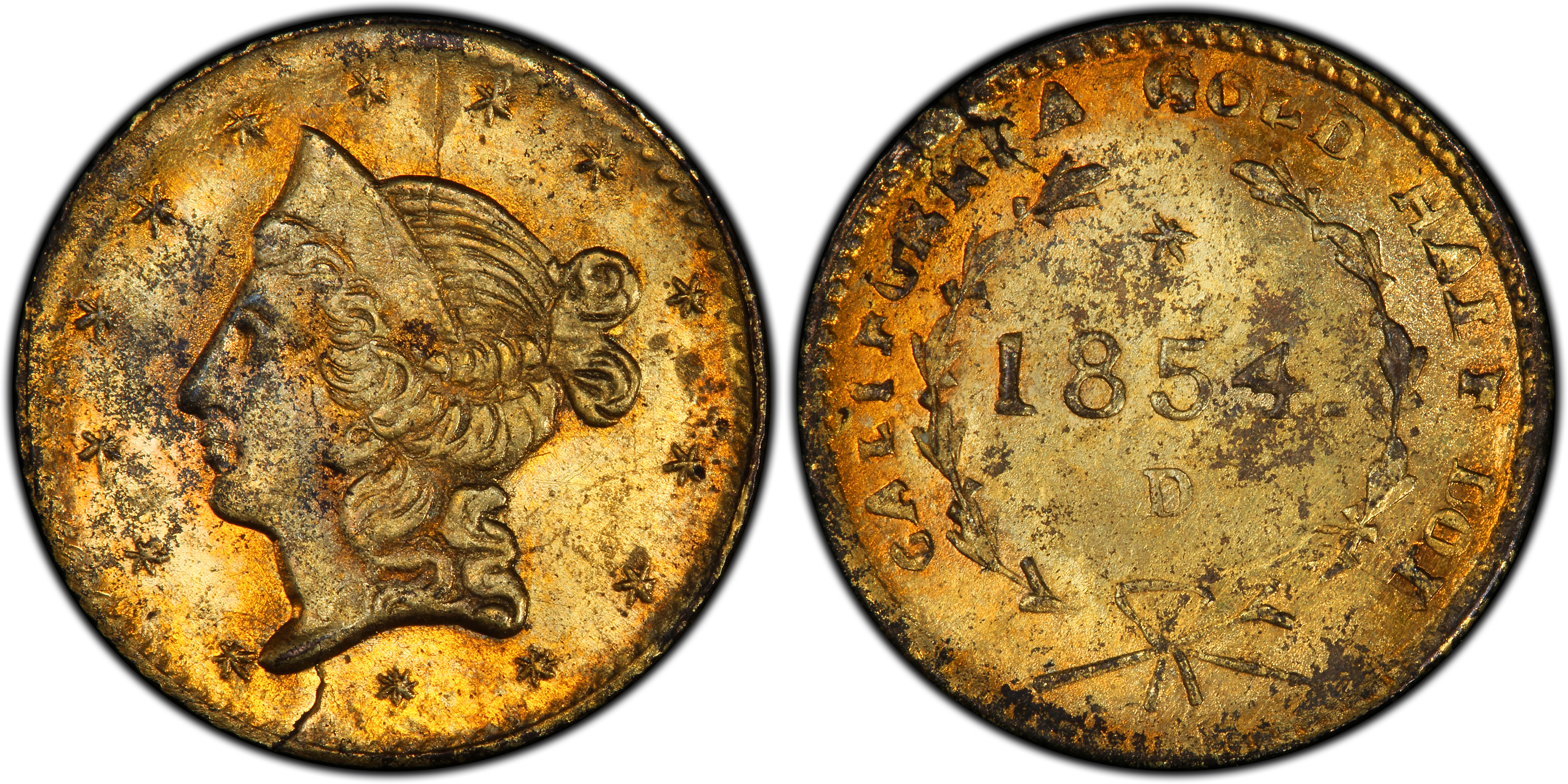
Obverse & Reverse
The 1854 BG-424 Half Dollar is a numismatic artifact of immense rarity born from the chaotic, commerce-starved environment of Gold Rush San Francisco. Following the discovery of gold in 1848, a massive influx of population created a thriving economy, yet one severely hampered by a chronic shortage of small-denomination coinage. Gold dust and tiny nuggets were impractical for daily transactions, and the newly established San Francisco Mint, which opened in 1854, initially focused on larger denominations and could not meet the overwhelming local demand for pocket change. Into this void stepped private jewelers and metallurgists who began striking their own fractional gold coins in quarter, half-dollar, and dollar denominations. These 'Period One' issues (1852-1857) were not novelty items but were intended to and did circulate as a vital substitute for federal coinage. The minter of BG-424, M. Deriberpie, was one of these prominent San Francisco jewelers. This variety is considered one of his last half-dollar issues. The primitive minting technology, often a simple sledgehammer striking hand-cut dies, resulted in coins of varied quality and frequent die failures. The BG-424 is a testament to this, as its dies failed catastrophically, creating a prominent bisecting crack on the obverse. This failure likely curtailed its mintage almost immediately, contributing to its legendary rarity today. While most Period One issues were accepted in trade, some researchers, including Mike Locke, have raised the provocative possibility that the BG-424 (along with BG-209B) is actually 'thinly gold plated over base metal or very low grade gold.' If true, this would dramatically recontextualize the BG-424 as a potential token or debased issue from a period generally respected for its higher-quality productions. Regardless of its precise composition, its existence is fleeting; Walter Breen could trace only two specimens. Its significance lies not just in its rarity, but in its representation of a short-lived, desperate solution to a regional economic crisis, produced on the edge of technical failure by a known Gold Rush artisan.
Associated EventCalifornia Gold Rush
Reason For MintingTo alleviate a severe shortage of small denomination coinage for daily commerce in Gold Rush-era California.
Minter HistoryM. Deriberpie was a French jeweler and one of the most significant private minters of 'Period One' California fractional gold in San Francisco during the 1850s. His initial 'D' appears on the reverse of many of his issues, including the BG-424. He often worked in partnership with other French jewelers in the city, such as Antoine Louis Nouizillet (their partnership issues are marked D.N.). Deriberpie's coins are characterized by their Liberty Head design, closely emulating the style of the official U.S. gold coinage of the era, which was a common practice among Period One minters to foster public acceptance.
Historical SignificanceThe BG-424 is a prime example of the privately issued coinage that served as the lifeblood of local commerce before the San Francisco Mint came into full production. Its extreme rarity, likely caused by a catastrophic die failure, makes it a tangible artifact of the technical challenges faced by these private minters. It is among the most elusive and storied varieties in the entire California fractional gold series.
BG-424
Denomination50 Cents
Minting Period1854
Assayer/MinterM. Deriberpie
Geographic OriginSan Francisco, California
Obverse DescriptionA small Liberty Head, facing left, similar in style to the contemporary U.S. gold dollar. Her hair is tied in a bun. The portrait is surrounded by 14 stars. A prominent, heavy die crack bisects the obverse, running vertically through the portrait.
Obverse Inscription Reverse DescriptionThe denomination '1/2' is centered within a wreath. The date '1854' appears below the fraction, inside the lower portion of the wreath. The minter's initial 'D' for Deriberpie is located beneath the date. A key diagnostic is that the left branch of the wreath is completely severed from the tie at the bottom.
Reverse Inscription1/2 1854 D
CompositionGold (Potentially very low-grade or gold-plated)
Stated Fineness Actual FinenessUnknown; research suggests it may be very low-grade gold or plated.
EdgePlain
Extremely small; likely just a few dozen at most before the dies failed.
Survival Estimate2-3 coins known. Walter Breen traced two (the Lee and Comstock specimens), and PCGS has certified two distinct examples.
Rarity ScaleR-8 (per Heritage Auctions); R-7 (per Holabird-Kagin Americana)
This is a landmark rarity in American numismatics, appealing to the most advanced collectors of territorial and fractional gold. Its allure comes from its near-mythical rarity, its direct connection to the Gold Rush, its dramatic and identifiable die failure, and the numismatic mystery surrounding its true composition.
Key VarietiesThere are no known varieties of the BG-424 die marriage itself, as its existence was likely too brief. No restrikes or special collector issues are known.
Authentication TipsAuthentication is paramount and relies on specific die markers. The primary diagnostic is the heavy, bisecting vertical die crack on the obverse. The reverse is identified by the minter's initial 'D' below the date and, crucially, the left branch of the wreath being completely severed from the tie. The planchets of known examples show issues such as laminations and flaking, which should be consistent with auction records. Given its rarity and value, any example must be certified by a top-tier grading service.
Shopping ConsiderationsAcquiring a BG-424 is a major numismatic event. A 'premium quality' example is simply one that exists and is certifiable. Buyers should focus on the clarity of the die state and the integrity of the planchet. Known examples have shown iridescent toning over satiny or matte-like surfaces, but also significant planchet flaws like peeling lamination. These are part of the coin's history and should not necessarily be seen as disqualifying defects. Given the extreme rarity, any opportunity to acquire an example, regardless of minor surface issues, would be considered extraordinary. Provenance is also a key value driver for a coin of this caliber.
A coin's grade is its condition, rated on a 1-70 scale. For rare coins, this is the most critical factor in determining value, as a tiny difference in preservation can mean a huge difference in price.
Relevant Grade TypesAll original examples of BG-424 are business strikes intended for circulation and are found in Circulated (1-58) and Mint State (MS, 60-70) grades. Due to their immediate rarity, the few known survivors are in Mint State. No Proof (PR/PF) examples were struck during the original period of issue, and no later-date restrikes are known to exist.
Mint State CharacteristicsThe two known certified examples are graded MS-61 and MS-62. A Mint State BG-424 is defined by the preservation of its original, often satiny or almost matte-like, surface texture. Luster may be subdued due to the nature of the strike and planchet quality. Toning on one example was described as 'iridescent rainbow.' The strike will be inherently weak in areas due to the crude production method. The massive obverse die crack is an integral part of the coin's identity, not a flaw. Marks are to be expected, but the overall eye appeal and lack of actual wear are paramount.
Circulated Wear PatternsWhile known examples are uncirculated, wear would first appear on the highest points of Liberty's hair, cheek, and the highest leaves and bow of the reverse wreath. In lower grades, the delicate date and minter's mark would begin to soften and merge with the design elements.
Key Factors For ValueFor a coin of this magnitude, the primary value factor is simply its existence and authenticity. Beyond that, the grade is critical; the difference between an MS-61 and a potential MS-63 would be immense. Surface quality is the next consideration; while planchet laminations are known for the issue, an example with a cleaner, more intact planchet would command a significant premium. Eye appeal, manifested as attractive original toning and a relatively sharp strike for the issue, adds considerable value. A CAC sticker on an issue this rare and important would be a powerful endorsement of its quality for the grade.
PCGS Price Guide
| Grade | Price | Population |
|---|---|---|
| 55 | $4,750.00 | 1 |
| 55+ | $5,250.00 | N/A |
| 58 | $6,000.00 | N/A |
| 58+ | $6,750.00 | N/A |
| 60 | $8,000.00 | 1 |
| 61 | $9,500.00 | N/A |
| 62 | $14,500.00 | 4 |
| 62+ | $17,500.00 | N/A |
| 63 | $20,000.00 | 1 |