1854 G$1 BG-534 Eagle (Regular Strike)
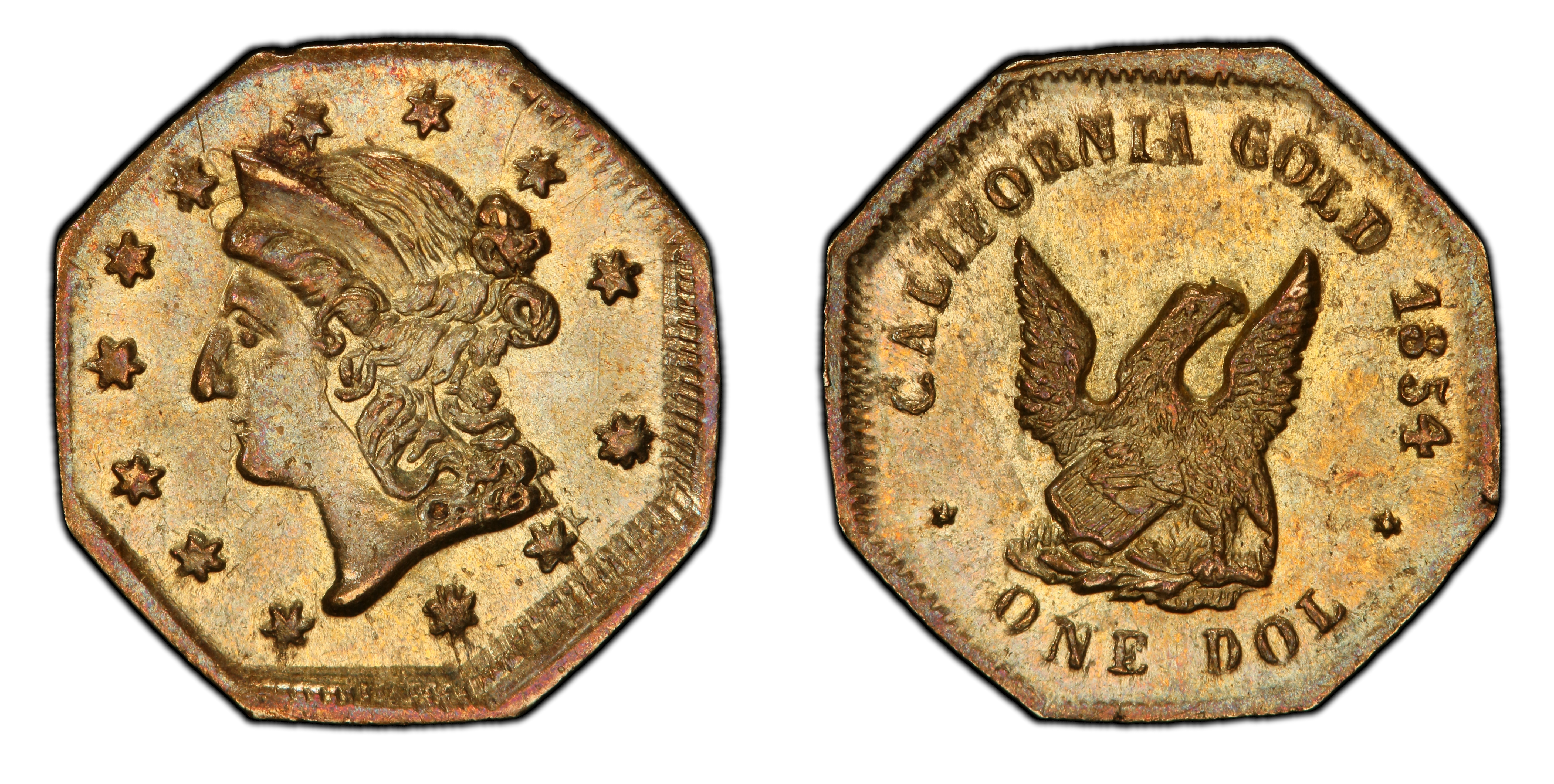
Obverse & Reverse
The 1854 G$1 BG-534 octagonal dollar is a tangible relic of the socio-economic chaos and ingenuity that defined the California Gold Rush. Following the discovery of gold at Sutter's Mill in 1848, a massive influx of over 300,000 people descended upon California, creating a booming economy almost overnight. This rapid expansion, however, far outpaced the supply of official United States coinage, leading to a severe shortage of small change for daily transactions. Commerce was initially conducted with gold dust, an imprecise and cumbersome method often described as a 'pinch' for a drink. This necessity mothered the invention of private coinage. Jewelers and metallurgists in booming cities like San Francisco began striking their own small-denomination gold coins in 1852. These 'California Fractional Gold' pieces, issued in quarter, half, and one-dollar denominations, were intended to circulate and facilitate trade. The BG-534, struck in 1854, belongs to what numismatists classify as 'Period One' (1852-1857) issues, which are believed to have genuinely circulated to meet this currency shortage. This was the very year the official San Francisco Branch Mint opened, but its initial output of small denomination coins was insufficient to meet the overwhelming demand. The BG-534 is particularly noteworthy for its reverse design, a bold eagle with a shield on its breast, which closely mimics the design of the massive $50 'slugs' issued by the U.S. Assay Office under Augustus Humbert. This was likely a deliberate choice by the minter, Antoine Louis Nouizillet, to inspire public confidence by associating his small dollar with the well-respected and substantial Humbert issues. Despite being underweight relative to their face value, a common trait of most fractional gold, these pieces gained acceptance out of sheer necessity. The production of these private coins continued until the Coinage Act of 1864 made them illegal, though enforcement was lax until the 1880s, allowing later 'souvenir' issues to be made. The BG-534, however, is a true product of the Gold Rush's peak, a private solution to a public problem, representing a fascinating chapter in American monetary history before the federal government could fully assert its control over the nation's currency.
Associated EventCalifornia Gold Rush
Reason For MintingTo alleviate a severe shortage of small-denomination circulating coinage for daily commerce in Gold Rush-era San Francisco.
Minter HistoryAntoine Louis Nouizillet was a French jeweler and one of the most prolific private minters of California Fractional Gold. He is believed to have been active in San Francisco during the peak years of the Gold Rush. Research by Walter Breen and Ronald Gillio has attributed numerous varieties of fractional gold, including the distinctive BG-534, to his handiwork. His pieces are often characterized by their specific design elements and punch-link analysis, though they are typically not signed. Like many of his contemporaries, Nouizillet operated in a legal gray area, producing essential currency that the government was not yet able to supply in adequate quantities.
Historical SignificanceThe BG-534 is significant as a 'Period One' issue, privately minted to serve as circulating currency during a critical period of economic expansion and federal coinage scarcity in California. Its reverse design, emulating the respected Humbert $50 slugs, highlights the private minters' attempts to create coinage that would be readily accepted by the public. It stands as a prime example of private enterprise filling a crucial gap in the monetary system and is a direct link to the commercial realities of the Gold Rush.
N/A
DenominationG$1
Minting Period1854
Assayer/MinterAntoine Louis Nouizillet
Geographic OriginSan Francisco, California
Obverse DescriptionA Liberty Head, facing left, with 'LIBERTY' inscribed on her coronet. The head is surrounded by thirteen stars, representing the original colonies. The date '1854' appears below the bust.
Obverse InscriptionLIBERTY 1854
Reverse DescriptionA heraldic eagle with a shield on its breast, clutching an olive branch and arrows in its talons. The design is a miniature version of the eagle found on the reverse of U.S. Assay Office ($50 Humbert 'slugs') and federal gold coinage. The inscription 'CALIFORNIA GOLD' surrounds the eagle above.
Reverse InscriptionCALIFORNIA GOLD
CompositionGold
Stated Fineness Actual FinenessTypically .800 to .900, alloyed with silver and copper from native California gold, which gives it a distinctive lighter color.
Weight0.50 grams
Diameter11.50 mm
EdgePlain
Unknown
Survival EstimateFewer than 75
Rarity ScaleHigh R-6
The BG-534 is highly coveted by collectors for several reasons: its great rarity (High R-6), its popular and historically significant 'Humbert Eagle' reverse design, its octagonal shape, and its status as a true 'Period One' circulating issue from the height of the Gold Rush.
Key VarietiesThe primary issue is the regular strike (BG-534). No contemporary proof strikings are known. While many California Fractional Gold varieties have later restrikes or souvenir issues from 'Period Two' (1858-1882), the BG-534 is not known to have them, enhancing the desirability of the original 1854 issue.
Authentication TipsAuthentic examples have a distinctive strike character. Look for a widely repunched 'O' in 'CALIFORNIA' on some specimens. The lettering and stars should be stylistically consistent with other known Nouizillet pieces. Counterfeits and modern replicas are common in the fractional gold series; many are brassy in color, have incorrect design details (like bears, which no original Period One issues have), or lack a denomination. Weight and specific gravity tests can help identify fakes, which are often made of gilt base metal or low-fineness gold.
Shopping ConsiderationsA premium quality BG-534 will exhibit a bold strike, particularly on the eagle's feathers and Liberty's coronet, which are often weak. Original, uncleaned surfaces with some remaining luster command a significant premium. The native gold often imparts an attractive 'green-gold' or reddish hue due to silver and copper content, which is desirable. Look for examples free of significant, distracting marks, as the small size makes any imperfection prominent. Avoid coins that have been used as jewelry, evidenced by solder marks, harsh cleaning, or holes, although even damaged examples are valuable due to the variety's extreme rarity.
A coin's grade is its condition, rated on a 1-70 scale. For rare coins, this is the most critical factor in determining value, as a tiny difference in preservation can mean a huge difference in price.
Relevant Grade TypesOriginal 1854 issues of BG-534 were business strikes intended for circulation, and they are found in Circulated grades (AG-3 to AU-58) and, very rarely, in Mint State (MS, 60-70). No Proofs were struck during the original minting period. No later-date Proof restrikes or special collector strikings of this specific variety are known to exist.
Mint State CharacteristicsAn uncirculated BG-534 is exceptionally rare. Quality is defined by the strength of the strike; many were crudely produced via the hammer method, resulting in areas of weakness, especially in the center of the obverse and on the eagle's highest points. Luster is typically soft and satiny rather than frosty. Due to the primitive minting and handling process, even MS examples will likely display some light contact marks or planchet imperfections. A complete lack of wear and pleasing, original color are the key determinants of a high-end Mint State grade.
Circulated Wear PatternsWear first appears on the highest points: Liberty's cheek, hair above the ear, and the coronet. On the reverse, the eagle's head, the upper portions of the wings, and the shield's high points will show initial friction and flattening. In lower grades (VG and below), the word 'LIBERTY' on the coronet becomes illegible and the finer feather details merge.
Key Factors For ValueFor the BG-534, rarity is the primary value driver. Beyond that, surface quality is paramount; an example with original, uncleaned 'skin' and attractive coloration is far more valuable than a cleaned, brighter-looking piece of the same grade. Strike sharpness is a major factor, with well-struck examples commanding strong premiums. Eye appeal, which is a subjective combination of color, strike, and marks, plays a significant role. Given the prevalence of counterfeits and the difficulty in attribution, certification by a top-tier service like PCGS or NGC is virtually essential for market acceptance, and a CAC sticker indicating premium quality for the grade adds a further substantial premium.
PCGS Price Guide
| Grade | Price | Population |
|---|---|---|
| 40 | $7,750.00 | 1 |
| 45 | $8,500.00 | N/A |
| 45+ | $9,000.00 | N/A |
| 50 | $10,000.00 | 2 |
| 50+ | $10,500.00 | N/A |
| 53 | $11,000.00 | 1 |
| 53+ | $11,500.00 | N/A |
| 55 | $12,000.00 | 3 |
| 55+ | $12,500.00 | N/A |
| 58 | $13,750.00 | 1 |
| 58+ | $14,000.00 | N/A |
| 60 | $14,500.00 | N/A |
| 61 | $15,000.00 | N/A |
| 62 | $16,500.00 | 3 |
| 62+ | $18,500.00 | N/A |
| 63 | $22,500.00 | 1 |