1871 G25C BG-718 (Regular Strike)
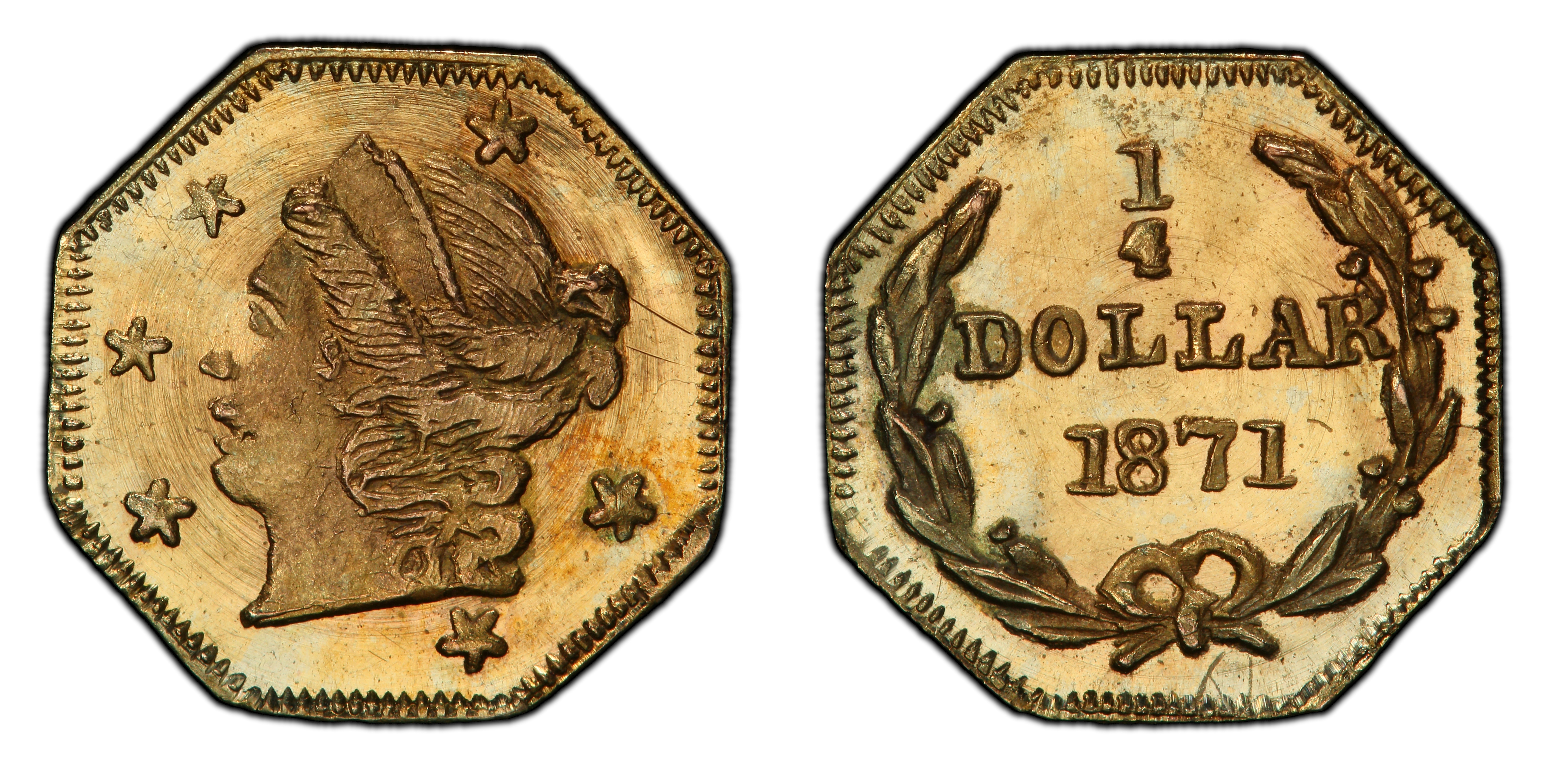
Obverse & Reverse
The 1871 Octagonal Liberty Head 25 Cents, cataloged as Breen-Gillio 718, is a numismatic artifact from the second great period of California's private gold coinage. By 1871, the initial, desperate need for small change that characterized the Gold Rush aftermath had largely subsided, thanks to the output of the San Francisco Mint. However, the allure of California gold had not faded. The transcontinental railroad, completed just two years prior, brought a new wave of tourists and settlers eager for tangible souvenirs of the Golden State. This created a thriving market for 'Period Two' (1858-1882) fractional gold pieces. These were no longer primarily instruments of commerce but rather jeweler's issues, struck to satisfy the robust demand for keepsakes and novelty items. Production of these pieces flourished, ironically, after the Private Coinage Act of 1864 made them technically illegal. The law, however, was not rigorously enforced by the Secret Service until the early 1880s, allowing a cottage industry of jewelers and private minters to operate with relative impunity. These minters, many of whom were skilled engravers, produced a dazzling array of designs, often mimicking federal coinage but with their own distinct styles. The BG-718 is a product of this environment. While the specific minter is not identified on the coin, historical evidence points towards the California Jewelry Company. This firm, in 1871, had just purchased the business of Robert B. Gray & Co., a prolific producer of fractional gold. It is highly probable that the California Jewelry Co. continued Gray's work, using existing equipment and perhaps even dies to meet the souvenir demand. The extreme rarity of the BG-718 variety today, with only a couple of examples known, suggests a very small, perhaps experimental, production. It may have been a trial striking from a new die combination or part of a very limited batch made for a specific client. Its existence testifies to the continued innovation and market-driven nature of private coining in post-Gold Rush San Francisco, a fascinating final chapter before federal authorities finally suppressed the practice.
Associated EventPost-Gold Rush California Souvenir Market
Reason For MintingPrimarily struck to be sold as souvenirs and jewelry items to tourists and settlers, rather than to alleviate a circulating coinage shortage.
Minter HistoryWhile not definitively marked, the BG-718 is attributed to the California Jewelry Company of San Francisco. This firm was the direct successor to Robert B. Gray & Co., a prominent jeweler and one of the most significant producers of 'Period Two' fractional gold. In 1871, Gray sold his interests to the California Jewelry Co., which likely continued the lucrative practice of striking small gold pieces for the souvenir trade. Their work represents the final phase of this private minting tradition before federal enforcement halted it in 1883.
Historical SignificanceThe BG-718 is a testament to the persistent and entrepreneurial nature of private enterprise in the American West. It represents a shift in the purpose of fractional gold from a necessary medium of exchange to a commercial souvenir product, reflecting California's changing economy and its growing identity as a tourist destination. Its profound rarity makes it a key numismatic marker of this unique and legally ambiguous period of American coinage.
N/A
Denomination25 Cents
Minting Period1871
Assayer/MinterCalifornia Jewelry Company (Attributed)
Geographic OriginSan Francisco, California
Obverse DescriptionA head of Liberty facing left, wearing a coronet, with hair tied in a bun. The portrait is encircled by six five-pointed stars. Based on analysis of the related BG-718A, the die diagnostics for this obverse include the first star positioned below Liberty's chin and the second star to the left of her nose.
Obverse Inscription Reverse DescriptionA wreath composed of two branches tied by a bow at the bottom. Inside the wreath, the denomination and date are inscribed.
Reverse Inscription1/4 DOLLAR 1871
CompositionGold
Stated Fineness Actual FinenessVaries, typically 14 to 22 karats for Period Two issues.
Weight0.25 grams
Diameter9.80 mm
EdgePlain
Extremely low; likely less than 25.
Survival Estimate2 known specimens.
Rarity ScaleR-7 (4-12 known)
The BG-718 is a connoisseur's coin of the highest order. Its appeal lies in its extreme, almost unobtainable rarity and its direct connection to the romantic era of California's private gold coinage. For the advanced specialist, acquiring a BG-718 is a pinnacle achievement, representing one of the scarcest varieties in the entire fractional gold series.
Key VarietiesThe primary related variety is the BG-718A, which shares the same obverse die but is paired with a different reverse die. The BG-718A reverse is identified by specific characteristics including a recut first '1' in the date and in the fraction, incomplete 'AR' in DOLLAR, and the top of the 'D' touching a leaf. The specific diagnostics of the BG-718 reverse die are not widely published due to its rarity. No later-date restrikes or special collector issues are known to exist.
Authentication TipsAuthentic Period Two fractionals like BG-718 are denominated with the word 'DOLLAR' or a clear abbreviation. Replicas and charms often omit this or use phrases like 'CAL GOLD'. Genuine pieces are often weakly or unevenly struck due to the hammer-striking method; modern fakes are typically sharp and uniform. The surfaces of genuine pieces can show fine die striations or a slightly prooflike or satiny texture. Be wary of pieces with a modern, cartoonish bear on the reverse, as this is a hallmark of a 20th-century souvenir token, not a genuine 19th-century coin.
Shopping ConsiderationsFor a coin of this rarity, any opportunity to acquire an example would be a major event. A 'premium quality' specimen would be one of the two known high-grade examples, likely graded MS64 or higher. A buyer should focus on certified examples from PCGS or NGC, as authentication is paramount. Look for original, undisturbed surfaces with a pleasing luster, which can range from satiny to prooflike. Given the hammer-striking process, some softness in the strike on the highest points (Liberty's hair, wreath leaves) is expected and acceptable. Avoid any examples that show signs of tooling, harsh cleaning, or being previously mounted in jewelry, although evidence of the latter is common in this series and must be evaluated on a case-by-case basis.
A coin's grade is its condition, rated on a 1-70 scale. For rare coins, this is the most critical factor in determining value, as a tiny difference in preservation can mean a huge difference in price.
Relevant Grade TypesAll original examples of BG-718 were struck as business strikes, intended for sale as souvenirs. They are found in Circulated (1-58) and, more commonly for surviving examples of this rarity, Mint State (MS, 60-70) grades. No proofs were struck during the original minting period, and no later-date Proof restrikes are known.
Mint State CharacteristicsAn uncirculated BG-718 will exhibit luster, though its character can vary. One of the known examples is described as having a 'satiny' obverse with die striations and a 'prooflike' reverse. The strike is often somewhat soft on the high points of Liberty's hair details and the central parts of the wreath. Due to the small size and low-purity gold, even high-grade examples may show minor planchet imperfections or handling marks, which must be carefully distinguished from circulation wear.
Circulated Wear PatternsOn a circulated example, wear would first appear on the highest points of the design. For the obverse, this would be Liberty's cheek, the coronet, and the strands of hair above her ear. On the reverse, the highest points of the wreath's leaves and the bow would show the first signs of friction and flattening. In lower grades, the delicate stars and reverse lettering would begin to lose their sharpness.
Key Factors For ValueWith only two known examples, the primary value factor is simply the coin's existence and availability. Beyond that, the grade is critical. The difference between an MS-64 and an MS-66, as seen in the NGC census, would represent a substantial leap in value. Surface quality is paramount; an example with original, uncleaned, lustrous surfaces will command a massive premium. Eye appeal, encompassing the quality of the strike and the attractiveness of the gold toning, is also a significant factor. A CAC sticker on a coin of this caliber would be a major endorsement of its quality for the grade.
PCGS Price Guide
| Grade | Price | Population |
|---|---|---|
| 20 | $250.00 | 1 |
| 61 | $650.00 | 1 |
| 62 | $750.00 | N/A |
| 62+ | $775.00 | N/A |
| 63 | $900.00 | 3 |
| 63+ | $975.00 | N/A |
| 64 | $1,200.00 | 4 |
| 64+ | $1,500.00 | N/A |
| 65 | $2,050.00 | 3 |
| 65+ | $2,200.00 | N/A |
| 66 | $2,400.00 | 2 |