1856 G25C BG-111 (Regular Strike)
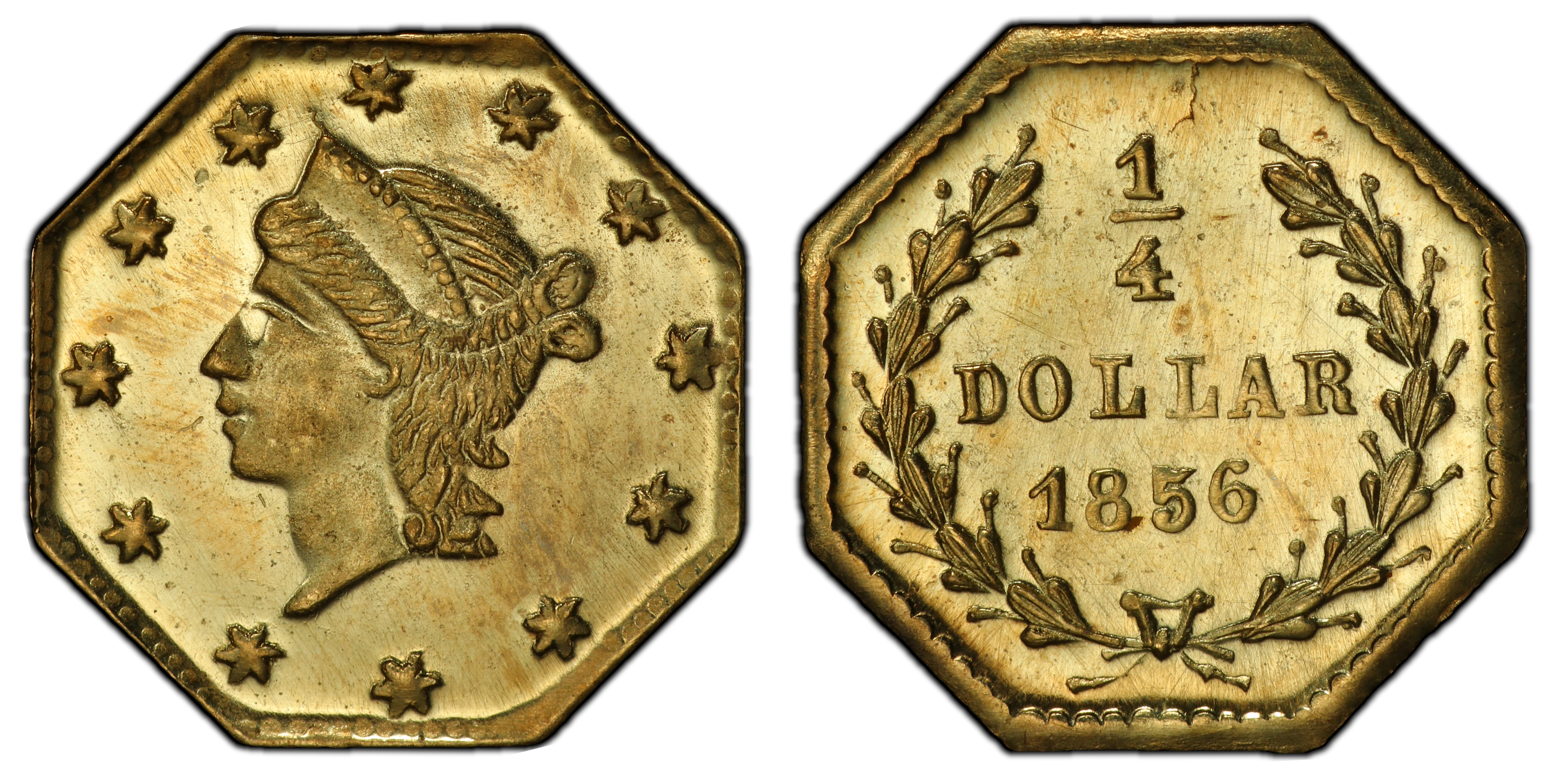
Obverse & Reverse
The 1856 G25C BG-111 octagonal 25-cent piece represents a fascinating and essential chapter in the economic history of Gold Rush California. In the early 1850s, the massive influx of prospectors and settlers created a booming economy, yet it was one critically short of small denomination coinage for daily transactions. Gold dust, the primary medium of exchange, was imprecise and cumbersome for minor purchases. While the U.S. government established a branch mint in San Francisco in 1854, its initial output focused on larger denominations, leaving a void for coins valued under a dollar. This necessity spurred private jewelers and metallurgists to fill the gap. Among the most prolific was Antoine Louis Nouizillet, a French jeweler in San Francisco, who produced a wide variety of these 'fractional' gold pieces. The BG-111 is a 'Period One' issue, a designation numismatists use for coins struck between 1852 and 1857, which are believed to have been genuinely intended for circulation. These tiny, octagonal gold coins, mimicking the shape of the massive $50 'slugs' produced by U.S. Assayer Augustus Humbert, would have been a welcome solution for making change. However, their diminutive size made them easy to lose, and their intrinsic gold value was often less than their face value, leading to their eventual rejection for widespread commercial use. Almost as soon as they appeared, they transitioned from functional currency to popular souvenirs and keepsakes that could be easily mailed back East. The Private Coinage Act of 1864 officially banned such private issues, but production of souvenir pieces continued until a Secret Service crackdown in 1883. The BG-111 variety was long considered scarce (rated R-3 by Breen-Gillio), but its numismatic story took a dramatic turn with the recovery of treasure from the S.S. Central America, which sank in 1857. Significant quantities were found in the shipwreck, including stunning prooflike examples, which dramatically increased the known population and made high-grade specimens more accessible to collectors. Today, the BG-111 stands as an iconic and tangible link to the vibrant, chaotic, and entrepreneurial spirit of the California Gold Rush.
Associated EventCalifornia Gold Rush
Reason For MintingTo alleviate a severe shortage of small-denomination coinage for everyday commercial transactions in Gold Rush-era California.
Minter HistoryAntoine Louis Nouizillet was one of the most prominent and skilled private minters operating in San Francisco during the Gold Rush. A French jeweler and engraver, he was responsible for a significant number of the 'Period One' California fractional gold varieties. His designs often featured a Liberty Head motif, stylistically similar to the official U.S. gold coinage of the era but with his own distinct artistic interpretation. His operation, like others, was a direct response to the local economic need for small change. While biographical details are scarce, his numismatic legacy is extensive, with his initials or recognizable work appearing on numerous surviving fractional gold pieces that are highly sought after by collectors today.
Historical SignificanceThe BG-111, as part of the broader California Fractional Gold series, is historically significant as a physical manifestation of private enterprise stepping in to solve a government monetary failure. It represents the creative adaptation required on the American frontier and serves as a primary artifact from the unique economy of the California Gold Rush, transitioning from a circulating medium of necessity to a cherished souvenir.
N/A
Denomination25 Cents
Minting Period1856
Assayer/MinterAntoine Louis Nouizillet
Geographic OriginSan Francisco, California
Obverse DescriptionA Liberty Head, facing left, with 13 stars surrounding the periphery. The portrait is in the style of the contemporary U.S. gold coinage but is a distinct, privately engraved version. The date '1856' is below the bust.
Obverse Inscription1856
Reverse DescriptionThe denomination '1/4 DOLLAR' is displayed within a wreath of leaves and berries, which is open at the top.
Reverse Inscription1/4 DOLLAR
CompositionGold
Stated Fineness Actual FinenessFineness varied, typically ranging from 14 to 22 karats, and the pieces were intentionally underweight for their face value.
Weight0.25 grams
Diameter9.50 mm
EdgePlain
Unknown
Survival EstimateOnce considered R-3 (Scarce), now considered one of the more common Period One varieties due to the S.S. Central America recovery; likely 500-700 known in all grades.
Rarity ScaleR-3 (Scarce)
This coin is highly appealing due to its direct connection to the California Gold Rush, its distinctive octagonal shape, and its status as a 'Period One' issue intended for circulation. The S.S. Central America pedigree on some examples adds a layer of historical romance and collectibility.
Key VarietiesThe primary variety is the regular strike BG-111. However, research suggests that some very late die states may be restrikes from around 1860. Additionally, a circa 1860 restrike known as BG-818A was made from the BG-111 dies but struck on a round planchet. The most significant special issues are the Prooflike (PL) examples recovered from the S.S. Central America shipwreck, which are considered a separate and highly desirable category by specialists due to their pristine, original surfaces.
Authentication TipsAuthentic pieces have a specific die diagnostic profile; for example, on the obverse, the nose on Liberty is often broken, and on the reverse, the bow and ribbon ends can appear fragmented. Counterfeits are common and often have incorrect weight, a soapy or cast-like appearance, incorrect lettering style, or tool marks around the design elements. Authentication by a major grading service (PCGS or NGC) is highly recommended for this series.
Shopping ConsiderationsA premium quality example for its grade will exhibit a sharp strike, particularly on Liberty's hair details and the numerals of the date. Look for clean, original surfaces without evidence of harsh cleaning, polishing, or tooling. Many examples were used as jewelry and may show signs of being mounted or holed; avoid these if seeking a problem-free coin. Because many high-grade examples came from the S.S. Central America, coins with exceptionally clean, prooflike surfaces command a significant premium. Eye appeal is paramount; seek out pieces with a pleasing, uniform luster and attractive original gold toning.
A coin's grade is its condition, rated on a 1-70 scale. For rare coins, this is the most critical factor in determining value, as a tiny difference in preservation can mean a huge difference in price.
Relevant Grade TypesOriginal 1856 issues were business strikes intended for circulation and are found in Circulated (1-58) and Mint State (MS, 60-70) grades. No proofs were struck during the original period of issue. However, a significant number of high-grade, Mint State coins recovered from the S.S. Central America shipwreck exhibit exceptional, mirrored surfaces and have been designated as Prooflike (PL) by grading services. These are not true proofs but business strikes from fresh, highly polished dies, and they are treated as a distinct and premium category by collectors.
Mint State CharacteristicsUncirculated examples are characterized by their luster, which is typically bright and slightly reflective. Due to the rudimentary minting process, strikes can be inconsistent; a well-struck coin with full detail on Liberty's portrait and the wreath is desirable. The surfaces are often slightly wavy. Bag marks are less common than on larger coins, but small contact marks from handling are typical. The S.S. Central America coins are the pinnacle of quality, often displaying superb, prooflike luster and minimal imperfections.
Circulated Wear PatternsWear first appears on the highest points of the design: Liberty's cheek, the hair above the eye, and the ribbon bow on the reverse. On more heavily circulated examples, the stars and date will begin to lose their sharpness, and the fine details of the wreath will become flat. The octagonal points are also susceptible to wear and rounding.
Key Factors For ValueThe primary drivers of value are grade and surface preservation. An original, uncleaned coin will always be worth more than a cleaned one of the same grade. Strike quality is crucial; a sharply struck MS-63 can be more valuable than a weakly struck MS-64. The 'Prooflike' (PL) designation adds a substantial premium. Finally, coins with a documented provenance to the S.S. Central America treasure are highly sought after and command top market prices due to their unique story and exceptional state of preservation.
PCGS Price Guide
| Grade | Price | Population |
|---|---|---|
| 40 | $200.00 | N/A |
| 45 | $210.00 | 1 |
| 45+ | $215.00 | N/A |
| 50 | $225.00 | 2 |
| 50+ | $230.00 | N/A |
| 53 | $245.00 | 2 |
| 53+ | $255.00 | N/A |
| 55 | $275.00 | 10 |
| 55+ | $280.00 | N/A |
| 58 | $325.00 | 24 |
| 58+ | $350.00 | N/A |
| 60 | $400.00 | 8 |
| 61 | $425.00 | 26 |
| 62 | $450.00 | 104 |
| 62+ | $475.00 | N/A |
| 63 | $500.00 | 94 |
| 63+ | $550.00 | N/A |
| 64 | $625.00 | 46 |
| 64+ | $675.00 | 1 |
| 65 | $850.00 | 10 |
| 65+ | $1,100.00 | N/A |
| 66 | $2,500.00 | 3 |
| 66+ | $3,250.00 | 1 |