1872 G25C BG-722, Washington (Regular Strike)
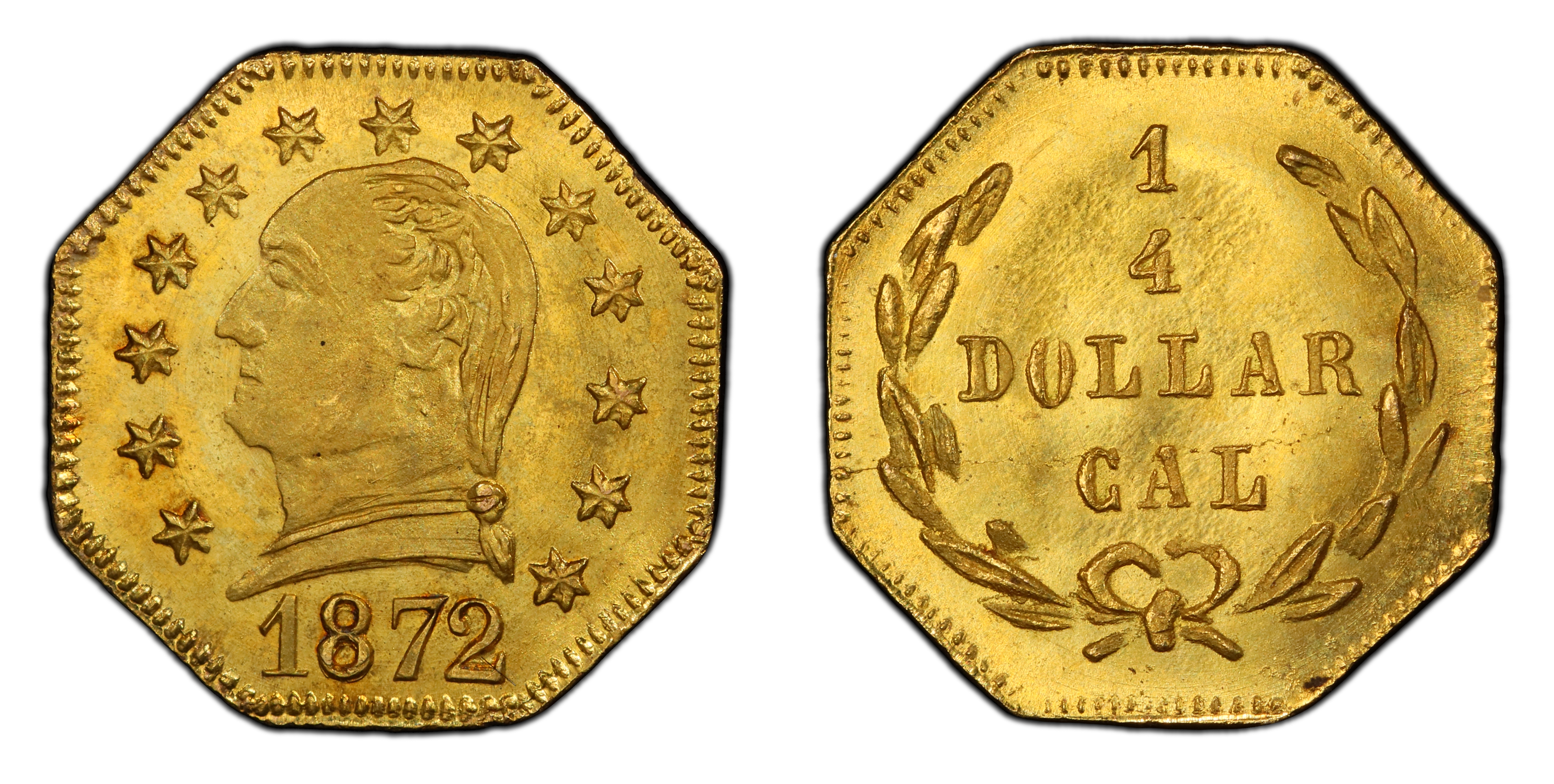
Obverse & Reverse
The 1872 BG-722 Washington Head 25 Cents is a quintessential example of 'Period Two' California Fractional Gold. By the 1870s, the initial, desperate need for small circulating currency that spurred the creation of the first fractional gold pieces in 1852 had largely subsided. The San Francisco Mint was producing ample federal coinage, and the fractional pieces had transitioned from a commercial necessity to a popular souvenir and jewelry item. Tourists and locals alike sought these miniature gold coins as mementos of the California Gold Rush, a tangible, glittering link to the state's defining event. This shift in purpose is reflected in the coin's production quality; they were often struck with more care than the earlier, utilitarian issues, sometimes featuring prooflike surfaces. The Washington portrait was a popular and patriotic motif, likely chosen to appeal to a broad audience. However, the legal environment for private minters was precarious. The Coinage Act of 1864 had prohibited private coinage, but enforcement was inconsistent. Minters operated in a gray area, often producing pieces that were technically tokens or charms to avoid federal scrutiny. These 'Period Two' pieces, unlike their 'Period One' predecessors, were knowingly struck underweight relative to their face value, solidifying their status as novelties rather than true circulating money. The BG-722 and its contemporaries represent the maturation of a numismatic niche, born from frontier necessity and sustained by commercial ingenuity and a burgeoning tourist trade that romanticized the Gold Rush era.
Associated EventPost-Gold Rush California Economic Development
Reason For MintingPrimarily struck to be sold as souvenirs and jewelry charms to tourists and locals, capitalizing on the romanticism of the Gold Rush.
Minter HistoryWhile not definitively signed, the BG-722 is stylistically and diagnostically attributed to Robert B. Gray & Co., a San Francisco jewelry firm known to have produced a variety of California fractional gold pieces during this period. Like many of their contemporaries, they were jewelers and manufacturers who saw a commercial opportunity in the continued demand for these small gold tokens long after their initial monetary purpose had faded. They were skilled in die work and striking, producing a wide array of popular designs.
Historical SignificanceThis piece is significant not as a coin for circulation, but as a historical artifact representing the evolution of California's economy and culture. It marks the transition of fractional gold from a vital commercial tool in a coin-starved frontier to a popular souvenir, reflecting a more settled, prosperous California that was beginning to market its own history.
BG-722
Denomination25 Cents
Minting Period1872
Assayer/MinterAttributed to Robert B. Gray & Co.
Geographic OriginSan Francisco, California
Obverse DescriptionA right-facing bust of George Washington, modeled after the prevailing patriotic imagery of the era. The portrait is encircled by thirteen six-pointed stars, representing the original colonies.
Obverse Inscription[None, pictorial only]
Reverse DescriptionThe denomination '1/4' is centered within a wreath of two olive branches tied with a bow at the bottom. Above the wreath is the date '1872' and below is the word 'DOLLAR'.
Reverse Inscription1872 1/4 DOLLAR
CompositionGold
Stated Fineness Actual FinenessVariable, but generally lower than federal coinage, as was typical for Period Two issues.
Weight0.25 grams
Diameter10.00 mm
EdgePlain
Unknown
Survival Estimate150-250
Rarity ScaleR-4
The BG-722 is highly popular due to its classic Washington portrait, a patriotic design that stands out within the series. Its octagonal shape adds to its appeal, and as a 'Period Two' issue, it is more frequently found in high grades than earlier, heavily circulated pieces, making it an attractive target for type collectors and those seeking high-quality examples of fractional gold.
Key VarietiesThe primary issue is the business strike. No original proof strikings are known. Collectors should be aware that many fractional gold pieces were used in jewelry, so examples may be found that were formerly mounted or show evidence of tooling or repair. There are no major die varieties widely collected for BG-722, but minor die states may exist.
Authentication TipsGenuine BG-722 pieces have a specific die character. The stars on the obverse should be sharp and well-formed. On the reverse, the numerals in the date and the fraction should match the style known for this variety. Counterfeits and modern replicas abound; many are brassy in color, have a crude or 'mushy' strike, incorrect weight, or feature a bear on the reverse (a common feature of modern tokens, not genuine fractionals). Authentication by a major grading service (PCGS or NGC) is highly recommended. The standard reference guide by Breen and Gillio is essential for die identification.
Shopping ConsiderationsA premium quality example of BG-722 will exhibit a sharp, well-centered strike. Look for full definition in Washington's hair details and the individual leaves of the wreath. Surfaces should be clean and free of distracting marks, although small planchet flaws are common for the series. Luster is a key value determinant; examples with frosty or even prooflike surfaces command significant premiums. Avoid pieces that have been harshly cleaned, which strips the original skin and imparts a dull or hairlined appearance. Also, check the edges carefully for evidence of prior mounting in jewelry, a common fate for these historic items.
A coin's grade is its condition, rated on a 1-70 scale. For rare coins, this is the most critical factor in determining value, as a tiny difference in preservation can mean a huge difference in price.
Relevant Grade TypesOriginal 1872 BG-722 issues were business strikes, although primarily intended for sale to collectors and tourists rather than for circulation. They are found in Circulated grades (AU-50 to AU-58 are most common for circulated examples) and, more frequently than Period One issues, in Mint State (MS, 60-70) grades. No true Proofs were struck during the original period of issue. Any piece described as a 'Proof' is likely a prooflike (PL) business strike, which refers to a coin struck with highly polished dies, resulting in mirror-like fields. These PL examples are highly desirable but are still graded on the MS scale.
Mint State CharacteristicsUncirculated examples of BG-722 are characterized by their luster and strike. High-end pieces often have a bright, satiny or even prooflike luster from fresh, polished dies. The strike can be variable; look for sharpness on Washington's cheek and hair curls, and on the bow of the wreath. Weakness is sometimes seen at the centers. As these are tiny gold pieces, even high-grade examples can have minor planchet irregularities or flecks, which are typically accepted as part of the manufacturing process and do not detract unless severe.
Circulated Wear PatternsWear first appears on the highest points of the design. On the obverse, this is Washington's cheekbone, the hair above his ear, and the front of his shoulder. On the reverse, the high points of the wreath's leaves and the numerals of the fraction will show the first traces of friction and flattening. In lower grades (VF and below), the stars on the obverse and the lettering on the reverse will begin to lose their sharpness.
Key Factors For ValueFor the BG-722, value is driven by several factors. First and foremost is the certified grade; a jump from MS63 to MS64 can double the price. Secondly, surface quality and eye appeal are paramount. An example with clean, original surfaces and strong luster will always be prized over a dull or heavily marked coin of the same grade. Prooflike (PL) or Deep Mirror Prooflike (DMPL) designations add a substantial premium. Finally, a CAC sticker, indicating a premium quality coin for the grade, is highly sought after by discerning collectors and can add 20-50% or more to the value.
PCGS Price Guide
| Grade | Price | Population |
|---|---|---|
| 50 | N/A | N/A |
| 58 | $700.00 | 1 |
| 58+ | $750.00 | N/A |
| 60 | $850.00 | N/A |
| 61 | $900.00 | 1 |
| 62 | $1,150.00 | 18 |
| 62+ | $1,200.00 | N/A |
| 63 | $1,350.00 | 26 |
| 63+ | $1,425.00 | 1 |
| 64 | $1,525.00 | 40 |
| 64+ | $1,675.00 | N/A |
| 65 | $1,900.00 | 27 |
| 65+ | $2,050.00 | 2 |
| 66 | $2,250.00 | 28 |
| 66+ | $3,500.00 | 5 |
| 67 | $4,500.00 | 5 |
| 67+ | N/A | 1 |