1854 G50C BG-425 (Regular Strike)
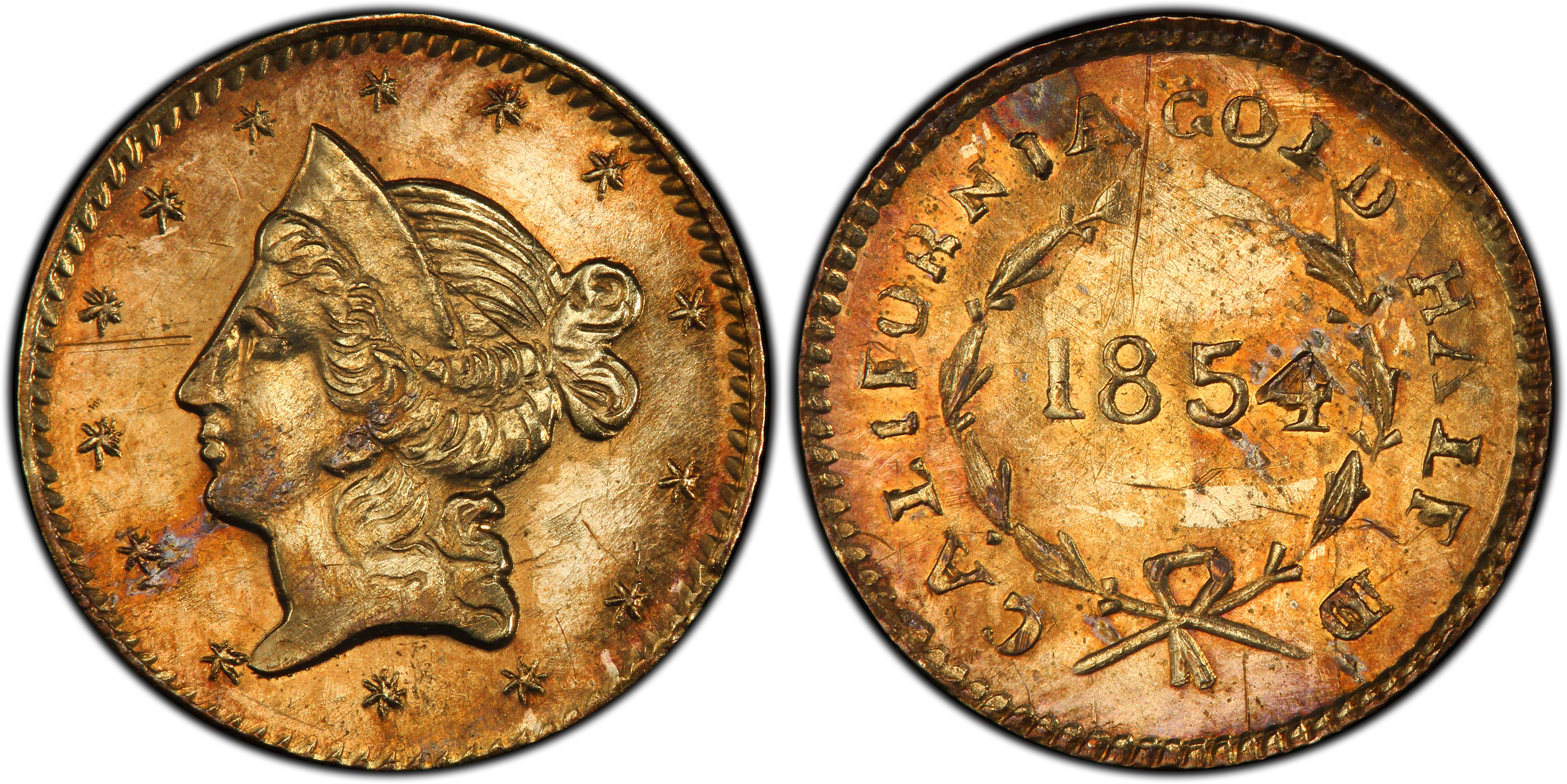
Obverse & Reverse
The 1854 G50C BG-425 is a tangible relic from the chaotic and economically dynamic 'Period One' (1852-1856) of California Fractional Gold production. The California Gold Rush, initiated in 1848, had flooded the isolated West Coast economy with raw gold, but a severe shortage of circulating small-denomination coinage created immense friction in daily commerce. Common transactions were often conducted with a 'pinch' of gold dust, a notoriously inaccurate and contentious method. While private assayers like Moffat & Co. and Kellogg & Co. struck larger denomination coins, the need for pocket change remained acute. This void was filled by enterprising jewelers and metalsmiths in San Francisco who began striking their own quarter, half, and dollar gold pieces. These were not government issues but were generally accepted in trade out of sheer necessity, despite often being underweight relative to their face value. The year 1854 was a pivotal moment; the official United States Branch Mint finally opened in San Francisco, signaling the eventual end of the era of private coinage. However, the new mint's initial output was inconsistent and insufficient to meet the rampant demand, allowing private minters to continue their operations for a few more years. The BG-425 was struck amidst this environment, a product of private enterprise directly serving the commercial needs of miners, merchants, and settlers before federal coinage could fully establish itself. These tiny gold pieces served a dual purpose: they were indispensable for commerce, yet their novelty and connection to the gold fields also made them popular souvenirs to be sent back East, which likely contributed to the survival of the few examples known today. The passage of federal laws in 1864 ultimately prohibited private coinage, cementing the status of these early fractional issues as a fascinating and historically significant, albeit brief, chapter in American numismatic history.
Associated EventCalifornia Gold Rush
Reason For MintingTo alleviate a severe shortage of small-denomination circulating coinage for daily commercial transactions in Gold Rush-era California.
Minter HistoryThe firm of Gaime, Guillemot & Co. is one of the more enigmatic producers of California fractional gold. Research by Walter Breen and Ronald Gillio suggests they were a New York-based jewelry firm. It is theorized that they did not operate a mint in San Francisco themselves, but rather contracted with an established San Francisco jeweler, likely Frontier, Deviercy & Co., to produce gold pieces on their behalf, marked with their 'GG' initials on some varieties. This arrangement highlights the commercial demand for these coins, which was so strong that it attracted investment and participation from firms on the East Coast. M. Deriberpe is another French jeweler associated with several Period One issues from 1853-1854, and the stylistic similarities across these issues suggest a small, interconnected community of producers, likely sharing die-sinking talent and minting equipment.
Historical SignificanceAs a 'Period One' issue, this coin represents the initial, utilitarian phase of California fractional gold, struck to meet a genuine economic need before becoming primarily souvenirs. Its extreme rarity underscores the ephemeral nature of these privately issued coins, most of which were withdrawn from circulation, melted, or simply lost over time.
BG-425
DenominationG50C (50 Cents)
Minting Period1854
Assayer/MinterGaime, Guillemot & Co. (Attributed)
Geographic OriginSan Francisco, California
Obverse DescriptionA Liberty Head, facing left, with 'LIBERTY' inscribed on her coronet. The portrait is surrounded by thirteen six-pointed stars, representing the original colonies. The style is a direct, if somewhat crude, imitation of the contemporary federal gold dollars designed by James B. Longacre.
Obverse Inscription Reverse DescriptionThe denomination '1/2' and the word 'DOLLAR' are enclosed within a wreath of olive or laurel. The date '1854' is positioned inside the wreath, below the denomination. The legend 'CALIFORNIA GOLD' encircles the wreath along the upper periphery.
Reverse InscriptionCALIFORNIA GOLD 1/2 DOLLAR 1854
CompositionGold
Stated Fineness Actual FinenessTypically varied, often between .800 and .900, usually from unrefined native California gold which contained silver.
Weight0.49 grams
Diameter11.00 mm
EdgePlain
Unknown
Survival Estimate10-20 coins
Rarity ScaleR-7 (Very Rare)
The BG-425 is highly coveted as a 'Period One' issue that genuinely circulated. Its appeal lies in its direct connection to the Gold Rush, its status as a private, territorial issue, and its extreme rarity. For specialists, completing a set of all Breen-Gillio varieties is a lifetime pursuit, and acquiring an R-7 variety like this is a major accomplishment.
Key VarietiesThe primary variety is the BG-425 Regular Strike. No known major variations, patterns, or restrikes from the original minting period exist for this specific variety. The broader series of California Fractional Gold includes hundreds of die varieties, as well as octagonal versions and different denominations, which form the basis of specialized collecting.
Authentication TipsAuthentic 'Period One' fractionals are characteristically thin and often weakly or unevenly struck due to the crude manual presses used. The details, particularly the stars and wreath elements, may appear soft. Counterfeits are often thicker, have a soapy or cast-like appearance, incorrect weight, and may feature a bear on the reverse, a motif not used on genuine pre-1883 issues. Examine the style of the lettering and the Liberty portrait; they should match known genuine examples cataloged in the Breen-Gillio reference. Third-party grading by a reputable service is highly recommended.
Shopping ConsiderationsFor an R-7 variety, any example is a significant find. A premium quality specimen would be one that is well-centered and relatively sharply struck for the issue, with minimal impairments. Look for original, undisturbed surfaces with a hint of reddish-gold toning from the native gold alloy. Avoid examples that have been harshly cleaned, which will appear unnaturally bright and show hairlines. Given the rarity, even coins with minor planchet flaws, laminations, or slight circulation wear are highly desirable. Pay close attention to the sharpness of 'LIBERTY' on the coronet and the date, as these are high points that can indicate the level of preservation.
A coin's grade is its condition, rated on a 1-70 scale. For rare coins, this is the most critical factor in determining value, as a tiny difference in preservation can mean a huge difference in price.
Relevant Grade TypesAll original examples of BG-425 were struck as business strikes intended for commerce. They are found in Circulated grades (AG-3 to AU-58) and, very rarely, in Mint State (MS, 60-70). No proofs were struck during the original period of issue, and there are no known later-date collector restrikes for this specific Breen-Gillio variety.
Mint State CharacteristicsAn uncirculated BG-425 is exceptionally rare. Quality is defined by the strength of the strike; a sharp strike on the high points of Liberty's hair and the wreath is paramount. Luster on these pieces is typically soft and satiny rather than deeply prooflike. Due to the rudimentary minting process and the softness of the gold, even Mint State examples will likely exhibit some minor planchet irregularities or contact marks that occurred at the time of minting or shortly thereafter.
Circulated Wear PatternsWear first appears on the highest points of the design: Liberty's cheek, the hair above the ear, and the inscription 'LIBERTY' on the coronet. On the reverse, the highest points of the wreath leaves and the digits of the date will show the first signs of friction. On lower grade examples (VF and below), the stars on the obverse and the lettering of 'CALIFORNIA GOLD' will begin to lose their sharpness and merge towards the fields.
Key Factors For ValueFor a coin of this rarity, simply being authenticated and problem-free is the primary value driver. Beyond that, a sharp strike is the most desirable attribute, as many were weakly produced. Secondly, original surfaces that have not been cleaned or polished are prized; a coin with its natural 'skin' and attractive reddish-gold color commands a significant premium. Eye appeal is critical, and a CAC sticker, indicating premium quality for the grade, would add substantially to the coin's value.
PCGS Price Guide
| Grade | Price | Population |
|---|---|---|
| 45 | $1,750.00 | 1 |
| 45+ | $1,835.00 | N/A |
| 50 | $2,000.00 | N/A |
| 50+ | $2,100.00 | N/A |
| 53 | $2,250.00 | N/A |
| 53+ | $2,450.00 | N/A |
| 55 | $2,750.00 | 1 |
| 55+ | $3,250.00 | N/A |
| 58 | $4,000.00 | 4 |
| 58+ | $4,500.00 | N/A |
| 60 | $5,250.00 | 1 |
| 61 | $6,000.00 | N/A |
| 62 | $7,000.00 | 2 |
| 62+ | $7,500.00 | N/A |
| 63 | $9,000.00 | 2 |