1854 G50C BG-304A (Regular Strike)
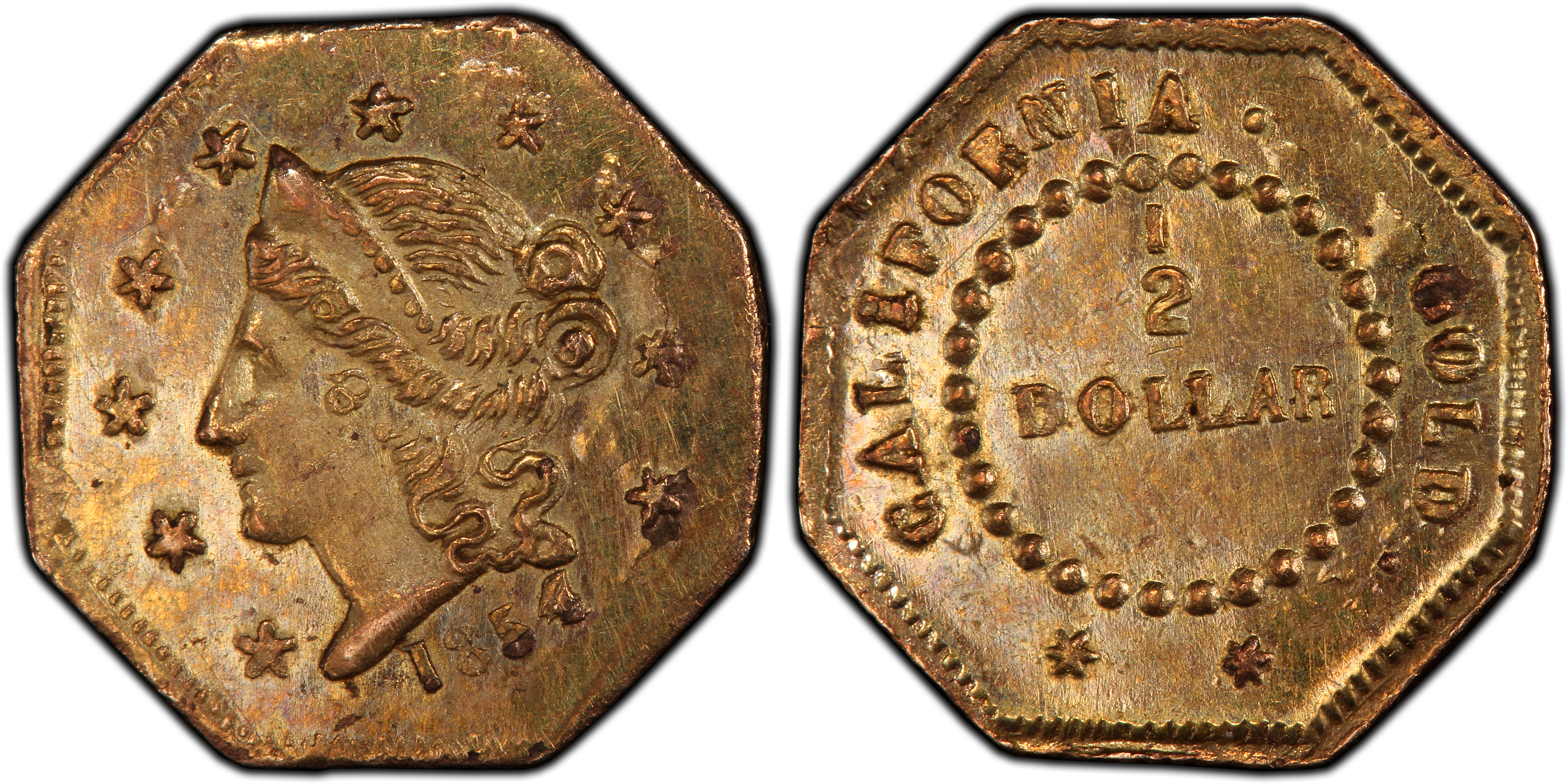
Obverse & Reverse
The 1854 Octagonal Gold 50 Cents, cataloged as Breen-Gillio 304A, is a numismatic artifact of staggering rarity, born from the chaotic economic crucible of the California Gold Rush. Following the discovery of gold at Sutter's Mill in 1848, a massive influx of prospectors and merchants descended upon California, creating a vibrant economy almost overnight. However, this boom was crippled by a severe shortage of circulating small-denomination coinage. Gold dust, weighed in 'pinches,' served as a crude medium of exchange, but it was imprecise and prone to theft and fraud. While private assayers like Moffat & Co. and Kellogg & Co. struck larger denomination coins, the need for pocket change for everyday transactions—a drink at a saloon, a loaf of bread—was acute. Into this void stepped a number of manufacturing jewelers, many of them French immigrants, who began striking their own fractional denomination gold coins in 1852. These 'Period One' issues (1852-1857) were intended for actual circulation and were generally of high quality and weight, designed to mimic federal issues to gain public trust. The BG-304A was struck in 1854, the same year the official San Francisco Branch Mint opened. However, the new mint's initial output of small coins was insufficient to meet demand, allowing private minters to continue their operations. The firm of Gaime, Guillemot & Co., located on Clay Street in San Francisco, is credited with producing this issue. These French jewelers were known for their craftsmanship, and their coins were a vital, if unofficial, part of the regional economy. The octagonal shape was a popular feature of the era, distinguishing these private issues from round federal coins and hearkening back to the massive $50 'slugs' produced by Augustus Humbert. The eventual saturation of the market with federal coinage from the San Francisco Mint by 1856-1857 rendered these private fractionals obsolete, and most were likely melted. The BG-304A's survival in minuscule numbers suggests an infinitesimally small original mintage or a near-total recall and destruction, cementing its status as one of the ultimate prizes in the entire field of U.S. territorial gold.
Associated EventCalifornia Gold Rush
Reason For MintingTo alleviate a severe shortage of small-denomination coinage for daily commercial transactions in Gold Rush-era California.
Minter HistoryGaime, Guillemot & Company was a firm of French manufacturing jewelers active in San Francisco during the early 1850s. Like several of their contemporaries, they leveraged their expertise in working with precious metals to fill a critical economic niche by producing private gold coinage. Their familiarity with die sinking and press operation allowed them to create coins that were accepted in local commerce. These jewelers were not assayers in the traditional sense but rather entrepreneurs who converted raw gold dust and nuggets into a more convenient and standardized form of currency. Their operations were eventually superseded by the full-scale production of the official U.S. Branch Mint in San Francisco.
Historical SignificanceThe BG-304A represents the peak of private, small-denomination coinage during the Gold Rush. As a 'Period One' issue, it is a tangible link to the daily economic life of miners and merchants before federal coinage became commonplace. Its extreme rarity underscores the ephemeral nature of these privately issued coins and their critical but short-lived role in the monetary system of the American West. It is a key variety for understanding the private sector's response to monetary scarcity on the frontier.
N/A
Denomination50 Cents
Minting Period1854
Assayer/MinterGaime, Guillemot & Company
Geographic OriginSan Francisco, California
Obverse DescriptionAn octagonal planchet featuring a left-facing bust of Liberty. Her hair is tied in a bun at the back. She is surrounded by thirteen six-pointed stars, representing the original colonies. The date '1854' is centered below the bust.
Obverse Inscription1854
Reverse DescriptionThe central device is a simple wreath composed of two branches tied with a bow at the bottom. Within the wreath, the denomination is expressed on two lines as '1/2' and 'DOL.'. The legend 'CALIFORNIA GOLD' is inscribed in an arc along the upper periphery, outside the wreath.
Reverse InscriptionCALIFORNIA GOLD 1/2 DOL.
CompositionGold
Stated Fineness Actual FinenessTypically .875 to .900 for Period One issues
Weight0.86 grams
Diameter11.00 mm
EdgePlain
Extremely low; exact figure unknown
Survival Estimate2-3 known
Rarity ScaleR-9 (High)
The BG-304A is a 'Holy Grail' variety for the advanced specialist of California Fractional Gold. Its appeal lies in its absolute rarity (R-9), its desirable octagonal shape, and its origin as a true circulating medium from the height of the Gold Rush. Acquiring an example is a landmark event for any collection of pioneer gold.
Key VarietiesThe BG-304A itself has no known sub-varieties due to its minuscule population. A closely related variety is the BG-304B, also dated 1854, which uses a different obverse die. No special collector issues, patterns, or restrikes of the BG-304A are known to exist.
Authentication TipsDue to its immense value and rarity, authentication by a top-tier grading service (PCGS or NGC) is mandatory. Diagnostics for genuine examples are based on precise die markers known only to a few experts and the major grading services. General characteristics of Period One fractionals to watch for include a sharp, albeit sometimes uneven, strike from hand-operated presses, and a consistent gold color typical of native California alloy (often with a slightly higher silver content). Beware of modern replicas, which are common for the series but will lack the precise die characteristics of the BG-304A. Any piece with a bear on the reverse is a fantasy piece, not a genuine fractional coin.
Shopping ConsiderationsThe acquisition of a BG-304A is a once-in-a-generation opportunity, typically occurring only when a major, long-held collection is liquidated at auction. A potential buyer should prioritize certification above all else; a raw example should be considered non-existent for practical purposes. Given the rarity, any certified example, regardless of grade, is a prize. A premium quality piece would be one that is well-centered and struck, with minimal marks and evidence of original, uncleaned surfaces. Provenance is also a significant factor, with examples traced to famous collections like Jay Roe's carrying a substantial premium. Expect to face intense competition from the most sophisticated collectors in the field.
A coin's grade is its condition, rated on a 1-70 scale. For rare coins, this is the most critical factor in determining value, as a tiny difference in preservation can mean a huge difference in price.
Relevant Grade TypesAll original examples of the BG-304A are business strikes intended for circulation and are found in Circulated (1-58) and Mint State (MS, 60-70) grades. Given the known population of 2-3 pieces, it is possible that all survivors are in Mint State or very high circulated grades. No Proofs were struck during the original period of issue, and no later-date Proof restrikes are known.
Mint State CharacteristicsA Mint State example of this issue would likely exhibit a soft, satiny luster characteristic of early California gold. The strike, produced by a hand-operated screw press, may show some areas of minor weakness, particularly at the centers (Liberty's hair bun, the numerals '1/2'). The octagonal edges would be sharp but might show slight unevenness inherent to the manufacturing process. Small planchet flaws or adjustment marks would not be unusual. Given the coin's journey, even an uncirculated piece may exhibit minor contact marks from handling with other coins in the 170 years since it was struck.
Circulated Wear PatternsBased on the design, wear would first appear on the highest points. On the obverse, this would be Liberty's cheek, the hair above her ear, and the tips of the stars. On the reverse, the highest points of the wreath's leaves and the numerals of the fraction '1/2' would exhibit the first traces of friction. In lower grades (which may not exist for this variety), the finer details of the hair and wreath would merge, and the legends would soften and begin to blend into the fields.
Key Factors For ValueFor a legendary rarity like the BG-304A, the primary factor for value is simply its existence and availability on the market. Assuming certification by PCGS or NGC, the specific numerical grade is the next determinant. Surface quality is paramount; an example with original, lustrous surfaces and minimal distracting marks will command a significant premium over one that has been cleaned, damaged, or exhibits heavy abrasions. Eye appeal, encompassing the quality of the strike and the richness of the gold coloration, is also a critical, albeit subjective, factor. Finally, a CAC sticker would provide a further layer of assurance regarding quality for the grade and would be highly sought after.
PCGS Price Guide
| Grade | Price | Population |
|---|---|---|
| 61 | $72,500.00 | 1 |