1860 G25C BG-731 (Regular Strike)
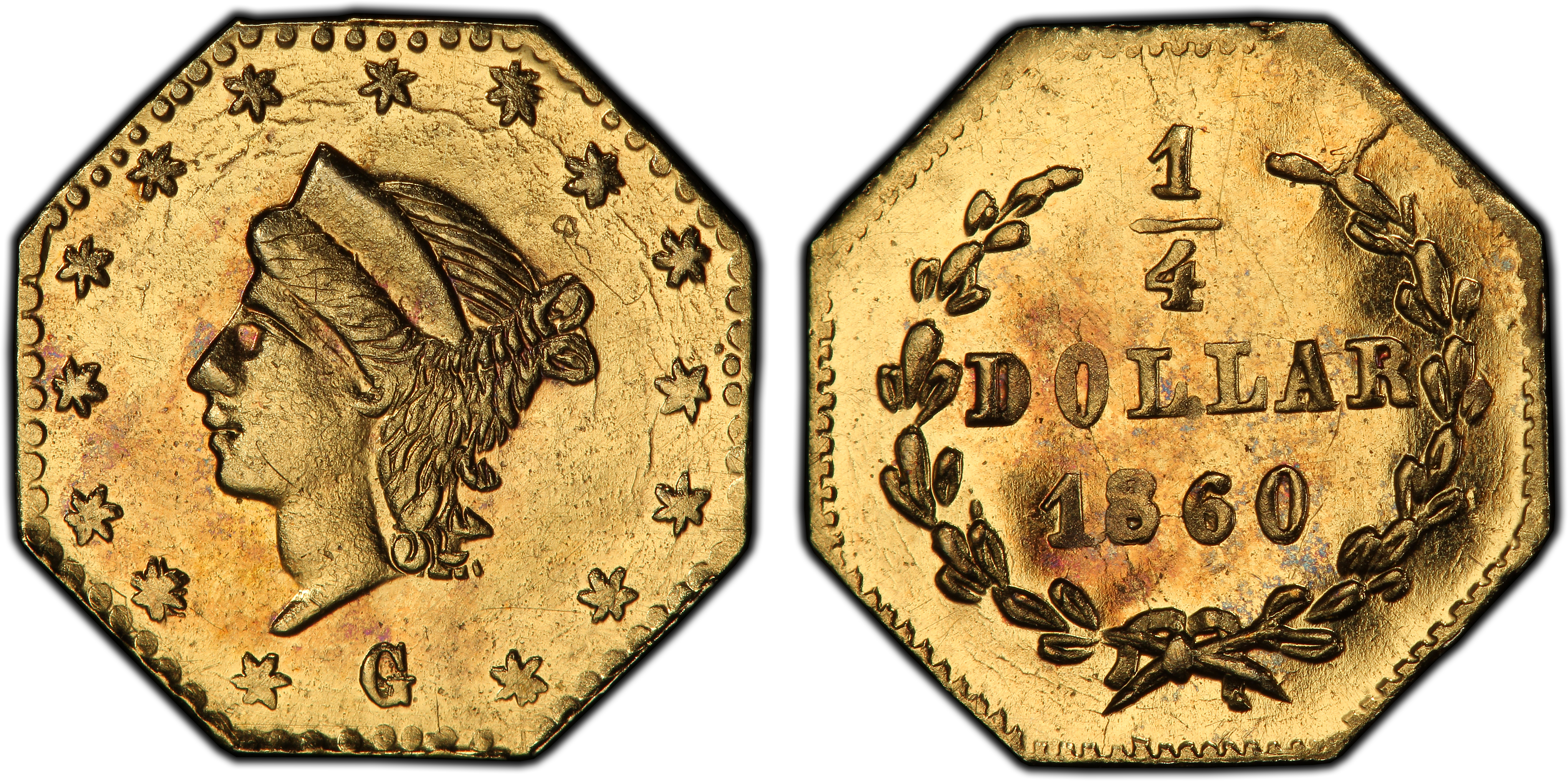
Obverse & Reverse
The 1860 BG-731 quarter dollar is a quintessential example of a 'Period Two' California Fractional Gold piece, a fascinating and complex series born from the economic realities of the American West. Following the initial California Gold Rush boom of 1849, the region remained flush with gold dust but chronically short of small denomination coinage for daily transactions. The first wave of fractional gold, 'Period One' (1852-1857), was struck with a high intrinsic value and served a genuine commercial need. However, by 1860, the landscape had shifted. The San Francisco Mint, opened in 1854, was producing sufficient federal coinage, diminishing the functional necessity for private issues. Consequently, the motivation behind Period Two pieces like BG-731 evolved. These later issues were produced primarily by San Francisco's community of French and European jewelers, who recognized a burgeoning market for gold souvenirs. Miners, merchants, and tourists desired small, affordable, and easily transportable keepsakes of their California adventure. These 'jeweler's issues' were often intentionally underweight relative to their face value, maximizing profit for the makers while still being objects of genuine gold. They were more akin to tokens or charms than true circulating currency, though their denominated nature placed them in a legally gray area. Struck crudely by hand using a hammer method—where a die was placed on a planchet and struck with a sledgehammer—their quality varied immensely. The production of these pieces continued until the Secret Service began cracking down on private coinage in the early 1880s, effectively ending the era. Today, the BG-731 represents this second, more commercial phase of fractional gold production, valued not for its role in commerce, but as a tangible link to the entrepreneurial spirit and souvenir trade of Gold Rush-era San Francisco.
Associated EventCalifornia Gold Rush
Reason For MintingPrimarily created to satisfy the demand for gold souvenirs and keepsakes in post-Gold Rush California, rather than to fill a circulating coinage shortage.
Minter HistoryWhile not definitively signed, BG-731 is attributed to the circle of French-immigrant jewelers active in San Francisco during this period, with Gaime, Guillemot & Co. being a prominent and likely producer of this style of fractional gold. These skilled artisans, located in the bustling commercial heart of the city, pivoted from jewelry making to producing these popular and profitable gold tokens. They operated outside the federal system, creating their own distinctive dies and striking methods. Their collective output defines the 'Period Two' era, characterized by a wide variety of designs and a shift from utilitarian coinage to commercial souvenirs.
Historical SignificanceThe BG-731 is significant not as a coin that facilitated widespread commerce, but as a historical artifact representing the evolution of the California Gold Rush economy. It marks the transition from a desperate need for any form of currency to a maturing society with a demand for luxury goods and mementos. It is a direct product of the private enterprise and immigrant craftsmanship that shaped San Francisco in the mid-19th century.
BG-731
Denomination$0.25 (25 Cents)
Minting Period1860
Assayer/MinterGaime, Guillemot & Co. (Attributed)
Geographic OriginSan Francisco, California
Obverse DescriptionA head of Liberty facing left, with thirteen stars encircling the portrait. The portrait style is crude, typical of the hand-engraved dies used by private minters of the era. The date '1860' appears below the bust.
Obverse Inscription1860
Reverse DescriptionThe denomination '1/4 DOLLAR' is displayed within a wreath of leaves and berries. The wreath is open at the top.
Reverse Inscription1/4 DOLLAR
CompositionGold
Stated Fineness Actual FinenessVariable, but generally lower than the .900 fineness of federal gold, as was common for Period Two issues.
Diameter9.50 mm
EdgePlain
Unknown
Survival Estimate76-150
Rarity ScaleR-5
The BG-731 is highly sought after by specialists in California fractional gold and collectors of Gold Rush history. Its appeal lies in its specific date, octagonal shape, clear denomination, and its status as a representative of the popular 'Liberty Head' type from the intriguing Period Two era. Each piece is unique due to the hand-striking process.
Key VarietiesThe primary issue is the business strike of 1860. Unlike federal coinage, there are no known major die varieties, patterns, or official restrikes for this specific BG number. The variety in this series comes from the hundreds of different die pairs (BG numbers) produced by various jewelers. No special collector issues such as proofs were made during the original period of manufacture for this variety.
Authentication TipsGenuine examples have a characteristic crude but sharp strike from a hammer blow, often resulting in slight unevenness. The lettering and stars, while not perfectly formed, should match known genuine examples in style and placement. Look for parallel striations on the fields, a hallmark of the planchet preparation process. Counterfeits are common and often have a soft, cast-like appearance, incorrect weight, or soapy details. Modern replicas are typically gold-plated and will not have the correct metallic signature. Familiarity with the Breen-Gillio reference photos is essential.
Shopping ConsiderationsA premium quality example for its grade will exhibit a bold, well-centered strike, which is uncommon for the issue. Look for sharp details on Liberty's hair and the leaves of the wreath. Original, uncleaned surfaces with some remaining luster are highly desirable and command significant premiums. Avoid examples that are harshly cleaned, polished, or have been mounted in jewelry, a common fate for these pieces. Minor planchet flaws are common and generally acceptable, but significant scratches, rim bumps, or tooling should be avoided. A greenish-gold or reddish-gold tint from original surfaces is often prized.
A coin's grade is its condition, rated on a 1-70 scale. For rare coins, this is the most critical factor in determining value, as a tiny difference in preservation can mean a huge difference in price.
Relevant Grade TypesOriginal period issues of BG-731 were all business strikes intended for sale as souvenirs, not circulation. They are found in Circulated grades (AU-58 and lower, though extensive circulation was unlikely) and Mint State (MS, 60-70) grades. No Proofs were struck during the original period. The term 'Prooflike' (PL) is often applied to high-grade examples that were struck from freshly polished dies, resulting in mirror-like fields, but these are a subset of business strikes and not true Proofs.
Mint State CharacteristicsIn uncirculated (MS) condition, the BG-731 often displays a soft, satiny luster rather than a hard, frosty one. The strike is a key determinant of quality; many are weakly struck in the center, particularly on the highest points of Liberty's hair and the wreath. Fields can be surprisingly clean but are often found with light, scattered marks due to the softness of the gold and casual handling. Prooflike examples with deep, reflective surfaces are rare and highly sought after.
Circulated Wear PatternsAlthough not intended for heavy circulation, wear on handled examples first appears on the high points of Liberty's hair, cheek, and the bow of the wreath. As wear progresses, the stars will begin to lose their definition, and the fine details of the wreath will merge. In lower grades (Fine and below), the date and legends may become weak or partially obliterated.
Key Factors For ValueThe primary value drivers for an 1860 BG-731 are grade and surface quality. An example with original, undisturbed luster and minimal marks will always command a premium. Strike is the next critical factor; a coin with a full, sharp strike is much more valuable than a weakly struck counterpart in the same numerical grade. Eye appeal, including attractive original toning (often a subtle reddish or greenish-gold hue), adds significantly to the value. Certification by a major grading service (PCGS or NGC) is standard, and a CAC sticker indicating premium quality for the grade often results in a substantial price increase.
PCGS Price Guide
| Grade | Price | Population |
|---|---|---|
| 40 | $200.00 | 1 |
| 45 | $210.00 | N/A |
| 45+ | $215.00 | N/A |
| 50 | $225.00 | 1 |
| 50+ | $230.00 | N/A |
| 53 | $240.00 | 1 |
| 53+ | $245.00 | N/A |
| 55 | $250.00 | 9 |
| 55+ | $275.00 | N/A |
| 58 | $350.00 | 18 |
| 58+ | $385.00 | N/A |
| 60 | $425.00 | 1 |
| 61 | $500.00 | 2 |
| 62 | $575.00 | 19 |
| 62+ | $625.00 | N/A |
| 63 | $750.00 | 1 |
| 63+ | $850.00 | N/A |
| 64 | $1,100.00 | 2 |