1853 G25C BG-214 (Regular Strike)
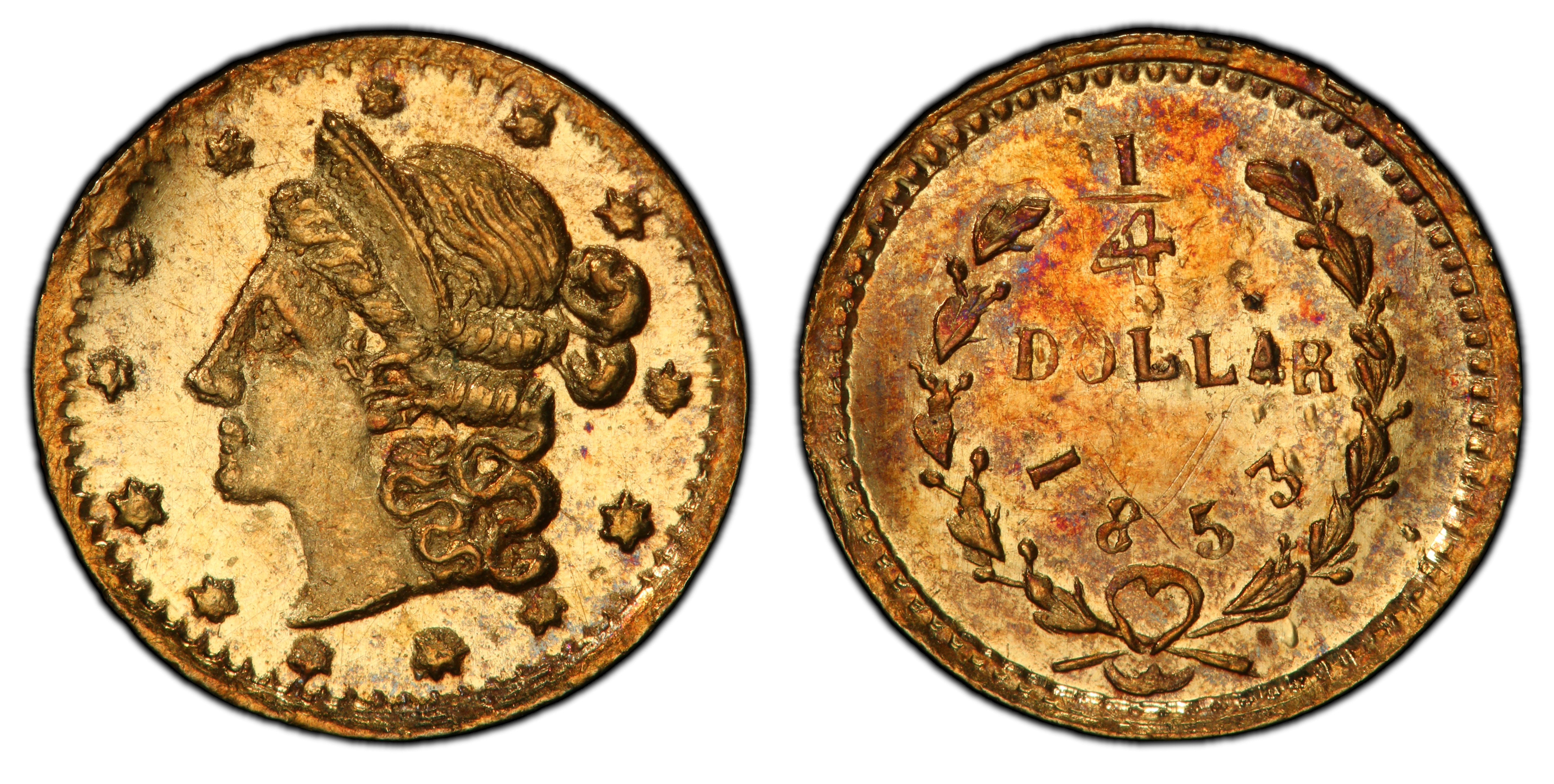
Obverse & Reverse
The 1853 G25C BG-214 Quarter Dollar is a tangible artifact from the chaotic and economically vibrant era of the California Gold Rush. Following the discovery of gold at Sutter's Mill in 1848, a massive influx of prospectors and merchants descended upon California, creating a booming economy almost overnight. However, this rapid growth far outpaced the supply of official United States coinage, leading to a severe, chronic shortage of small change. Daily transactions were cumbersome, often conducted with pinches of gold dust, a system prone to waste and inconsistency. Into this monetary vacuum stepped a number of private jewelers and metallurgists, many of French origin, who began minting their own small-denomination gold coins. These issues, now classified by numismatists as 'Period One' (1852-1857) California Fractional Gold, were not souvenirs, but rather utilitarian pieces intended to circulate and facilitate commerce. Unlike later issues, Period One coins were generally struck with a gold content close to their face value and were accepted, albeit unofficially, in trade. The BG-214 variety is attributed to Gaime, Guillemot & Co., a firm of jewelers and watchmakers located at 103 Montgomery Street in San Francisco during 1853-1854. However, numismatic scholarship, notably the work of Walter Breen and Ronald J. Gillio, suggests that the actual dies and planchets were likely produced for them by the more prolific minting firm of Frontier, Deviercy & Co. This arrangement was not uncommon, as many jewelers capitalized on the demand for coinage without possessing the necessary minting equipment. The BG-214 is an issue of extreme rarity, a testament to a probable low initial mintage and the harsh conditions of frontier circulation, which claimed the vast majority of these tiny, easily lost coins. Their existence was fleeting; by 1855-1856, the new San Francisco Mint was producing enough official federal coinage to alleviate the shortage, rendering the private issues obsolete and causing them to slowly disappear from circulation.
Associated EventCalifornia Gold Rush
Reason For MintingTo alleviate a severe shortage of small-denomination coinage for daily commerce in Gold Rush-era San Francisco.
Minter HistoryGaime, Guillemot & Co. was a jewelry and watchmaking firm operating at 103 Montgomery Street, San Francisco, in the early 1850s. Like many jewelers of the period, they entered the lucrative business of private coinage to meet the demands of the local economy. While the coins bear their implicit attribution, evidence strongly suggests the technical aspects of manufacturing, including die cutting and striking, were contracted out to Frontier, Deviercy & Co., a prominent and skilled private minting operation in the city. This partnership allowed Gaime, Guillemot & Co. to distribute coinage under their name without the significant capital investment in minting machinery. The firm's presence in the numismatic record is defined by these rare fractional gold pieces.
Historical SignificanceThe BG-214, as a Period One California Fractional Gold piece, represents a crucial solution to a regional economic crisis. It stands as evidence of private enterprise stepping in to fulfill a basic governmental function—the supply of circulating money—in a remote and rapidly developing territory. Its extreme rarity today underscores the ephemeral nature of these issues and their importance as essential, though short-lived, tools of commerce on the American frontier.
N/A
Denomination25 Cents
Minting Period1853
Assayer/MinterGaime, Guillemot & Co. (likely manufactured by Frontier, Deviercy & Co.)
Geographic OriginSan Francisco, California
Obverse DescriptionA Liberty Head, facing left, with LIBERTY inscribed on her coronet. The head is surrounded by thirteen six-pointed stars.
Obverse InscriptionLIBERTY
Reverse DescriptionThe denomination '25 CENTS' and date '1853' are enclosed within a wreath of two olive branches joined at the bottom by a bow.
Reverse Inscription25 CENTS 1853
CompositionGold
Stated Fineness Actual FinenessTypically .880 to .900 for Period One issues
EdgePlain
Unknown; extremely small
Survival Estimate4 to 9 coins known
Rarity ScaleR-7
This coin is highly sought after for its extreme rarity (R-7), its connection to the height of the California Gold Rush, and its status as a 'Period One' issue genuinely intended for circulation. Its elusiveness makes it a trophy piece for advanced collectors of territorial and fractional gold.
Key VarietiesThere are no known major varieties, patterns, or restrikes of the BG-214 from the original minting period. All known examples are considered business strikes.
Authentication TipsGenuine Period One fractionals like the BG-214 must have a denomination (e.g., '25 CENTS' or 'QUARTER DOL.'). Be wary of pieces that lack a denomination or feature anachronistic designs, such as a bear, which are hallmarks of later souvenirs or replicas. The strike is often crude by federal mint standards, but the lettering and devices should be distinct, not mushy or cast-looking. The gold color should be consistent with California ore, which often has a slightly lighter, brassy-yellow hue due to natural silver content. Authentication by a major third-party grading service (PCGS or NGC) is essential.
Shopping ConsiderationsFor an R-7 issue, any example offered is a major opportunity. A 'premium quality' example would be one that is free of significant planchet problems, such as laminations or heavy adjustment marks. Look for the sharpest strike possible, particularly on the word LIBERTY on the coronet and the digits of the date, which are often weakly struck. Original, uncleaned surfaces with some remaining mint luster are exceptionally rare and command a significant premium. Given the high rarity, even coins with minor problems (such as being slightly bent, as noted in some auction descriptions for this variety) are still considered highly desirable. Focus on originality and eye appeal above all else for the assigned grade.
A coin's grade is its condition, rated on a 1-70 scale. For rare coins, this is the most critical factor in determining value, as a tiny difference in preservation can mean a huge difference in price.
Relevant Grade TypesAll original 1853 BG-214 coins are business strikes, created for circulation. They are found in Circulated grades (AG-3 to AU-58) and, very rarely, in Mint State (MS, 60-70). No Proof (PR/PF) examples were struck during the original period of issue, and no later-date restrikes are known to exist.
Mint State CharacteristicsUncirculated examples of the BG-214 are exceedingly rare. A typical Mint State piece will likely exhibit some weakness in the strike, especially on the highest points of Liberty's hair and the wreath's leaves. Luster is typically satiny rather than deeply prooflike, though some examples are described as having semi-prooflike fields. Due to the primitive minting process and the softness of the gold, even uncirculated specimens will almost certainly display some light contact marks or planchet imperfections; a 'clean' surface for the grade is a key value driver.
Circulated Wear PatternsWear first appears on the highest points of the design: Liberty's cheek, the hair above her eye, and the coronet. On the reverse, the high points of the wreath leaves and the bow will show initial friction. On moderately worn examples (VF-F), the word LIBERTY on the coronet will become partially obscured, and the finer details of the wreath will merge. In lower grades, the stars and legends will begin to weaken and fade into the fields.
Key Factors For ValueFor the BG-214, the primary factor for value is simply its existence and authenticity, given its R-7 rarity. Beyond that, a sharp strike is highly prized, as many were weakly impressed. Surface preservation is critical; an example with original, unmolested surfaces and a pleasing reddish-gold toning will command a substantial premium over one that has been cleaned or polished. Any coin certified by PCGS or NGC will be more valuable, and a CAC sticker, signifying premium quality for the grade, would add another significant layer of value.
PCGS Price Guide
| Grade | Price | Population |
|---|---|---|
| 60 | $2,350.00 | N/A |
| 61 | $2,550.00 | N/A |
| 62 | $2,850.00 | 2 |
| 62+ | $4,000.00 | N/A |
| 63 | $6,750.00 | 6 |
| 63+ | $7,250.00 | N/A |
| 64 | $8,000.00 | 3 |