1853 G$1 BG-526 (Regular Strike)
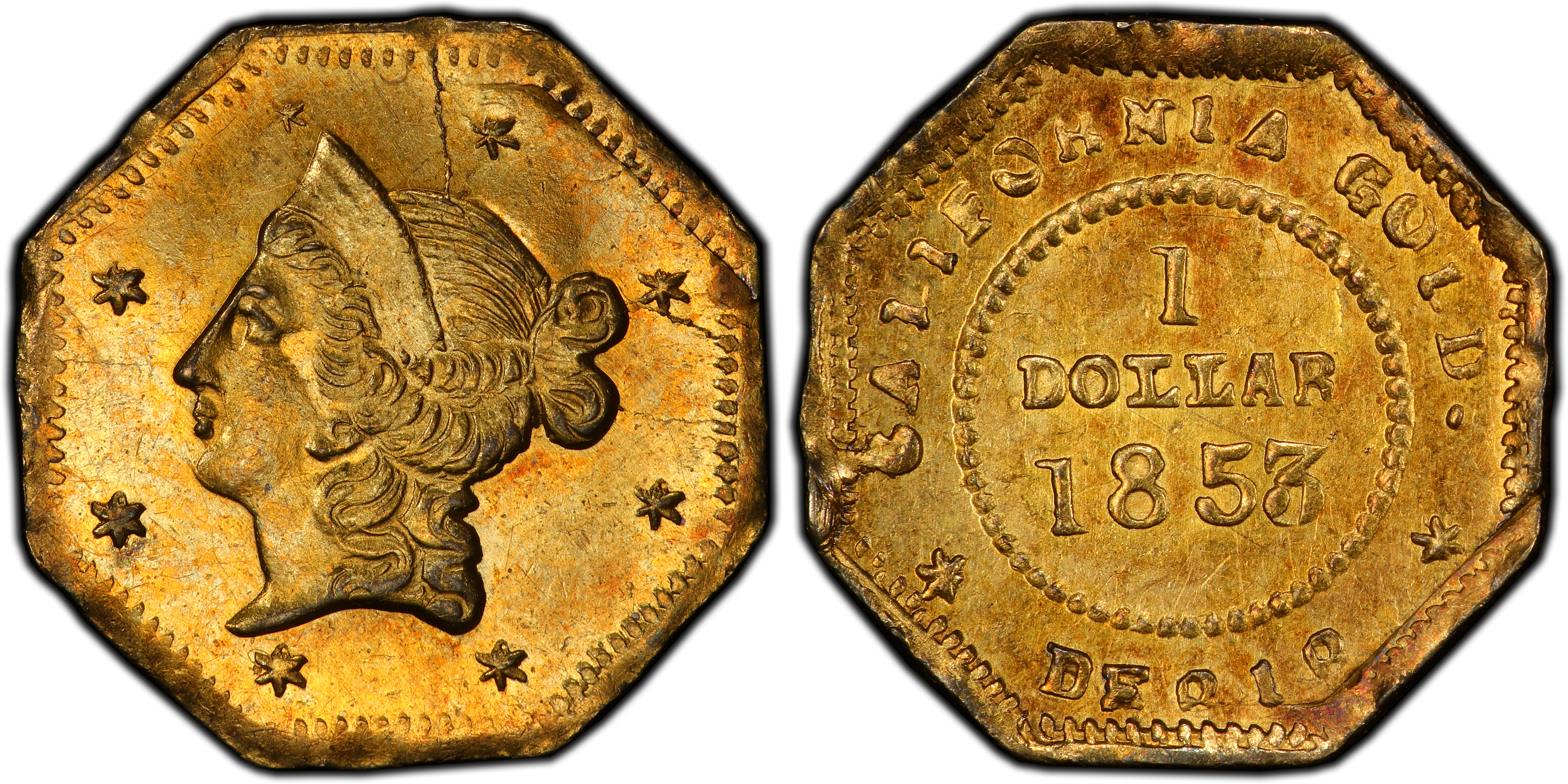
Obverse & Reverse
The 1853 Octagonal Gold Dollar, cataloged as Breen-Gillio 526, stands as a quintessential artifact from the chaotic and economically vibrant era of the California Gold Rush. Following the discovery of gold at Sutter's Mill in 1848, a massive influx of prospectors and merchants descended upon California, creating a new, dynamic economy virtually overnight. This boom, however, was plagued by a severe and persistent shortage of circulating small-denomination coinage. Gold dust and nuggets, the primary medium of exchange, were cumbersome, difficult to value accurately, and prone to theft and fraud. While several private firms began minting larger denomination coins ($5 to $50), the need for 'pocket change' for daily transactions remained acute. The United States government was slow to respond; the San Francisco Mint would not begin operations until 1854, and even then, its initial output of small coins was woefully inadequate. Into this monetary vacuum stepped a number of enterprising jewelers and metalsmiths, many of whom were French immigrants. From 1852 to 1857, a period numismatists classify as 'Period One' of California Fractional Gold, these private minters produced a dizzying array of quarter dollar, half dollar, and dollar coins. These were not government-sanctioned issues but were generally accepted in local commerce out of sheer necessity. The BG-526 is a prime example of this phenomenon. Struck by M. Deriberpie, a San Francisco jeweler, this octagonal dollar was crudely but functionally designed to resemble the federal gold dollars of the era, lending it a degree of familiarity and trustworthiness. These coins were typically manufactured by hand using the 'hammer method,' where dies were struck against a planchet with a sledgehammer, resulting in inconsistent strike quality and frequent die failures, such as the prominent cracks seen on the BG-526. Though intended for circulation, their small size and novelty also made them popular souvenirs. Most of these 'Period One' issues were notoriously underweight and of inconsistent fineness, a fact that eventually drew the scrutiny of authorities and led to the demise of many of these private minting operations by 1857 as federal coinage became more plentiful.
Associated EventCalifornia Gold Rush
Reason For MintingTo alleviate a severe shortage of small-denomination coinage for daily commercial transactions in Gold Rush-era San Francisco.
Minter HistoryM. Deriberpie was one of several prominent French jewelers and metalsmiths who operated in San Francisco during the early 1850s. Alongside contemporaries like Antoine Louis Nouizillet and the firm of Frontier, Deviercy & Co., Deriberpie played a key role in filling the region's desperate need for circulating coinage before the establishment of the U.S. Mint in the city. Little is documented about his personal life or the specific dates of his business operations, but his numismatic legacy is significant. The dies he created are distinctive, and his issues, including the dollar coins BG-526, BG-527, and BG-528, are central to the study and collection of 'Period One' California Fractional Gold. The die work suggests a skilled but perhaps hurried craftsman working with limited equipment, a common situation for these private minters.
Historical SignificanceThe BG-526 is historically significant as a tangible solution to a critical economic problem on the American frontier. It represents a period of unregulated, necessity-driven private enterprise in coinage, predating effective federal monetary control in California. Its existence and circulation, however brief, underscore the immense pressures of the Gold Rush economy and the ingenuity of the artisans who serviced it. Today, it is a highly prized numismatic relic of that unique era.
N/A
Denomination$1
Minting Period1853
Assayer/MinterM. Deriberpie
Geographic OriginSan Francisco, California
Obverse DescriptionA head of Liberty facing left, her hair tied in a bun at the back. She is surrounded by thirteen six-pointed stars arranged in a circle near the octagonal border. The date, 1853, is centered below the bust.
Obverse Inscription1853
Reverse DescriptionThe denomination '1 DOLLAR' is centered within a wreath composed of two branches tied with a bow at the bottom. The inscription 'CALIFORNIA GOLD' appears along the upper periphery, following the octagonal border.
Reverse InscriptionCALIFORNIA GOLD 1 DOLLAR
CompositionGold
Stated Fineness Actual FinenessVariable, but generally below the .900 standard of federal coinage.
Weight0.90 grams
Diameter12.50 mm
EdgePlain
Unknown
Survival EstimateFewer than 20
Rarity ScaleR-6+
The BG-526 is a classic and highly sought-after 'Period One' California Fractional Gold dollar. Its appeal lies in its direct connection to the Gold Rush, its crude but charming handmade quality, its octagonal shape, and its high rarity. The prominent die cracks serve as a key diagnostic and a story of its manufacture.
Key VarietiesThe primary variety is the regular strike BG-526. Recently, a unique and numismatically significant 'mule' was discovered and designated BG-526a. This variety pairs the known BG-526 obverse die with the reverse die of a different variety, BG-529 (an 1854-dated dollar). Analysis of the die state shows the die cracks on the BG-526a's obverse are more advanced than on the BG-526, proving the obverse die was used for the 1853-dated coins before being repurposed in 1854 for the BG-526a striking, likely just before it failed completely. No proof or presentation strikings from the original period are known or believed to exist.
Authentication TipsAuthenticity is paramount. The key diagnostic for a genuine BG-526 is the presence of three prominent, sharp die cracks on the obverse: one above Liberty's head connecting to the rim, and two near 3 o'clock connecting the hair bun to the rim. These must be sharp and integral to the coin, not added-on tool marks. The overall fabric should appear correct for a hand-hammered piece, with some softness in the strike and a slightly irregular planchet. Modern counterfeits often have a mushy or cast-like appearance, incorrect weight, and improperly replicated die cracks. Study high-resolution photos of certified examples before purchase.
Shopping ConsiderationsA premium quality example for its grade will show a bold, well-centered strike, which is uncommon for the issue. Look for minimal distracting marks on the delicate surfaces and evidence of original, unconserved skin or luster. Many survivors are found in circulated grades, often with impairments such as having been holed for jewelry, cleaned, or bent. An example that is problem-free, even in a lower grade like VF, is highly desirable. Pay close attention to the sharpness of the date and the word 'DOLLAR,' as these are often weak. A coin certified by a major grading service (PCGS or NGC) is strongly recommended, as it removes concerns about authenticity and provides a standardized grade.
A coin's grade is its condition, rated on a 1-70 scale. For rare coins, this is the most critical factor in determining value, as a tiny difference in preservation can mean a huge difference in price.
Relevant Grade TypesAll original BG-526 examples are business strikes intended for circulation. They are found in Circulated grades (AG-3 to AU-58) and, very rarely, in Mint State (MS-60 to 70). No Proof (PR/PF) examples were struck during the original minting period, and no later-date restrikes are known.
Mint State CharacteristicsAn uncirculated BG-526 will exhibit some degree of mint luster, though it is typically soft and satiny rather than deeply frosty. The strike is almost never full; expect some weakness in the center of the reverse (the denomination) and on the highest points of Liberty's hair. The planchets were not perfectly prepared, so minor inherent flaws may be present. Bag marks are less of a concern than with federal issues, but small handling marks from 170 years of existence are common even on high-grade examples.
Circulated Wear PatternsWear first appears on the highest points of the design. On the obverse, check the hair above Liberty's eye and ear, her cheek, and the tips of the stars. On the reverse, the high points of the wreath's leaves and the letters in 'DOLLAR' will show initial friction and smoothing. In lower grades (Fine and below), the date and legends become weak and Liberty's portrait details merge.
Key Factors For ValueFor the BG-526, value is driven by three main factors: grade, surface quality, and eye appeal. A higher grade is always better, but a problem-free AU with original surfaces is often more valuable than a cleaned or damaged Mint State example. The 'skin' is critical; collectors pay huge premiums for coins that have not been harshly cleaned, polished, or tooled. Eye appeal is subjective but important; an example with a sharp strike for the issue and attractive, reddish-gold toning will command a significant premium. A CAC sticker indicating premium quality for the grade will add substantially to the coin's value.
PCGS Price Guide
| Grade | Price | Population |
|---|---|---|
| 25 | $800.00 | N/A |
| 30 | $950.00 | N/A |
| 35 | $1,050.00 | N/A |
| 40 | $1,200.00 | N/A |
| 45 | $1,500.00 | 1 |
| 45+ | $1,650.00 | N/A |
| 50 | $2,000.00 | 5 |
| 50+ | $2,075.00 | N/A |
| 53 | $2,250.00 | 2 |
| 53+ | $2,500.00 | N/A |
| 55 | $3,000.00 | 5 |
| 55+ | $3,150.00 | N/A |
| 58 | $3,300.00 | 1 |
| 58+ | $3,500.00 | N/A |
| 60 | $3,750.00 | 1 |
| 61 | $4,750.00 | 2 |
| 62 | $7,000.00 | 3 |
| 62+ | $7,750.00 | N/A |
| 63 | $9,000.00 | 1 |