1868 G25C BG-710 (Regular Strike)
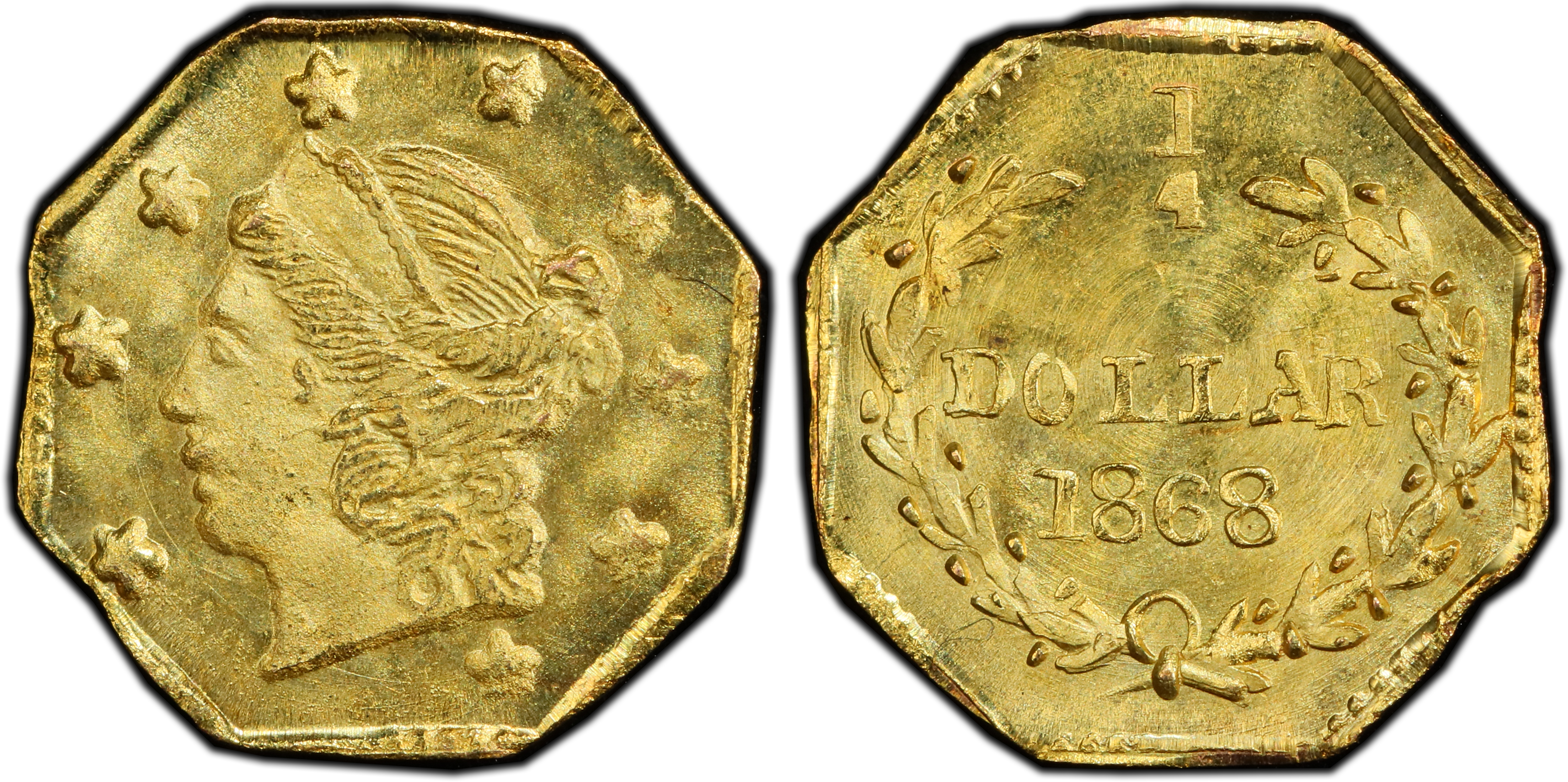
Obverse & Reverse
The 1868 G25C, cataloged as Breen-Gillio 710 (BG-710), represents a fascinating chapter in the long and complex story of California Fractional Gold. By 1868, the frenetic energy of the initial Gold Rush had subsided, but California's economy was maturing, and a persistent need for small-denomination coinage remained. Federal coins were still scarce on the West Coast, and the smallest circulating U.S. coin was the silver three-cent piece. The 'pinch' of gold dust, once a common measure for small transactions, was imprecise and impractical for daily commerce. Into this void stepped numerous private jewelers and minters, primarily in San Francisco, who began producing small, denominated gold tokens. These pieces, often called 'charms' or 'tokens' to circumvent federal laws against private coinage enacted in 1864, served as a de facto currency for minor purchases. The BG-710 is a product of this later period, characterized by more refined designs and production techniques compared to the crude issues of the early 1850s. The identity of the minter for this specific variety, like many from this era, is lost to history, but they were likely a skilled jeweler capitalizing on the local demand. These tiny gold pieces circulated widely in the saloons, shops, and marketplaces of San Francisco and the surrounding mining camps. Their existence highlights the unique economic conditions of the American West, where local necessity spurred innovative, if legally ambiguous, solutions to monetary shortages. As more federal coinage finally reached California in the late 1870s and early 1880s, the need for these fractional gold pieces dwindled, and production ceased by 1882, closing a vibrant and iconic chapter of American numismatic history.
Associated EventPost-California Gold Rush Economic Development
Reason For MintingA severe shortage of small-denomination federal coinage for everyday transactions in California prompted private minting.
Minter HistoryThe manufacturer of the BG-710 is unknown. Most California Fractional Gold pieces from this period were produced by jewelers and goldsmiths in San Francisco, such as Robert B. Gray & Co. or Antoine Louis Nouizillet, though attribution for this specific variety is not confirmed. These makers operated in a legally gray area, often marketing their products as tokens or souvenirs to avoid prosecution under the Private Coinage Act of 1864.
Historical SignificanceThe BG-710 is a tangible link to the everyday commercial life of post-Gold Rush California, representing a localized, private-sector response to a failure in the national monetary supply. It is a testament to the continued economic isolation and unique needs of the American West during the latter half of the 19th century.
N/A
DenominationG25C (Gold Quarter Dollar)
Minting Period1868
Assayer/MinterUnknown Private Minter
Geographic OriginSan Francisco, California
Obverse DescriptionA stylized head of an Indian princess facing right, a common motif for this period of fractional gold. The portrait is surrounded by 13 six-pointed stars, representing the original colonies. The date '1868' is positioned below the bust.
Obverse Inscription1868
Reverse DescriptionThe denomination '1/4' is enclosed within a beaded circle, which is itself surrounded by a wreath of leaves and berries. The inscription 'DOLLAR' appears at the top curve, and 'CAL' is at the bottom curve.
Reverse Inscription1/4 DOLLAR CAL
CompositionGold
Stated FinenessNot explicitly stated on the coin.
Actual FinenessVaries, but typically ranges from .500 to .800 fine (12k to 19k gold).
Weight0.24 grams
Diameter9.70 mm
EdgePlain
Unknown
Survival Estimate50-75
Rarity ScaleR-6 (Very Rare)
The BG-710 is highly sought after for its attractive 'Indian Head' design, its status as a dated issue from a well-defined period, and its significant rarity. It appeals to collectors of territorial gold, numismatic Americana, and those fascinated by the history of the American West.
Key VarietiesThe primary variety is the regular business strike. There are no known major die varieties for BG-710 from the original minting period. No known period proofs, patterns, or official restrikes were made. Collectors should be aware of contemporary counterfeits and modern replicas, which are common for this series but are not considered numismatic varieties.
Authentication TipsAuthentic examples have a characteristic soft, satiny luster and a slightly crude but sharp strike from hand-operated presses. Key diagnostics include the specific shape of the '4' in the denomination and the precise arrangement of the leaves in the wreath. Counterfeits are often brassy in color, have porous or tool-marked surfaces, and may exhibit incorrect weight or lettering styles. The stars and denticles on fakes are often mushy or poorly defined compared to a genuine specimen.
Shopping ConsiderationsA premium quality example for its grade will possess a strong, well-centered strike, particularly on the high points of the Indian's hair and the details within the wreath. Original, uncleaned surfaces are paramount; look for a warm, reddish-gold or orange-peel texture. Many surviving examples have been harshly cleaned, polished, or used as jewelry, which drastically reduces their value. Scrutinize the coin for evidence of removal from a bezel or solder marks. An example with minimal distracting contact marks and strong eye appeal will command a significant premium.
A coin's grade is its condition, rated on a 1-70 scale. For rare coins, this is the most critical factor in determining value, as a tiny difference in preservation can mean a huge difference in price.
Relevant Grade TypesOriginal issues were business strikes intended for circulation and are found in Circulated (1-58) and Mint State (MS, 60-70) grades. Due to their small size and practical use, most examples are found in circulated grades. No Proof (PR/PF) examples were struck during the original period of issue, and there are no known later-date collector restrikes.
Mint State CharacteristicsAn uncirculated BG-710 will exhibit full, unbroken mint luster, often with a slightly satiny or frosty texture. The strike can be inconsistent; a top-tier example will show sharp details on the headdress feathers and the bow of the wreath, but some central weakness is common and not always a detriment. Due to the softness of the gold and loose handling at the time of issue, even Mint State coins will typically show some minor contact marks or hairlines.
Circulated Wear PatternsWear first appears on the high points of the design. On the obverse, check for flatness on the cheekbone, the hair above the eye, and the tips of the feathers. On the reverse, the highest points of the wreath's leaves and the fraction '1/4' will show the first signs of friction and metal loss. In lower grades (below VF), the stars and date begin to weaken and merge with the fields.
Key Factors For ValueFor the BG-710, the primary value drivers are grade and surface preservation. An example with completely original, 'crusty' surfaces that has never been cleaned will sell for a massive premium over a dipped or polished coin of the same grade. Strike is also critical; a sharply struck coin is more desirable than one with a weak or mushy appearance. Eye appeal, which includes attractive toning and a lack of distracting marks, is a major factor. A sticker from CAC (Certified Acceptance Corporation) indicating a premium quality coin for the grade will add a significant premium, as it confirms originality and superior quality.
PCGS Price Guide
| Grade | Price | Population |
|---|---|---|
| 6 | N/A | N/A |
| 58 | N/A | N/A |
| 61 | $325.00 | 1 |
| 62 | $400.00 | 4 |
| 62+ | $450.00 | N/A |
| 63 | $600.00 | 6 |
| 63+ | $650.00 | N/A |
| 64 | $850.00 | 7 |
| 64+ | $950.00 | N/A |
| 65 | $1,250.00 | 8 |
| 65+ | $1,575.00 | N/A |
| 66 | $3,500.00 | 4 |
| 66+ | $4,000.00 | N/A |
| 67 | $5,000.00 | 3 |