1854 G50C BG-305 (Regular Strike)
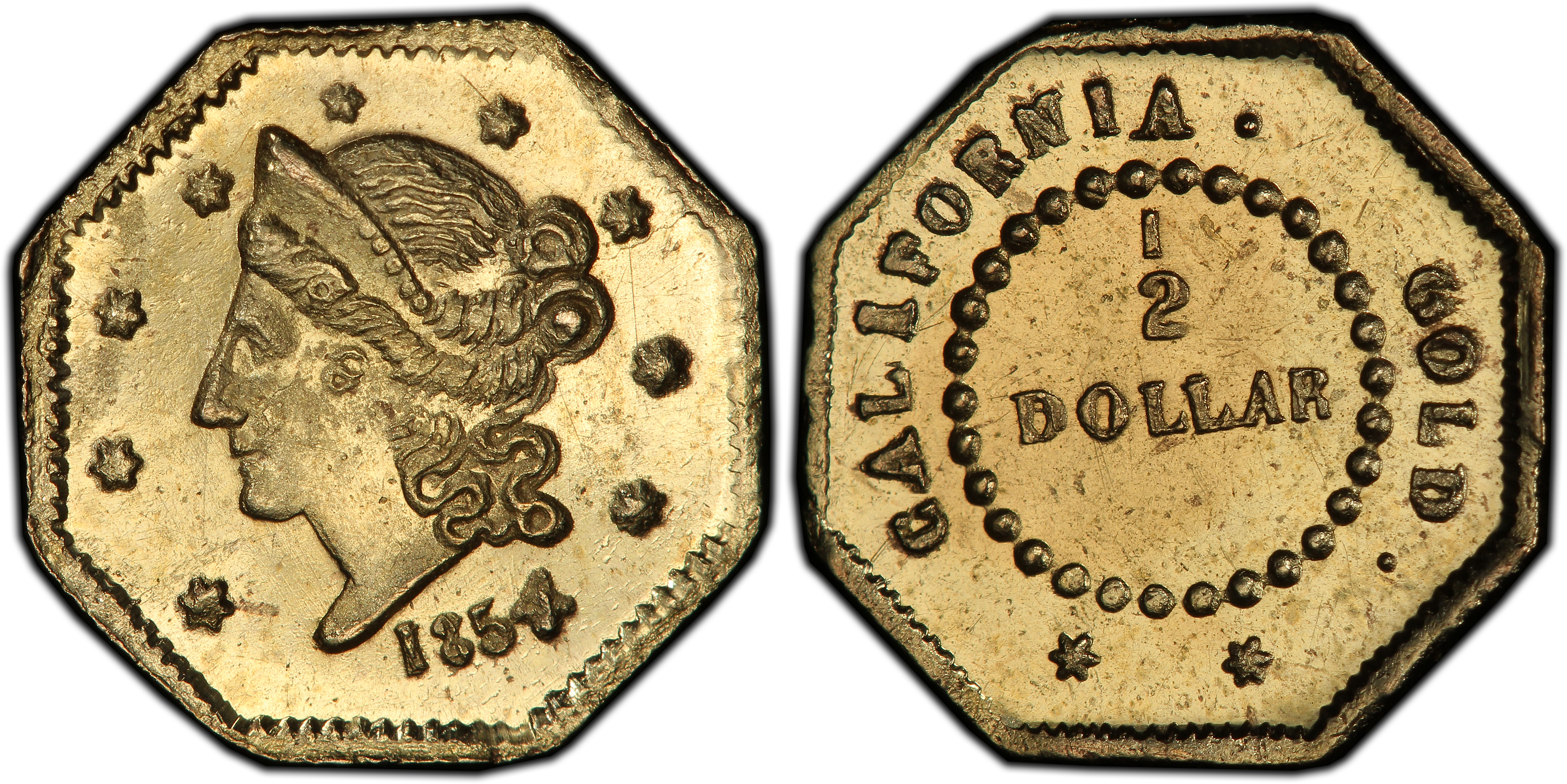
Obverse & Reverse
The 1854 Octagonal Gold 50 Cents, cataloged as BG-305, is a quintessential artifact from the 'Period One' of California's private gold coining era. This period, from 1852 to roughly 1857, was defined by a critical shortage of small-denomination coinage for daily commerce, a problem paradoxically created by the immense wealth of the Gold Rush. While miners extracted vast quantities of gold, the local economy was starved for circulating money. Gold dust, a common medium of exchange, was imprecise and prone to waste and fraud. The large-denomination slugs and territorial coins being produced did little to help a citizen buy a meal or a drink. In response to this need, private jewelers and metallurgists in San Francisco began striking their own fractional denominations—25 cents, 50 cents, and one dollar pieces. The year 1854 was a pivotal one for commerce in California. The long-awaited San Francisco Branch Mint officially opened its doors in April. However, its initial output was focused on larger denominations and was insufficient to saturate the economy and drive out the privately made coins. In fact, for many months, the need for small change remained as acute as ever, creating a continued market for pieces like the BG-305. These 'Period One' issues were generally made with the intent to circulate and were designed to mimic the appearance of official federal coinage, featuring Liberty heads and simple wreaths to inspire public confidence. They were struck from locally sourced gold, which often contained a natural silver alloy, giving them a distinct lighter color compared to federal issues. Though typically underweight for their stated value, they were accepted in trade out of sheer necessity and served as a vital lubricant for the region's booming economy until federal coinage became plentiful enough to displace them.
Associated EventCalifornia Gold Rush
Reason For MintingTo alleviate a severe shortage of small-denomination coinage for daily commercial transactions in Gold Rush-era San Francisco.
Minter HistoryThe specific minter or jewelers' firm responsible for the BG-305 variety is unknown. Many Period One fractional gold coins were produced anonymously. Research by Breen and Gillio attributes many issues to French jewelers active in San Francisco at the time, such as Antoine Louis Nouizillet or the firm of Frontier, Deviercy & Co., but no definitive link has been established for this particular variety.
Historical SignificanceAs a 'Period One' issue, BG-305 represents a genuine attempt to solve a circulating currency crisis. Its existence in 1854, the same year the San Francisco Mint opened, highlights the slow transition from a makeshift private monetary system to a reliable federal one. These coins are tangible relics of the chaotic, entrepreneurial, and economically vibrant environment of mid-1850s California.
N/A
Denomination50 Cents
Minting Period1854
Assayer/MinterUnknown
Geographic OriginSan Francisco, California
Obverse DescriptionA beaded border encloses a Liberty Head facing left, her hair tied in a bun. The portrait is surrounded by nine five-pointed stars. The design is a miniature, somewhat crude imitation of the official U.S. Mint's Liberty Head motif of the period.
Obverse Inscription Reverse DescriptionA beaded border encloses a wreath of two branches tied with a bow at the bottom. Inside the wreath, the denomination is expressed as '1/2'. The date '1854' appears below the wreath.
Reverse Inscription1/2 1854
CompositionGold
Stated Fineness Actual FinenessVariable, but typical for Period One issues which were struck from native California gold with a natural silver alloy content. Often in the 800-900 fine range.
Weight0.75 grams
Diameter10.80 mm
EdgePlain
Unknown
Survival Estimate31-75 coins known
Rarity ScaleR-5 (Very Rare)
BG-305 is highly sought after as a representative 'Period One' octagonal half dollar. Its appeal lies in its direct connection to the commercial chaos of the Gold Rush, its classic Liberty Head design, and its established rarity. Collectors value these pieces as legitimate, privately-issued circulating currency from one of the most romanticized periods in American history.
Key VarietiesThe primary BG-305 is the only known variety for this die pairing. However, it is critical for collectors to be aware of contemporary counterfeits and later facsimiles. The Breen-Gillio reference specifically lists several copies of BG-305, cataloged as BG-1309, BG-1310, and BG-1311. These are considered separate collectible items but are not original Period One strikes and have significantly lower value. No original-period Proofs or special strikes are known.
Authentication TipsAuthentic Period One fractionals like BG-305 are characteristically thin and sometimes weakly struck in areas, a result of being manually produced via hammer striking. The planchets are often not perfectly flat. Replicas are often thicker, have a more modern, 'soapy' luster, and may feature incorrect design details or lettering styles. The stars and digits should be sharp, not rounded or mushy. Any specimen should be compared to high-resolution images of certified examples. Third-party grading by PCGS or NGC is highly recommended for authentication.
Shopping ConsiderationsA premium quality BG-305 for its grade will exhibit a bold strike, particularly on the central high points of Liberty's hair and the digits of the date. Original, uncleaned surfaces are paramount; many examples have been harshly cleaned or used as jewelry over the years, which drastically reduces value. Look for examples with minimal distracting marks and original, slightly reddish-gold or lighter yellowish 'alloyed' toning. Avoid pieces that are bent, have rim damage, or show evidence of being mounted. A strong strike and pleasing, original surfaces define a top-tier example.
A coin's grade is its condition, rated on a 1-70 scale. For rare coins, this is the most critical factor in determining value, as a tiny difference in preservation can mean a huge difference in price.
Relevant Grade TypesOriginal BG-305 coins were business strikes intended for circulation and are found in Circulated (1-58) and Mint State (MS, 60-70) grades. No Proof (PR/PF) examples were struck during the original minting period. As these were utilitarian coins, well-circulated examples are common, while choice Mint State specimens are very rare. Any coin described as a 'Proof' would be a later issue or fantasy piece and not an original BG-305.
Mint State CharacteristicsAn uncirculated BG-305 is defined by the presence of original mint luster. This luster is typically soft and satiny rather than deeply prooflike. Due to the crude, manual striking process, even Mint State examples can show weakness in the strike, particularly on the highest points of Liberty's hair bun and the reverse wreath. Small planchet flaws or adjustment marks are not uncommon and are generally accepted by specialists. Contact marks are the primary determinant of grade, with the cheek of Liberty being a vulnerable area.
Circulated Wear PatternsWear first appears on the highest points of the design. On the obverse, friction will first dull the luster and flatten the details on Liberty's cheek, the hair above her ear, and the strands of her bun. On the reverse, the high points of the wreath's leaves and the bow will show wear first. In lower grades (VG and below), the stars on the obverse will begin to merge with the field and the date on the reverse will become weak or illegible.
Key Factors For ValueFor the BG-305, value is driven by three main factors: 1) Grade and Surface Preservation: An uncleaned coin with original luster will always command a significant premium over a cleaned or damaged one of the same technical grade. 2) Strike Quality: A sharply struck example showing clear details in the hair and wreath is far more desirable and valuable than a weakly struck counterpart. 3) Eye Appeal: Coins with attractive, original toning and minimal distracting marks are prized. A CAC sticker for this issue confirms premium quality for the grade and typically results in a higher market value.
PCGS Price Guide
| Grade | Price | Population |
|---|---|---|
| 45 | $200.00 | 1 |
| 45+ | $210.00 | N/A |
| 50 | $220.00 | 2 |
| 50+ | $235.00 | N/A |
| 53 | $260.00 | 3 |
| 53+ | $285.00 | N/A |
| 55 | $315.00 | 6 |
| 55+ | $335.00 | N/A |
| 58 | $375.00 | 20 |
| 58+ | $400.00 | N/A |
| 60 | $425.00 | 3 |
| 61 | $450.00 | 9 |
| 62 | $475.00 | 36 |
| 62+ | $500.00 | 1 |
| 63 | $550.00 | 42 |
| 63+ | $625.00 | N/A |
| 64 | $900.00 | 7 |
| 64+ | $1,125.00 | N/A |
| 65 | $1,650.00 | N/A |
| 65+ | $2,250.00 | N/A |
| 66 | $3,500.00 | 1 |