1855/4 G25C BG-106 (Regular Strike)
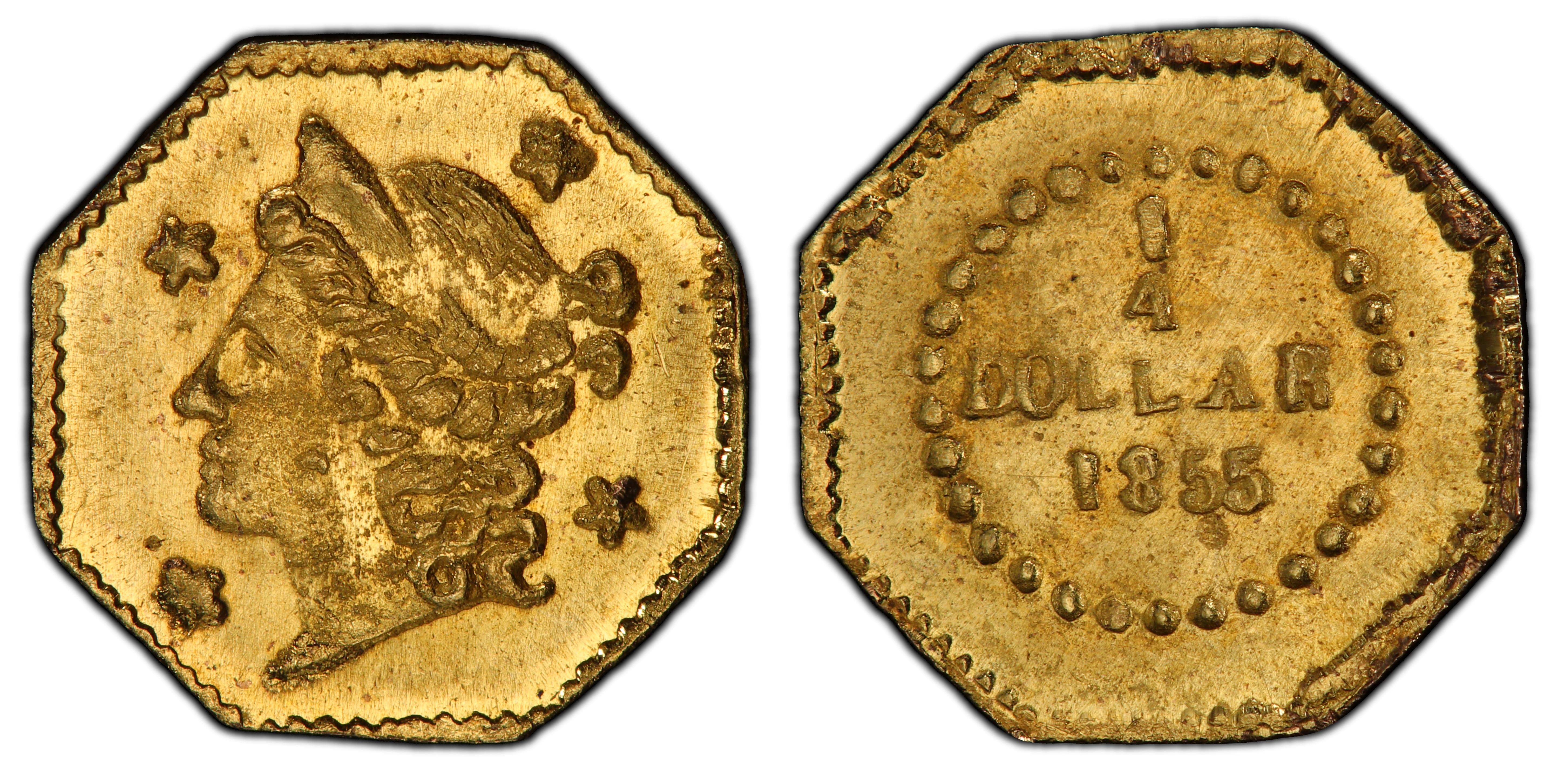
Obverse & Reverse
The 1855/4 BG-106 25 Cents is a quintessential artifact from what numismatists classify as 'Period One' (1852-1857) of the California Fractional Gold series. This era represents the most legitimate and utilitarian phase of this fascinating private coinage. Following the initial gold discoveries in 1848, California was flooded with hundreds of thousands of prospectors and merchants. While larger private and, eventually, federal coins handled significant transactions, the economy was crippled by a severe shortage of small denomination coins for daily commerce. Gold dust, often measured imprecisely in 'pinches,' was a clumsy and often inequitable substitute for everyday purchases like a drink or a loaf of bread. Into this void stepped a number of enterprising San Francisco jewelers and metalworkers, many of whom were French immigrants. Between 1852 and the establishment of full-scale production at the San Francisco Mint in 1856, these private minters produced fractional denominations of $1, 50 cents, and 25 cents. These pieces, struck from the very gold being unearthed in the Sierra Nevada foothills, were intended to circulate and alleviate the chronic shortage of small change. The BG-106, with its octagonal shape and Liberty Head design mimicking federal gold dollars, was clearly intended to inspire public confidence. It is struck from an overdated die, where a die from 1854 was re-punched with the new date, a common money-saving practice. Although these coins did circulate, their tiny size made them inconvenient, and by 1853 they had also become popular as souvenirs to be sent back East. This dual purpose—commerce and keepsake—likely saved many from being melted, contributing to their survival today. The Private Coinage Act of 1864 eventually made such issues illegal, cementing the status of these Period One fractionals as genuine relics of the Gold Rush's most chaotic and entrepreneurial period.
Associated EventCalifornia Gold Rush
Reason For MintingTo alleviate a severe shortage of small-denomination coinage for everyday commercial transactions in Gold Rush-era California.
Minter HistoryThe specific minter for the BG-106 variety is not definitively known, as is the case for many fractional pieces that do not bear initials. Most Period One fractionals were produced by a handful of jewelers in San Francisco. Some numismatic listings attribute this variety to Frontier & Deviercy, a firm active in the city from 1852-1856. Like their contemporaries, they employed manual hammer-striking methods, which resulted in coins of varying strike quality and occasional off-center impressions. These minters operated in a legally gray area but provided a crucial service to the burgeoning local economy before the San Francisco Mint could fully meet the region's coinage needs.
Historical SignificanceThe BG-106 is historically significant as a tangible example of private enterprise filling a critical infrastructural gap left by the federal government during the chaotic peak of the California Gold Rush. It represents the initial, utilitarian phase of fractional gold production before later issues devolved into underweight souvenirs. Its existence speaks to the unique economic conditions of a geographically isolated region awash in raw gold but starved of functional currency.
N/A
Denomination25 Cents
Minting Period1855
Assayer/MinterUnknown (Possibly Frontier & Deviercy)
Geographic OriginSan Francisco, California
Obverse DescriptionA representation of the Liberty Head, facing left, styled after the contemporary U.S. federal gold dollars. She wears a coronet inscribed with 'LIBERTY'. The portrait is encircled by four five-pointed stars, two on each side.
Obverse InscriptionLIBERTY
Reverse DescriptionA simple wreath composed of two branches tied with a bow at the bottom. The denomination '1/4' appears in the center, with 'DOLLAR' below it and the date '1855' situated just below the wreath. A key diagnostic is the clear repunching of the 5 over the final 4 in the date.
Reverse Inscription1/4 DOLLAR 1855
CompositionGold
Stated Fineness Actual FinenessTypically .800 to .900, using native California gold which contained natural silver alloys.
Weight0.25 grams
Diameter9.50 mm
EdgePlain
Unknown
Survival Estimate201-500
Rarity ScaleR-3
This coin is highly sought after for its clear 1855/4 overdate, its connection to the legitimate 'Period One' of fractional gold production, its octagonal shape, and its direct link to the California Gold Rush. It represents a more attainable entry point into the world of territorial gold compared to the larger, prohibitively expensive denominations.
Key VarietiesThe primary variety is the regular business strike. A historically significant subset of BG-106 coins are those recovered from the 1857 wreck of the S.S. Central America, the famed 'Ship of Gold.' These are often specially encapsulated by PCGS and designated as such, sometimes with an included 'pinch' of recovered gold dust. These 'shipwreck effect' coins, which may show signs of their long submersion, carry a significant historical premium. No known patterns or later-date proof restrikes exist for this specific die marriage.
Authentication TipsAuthentication requires careful examination. Look for the sharp, distinct characteristics of a die-struck coin, not the soft, mushy details of a cast counterfeit. The 5/4 overdate should be clearly visible under magnification. The style of the Liberty head and the wreath should match known genuine examples. Period One pieces were generally made of good-quality gold, so coins that appear brassy or have plating peeling are suspect. Weight can be a key indicator; genuine pieces are tiny but should feel dense for their size.
Shopping ConsiderationsFor a premium quality example, seek a coin with a sharp, well-centered strike, especially on the delicate features of Liberty's portrait and the digits of the date. Luster is a significant value-driver; high-grade examples will exhibit a satiny, original sheen. Due to the crude hammer-striking process, perfectly struck coins are the exception, and well-centered examples command a premium. Common issues to avoid include cleaning (which imparts hairline scratches and strips the original surface), excessive planchet flaws, and jewelry mounting or repair. An attractive, original reddish-gold toning that has not been tampered with is highly desirable. Certification by PCGS or NGC is highly recommended for this series due to the prevalence of counterfeits.
A coin's grade is its condition, rated on a 1-70 scale. For rare coins, this is the most critical factor in determining value, as a tiny difference in preservation can mean a huge difference in price.
Relevant Grade TypesAll original 1855/4 BG-106 coins are business strikes intended for circulation. They are found in Circulated grades (AG-3 to AU-58) and Mint State grades (MS-60 to MS-70). No Proof examples were struck during the original minting period, and no later-date Proof restrikes of this variety are known to exist. Any coin described as a 'Proof' is likely a later-made token or has been misattributed.
Mint State CharacteristicsAn uncirculated BG-106 will exhibit full, unbroken mint luster, often with a soft, satiny texture. Strike quality varies significantly; a typical example may show some weakness on the highest points of Liberty's hair and the leaves of the wreath. A superior, premium-quality MS coin will be sharply struck for the issue, with full details in the coronet and wreath. Small, scattered planchet flaws or adjustment marks made prior to striking are common for the series and are generally accepted, though large, distracting flaws will limit the grade.
Circulated Wear PatternsWear first appears on the highest points of the design. On the obverse, this includes Liberty's cheek, the hair just above the ear, and the coronet. On the reverse, the highest points of the wreath's leaves and the bow will show the first signs of friction. On lower-grade examples, the stars and the date will begin to lose their sharpness and merge with the fields.
Key Factors For ValueThe primary drivers of value are grade and surface preservation. An example with original, uncleaned surfaces and attractive luster will always be worth significantly more than a cleaned or polished coin of the same technical grade. The sharpness of the strike is crucial; a well-struck coin with full details is highly prized. Eye appeal, encompassing toning, luster, and strike, is paramount. Coins recovered from the S.S. Central America carry a premium due to their historical provenance. A sticker from CAC, indicating premium quality for the grade, adds a significant premium for this and other territorial issues.
PCGS Price Guide
| Grade | Price | Population |
|---|---|---|
| 50 | $225.00 | 2 |
| 50+ | $235.00 | N/A |
| 53 | $250.00 | 1 |
| 53+ | $260.00 | N/A |
| 55 | $275.00 | 6 |
| 55+ | $290.00 | N/A |
| 58 | $310.00 | 6 |
| 58+ | $325.00 | N/A |
| 60 | $340.00 | 1 |
| 61 | $360.00 | 12 |
| 62 | $375.00 | 38 |
| 62+ | $400.00 | N/A |
| 63 | $550.00 | 52 |
| 63+ | $625.00 | N/A |
| 64 | $750.00 | 40 |
| 64+ | $875.00 | 1 |
| 65 | $1,050.00 | 12 |
| 65+ | $1,200.00 | N/A |
| 66 | $1,750.00 | 5 |