1853 G50C BG-417 (Regular Strike)
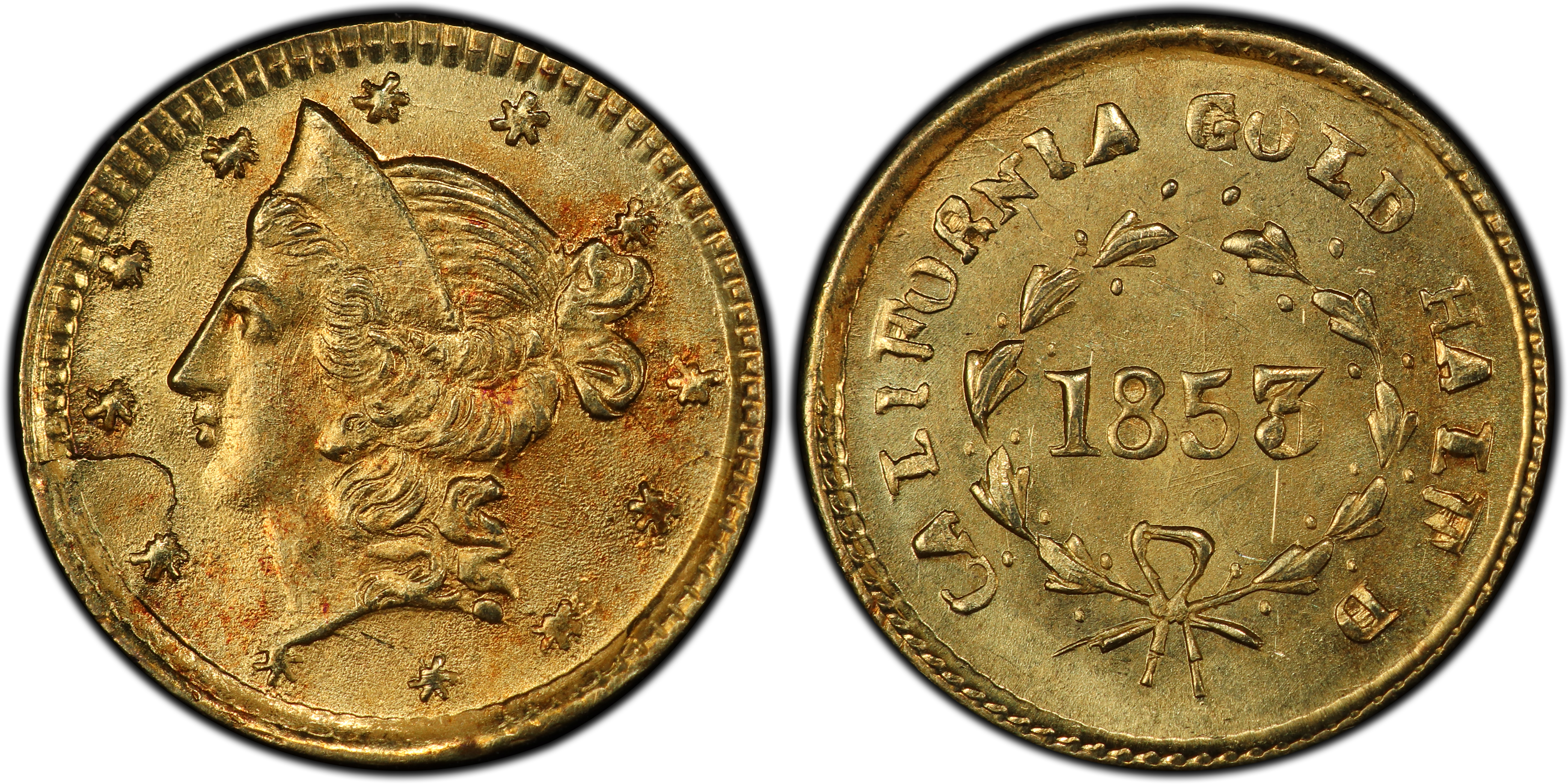
Obverse & Reverse
The 1853 BG-417 50 Cents piece is a quintessential artifact of the California Gold Rush, a period of frantic economic expansion and monetary chaos. Following the discovery of gold at Sutter's Mill in 1848, a massive influx of prospectors and merchants descended upon California, creating a vibrant but unstable economy. A critical problem was the acute shortage of circulating coinage, especially for small, everyday transactions. Gold dust, the primary medium of exchange, was inconvenient, prone to spillage and theft, and difficult to measure accurately for minor purchases. While the U.S. Mint was authorized to open a branch in San Francisco in 1852, it would not begin operations until 1854. Into this monetary vacuum stepped private minters, assayers, and, most relevantly for fractional gold, manufacturing jewelers. These artisans, skilled in working with precious metals, recognized the dire need for small-denomination coins and began producing quarter dollar, half dollar, and dollar pieces to facilitate commerce. The earliest pieces, categorized by numismatists as 'Period One' (1852-1857), were often crudely made but eagerly accepted. The BG-417, with its simple 'Indian Head' design, is a prime example of these utilitarian issues. It was not intended as a government-sanctioned coin but as a practical token whose value was derived from its intrinsic gold content and its immediate usefulness. These pieces were indispensable for merchants, laborers, and miners trying to navigate an economy where a pinch of gold dust might be the only way to pay for a drink or a meal. However, many of these early fractionals were underweight, a fact that eventually led to public outcry and government intervention, culminating in an 1864 law that prohibited private coinage. The BG-417 circulated for a time before being withdrawn, melted, or lost, contributing to its modern-day rarity. Its very existence is a testament to the ingenuity and necessity-driven innovation that characterized one of America's most dynamic and transformative eras.
Associated EventCalifornia Gold Rush
Reason For MintingTo alleviate a severe shortage of small-denomination coinage for daily commercial transactions in Gold Rush-era California.
Minter HistoryThe minter of BG-417, like most Period One fractional gold producers, is unknown. Research by Robert D. Leonard Jr. and other specialists suggests these pieces were not made by dedicated private mints (like Kellogg & Co. or Moffat & Co.) but by manufacturing jewelers who already possessed the requisite skills and equipment (dies, presses) for working with gold. Firms like Deriberpe, Lacoste & Co. or Gaime, Guillemot & Co. in San Francisco are considered potential candidates. They produced these pieces as a profitable sideline, meeting a clear market demand without the fanfare or official branding of the larger assay companies.
Historical SignificanceThe BG-417 is significant as a tangible link to the grassroots economy of the California Gold Rush. It represents a private, unregulated solution to a government failure in supplying adequate coinage, highlighting the resourcefulness of frontier entrepreneurs. As a Period One issue, it stands among the earliest attempts to solve this problem and is a key piece for understanding the evolution of private and territorial coinage in the United States.
BG-417
Denomination50 Cents (Half Dollar)
Minting Period1853
Assayer/MinterUnknown, likely produced by a manufacturing jeweler in San Francisco.
Geographic OriginSan Francisco, California
Obverse DescriptionA crude, somewhat primitive portrait of a left-facing 'Indian Head' wearing a feathered headdress. The portrait is surrounded by thirteen six-pointed stars, which are often unevenly spaced and weakly struck.
Obverse Inscription Reverse DescriptionThe denomination '1/2' is centrally located. Above it, the word 'CALIFORNIA' is arranged in an arc. Below the denomination is the word 'GOLD'. The date '1853' is at the bottom, following the curvature of the planchet.
Reverse InscriptionCALIFORNIA GOLD 1/2 1853
CompositionGold
Stated Fineness Actual FinenessVariable, but generally around .800 to .875 fine.
Weight0.97 grams
Diameter12.70 mm
EdgePlain
Unknown
Survival Estimate50-75
Rarity ScaleR-5
BG-417 appeals to collectors for its direct connection to the Gold Rush, its status as a scarce Period One issue, and its charming, primitive design. It is one of the more available 1853-dated 'Indian Head' half dollars, making it an achievable yet challenging goal for series specialists.
Key VarietiesFor the BG-417 catalog number, there are no major varieties struck during the period of issue. The primary variations seen are in die state and strike quality. No known patterns, trial pieces, or official later-date restrikes exist for this specific variety. Collectors should be wary of contemporary counterfeits and modern replicas, which are common for California Fractional Gold.
Authentication TipsAuthentic examples often exhibit a crude, slightly soft strike, particularly on the stars and the feathers of the headdress. The planchets are typically irregular and may show adjustment marks. The lettering style is distinctive to the die; compare it to high-resolution images of certified examples. The color of the gold should be consistent with the known fineness, often a slightly brassy yellow. Weight and diameter should be close to the published specifications. Many modern fakes are brass-plated and will have a soapy, artificial luster and sharp, perfectly formed details uncharacteristic of genuine pieces.
Shopping ConsiderationsA premium quality example for this issue is defined by a bold strike, minimal surface marks, and pleasing original color. Look for sharpness on the central details of the feathers and the numerals '1/2' on the reverse. Many specimens are weakly struck at the peripheries, so any example with fully visible stars and legends commands a premium. Avoid coins that have been harshly cleaned, which strips the original patina and imparts a dull or unnaturally bright appearance. Also, inspect carefully for evidence of having been previously mounted in jewelry, such as rim damage, solder marks, or tooling. A coin with honest, even wear is far more desirable than a higher-grade but problematic piece.
A coin's grade is its condition, rated on a 1-70 scale. For rare coins, this is the most critical factor in determining value, as a tiny difference in preservation can mean a huge difference in price.
Relevant Grade TypesOriginal period issues of BG-417 were business strikes intended for circulation and are found in Circulated (1-58) and Mint State (MS, 60-70) grades. No Proof examples were struck during the original period of issue. Any piece described as a 'Proof' is almost certainly a modern fantasy piece or replica and not a genuine numismatic item from 1853.
Mint State CharacteristicsUncirculated examples of BG-417 are very rare. A true Mint State specimen would exhibit full, frosty, or satiny mint luster. The strike is almost never perfectly sharp; weakness on the peripheral stars and the highest points of the feathers is typical and should be expected. Contact marks are common due to the softness of the gold and the crude handling methods of the era. The key is to find an example with minimal marks and vibrant, undisturbed luster.
Circulated Wear PatternsWear first appears on the highest points of the design: the cheek and the upper feathers of the headdress on the obverse. On the reverse, the fraction '1/2' and the 'O' and 'L' in 'GOLD' are the first elements to show flatness. In grades of VF and below, the individual feathers will begin to merge, and the smaller stars will become indistinct. In lower grades (VG and below), the date and legends will be soft but should still be mostly legible.
Key Factors For ValueThe primary drivers of value for an 1853 BG-417 are grade and surface quality. An example with original, uncleaned surfaces and a minimum of distracting marks will always be prized. The sharpness of the strike is a significant factor; a well-struck coin with clear details is far more desirable than a weakly struck example of the same grade. Eye appeal, which includes factors like attractive toning or a pleasing original 'skin', can add a substantial premium. Finally, certification by a top-tier grading service (PCGS or NGC) is essential for market acceptance, and a CAC sticker for this issue indicates superior quality for the grade, adding yet another layer of value.
PCGS Price Guide
| Grade | Price | Population |
|---|---|---|
| 53 | $400.00 | 4 |
| 53+ | $415.00 | N/A |
| 55 | $450.00 | 3 |
| 55+ | $460.00 | N/A |
| 58 | $500.00 | 6 |
| 58+ | $510.00 | N/A |
| 60 | $550.00 | 1 |
| 61 | $580.00 | N/A |
| 62 | $650.00 | 8 |
| 62+ | $750.00 | N/A |
| 63 | $1,125.00 | 3 |
| 63+ | $1,350.00 | N/A |
| 64 | $2,500.00 | 3 |
| 64+ | $3,000.00 | N/A |
| 65 | $3,750.00 | N/A |
| 65+ | $4,250.00 | N/A |
| 66 | $5,000.00 | 1 |