1855 G50C BG-309 (Regular Strike)
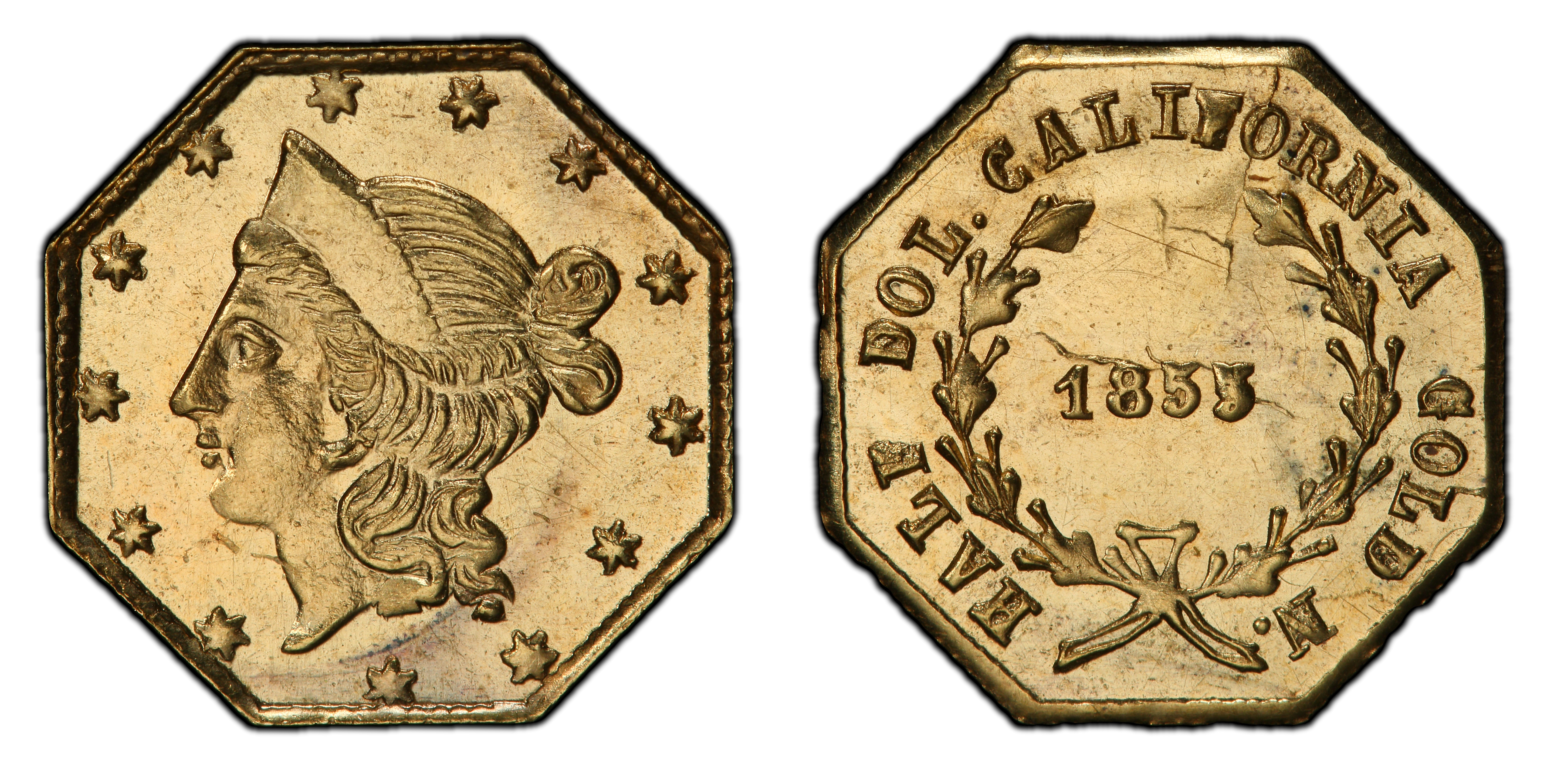
Obverse & Reverse
The 1855 BG-309 50 Cent piece is a quintessential product of the California Gold Rush's chaotic and economically starved commercial environment. Following the initial strikes of 1848-49, a massive influx of gold dust and nuggets flooded California, but federally issued coinage remained critically scarce. This created a severe impediment to daily commerce; a pinch of gold dust for a drink or loaf of bread was an inefficient and often inequitable system. In response, a wave of private minters, jewelers, and assayers began producing their own coinage, first in larger dollar denominations and soon after in smaller, fractional denominations to facilitate minor transactions. These 'small change' pieces, denominated as 25 cents, 50 cents, and one dollar, became the lifeblood of local economies. The BG-309 variety, attributed to Antoine Louis Nouizillet, a French immigrant and manufacturing jeweler in San Francisco, represents the peak of this fractional gold production period. Nouizillet was a prolific maker of these tokens, known for his distinctive designs. However, the fractional gold pieces were a constant source of controversy. They were almost universally underweight for their stated face value, a fact not lost on the public or authorities. Their gold content was often worth only 70-80% of their denomination. This led to public outcry and legislative action, culminating in an 1856 San Francisco ordinance banning their circulation and later state and federal laws that effectively ended their production by the early 1880s. Despite their questionable intrinsic value, they served a vital, albeit temporary, role. Today, these pieces are not seen as fraudulent tokens but as historically significant artifacts that capture the ingenuity and necessity born from the unique economic conditions of Gold Rush California.
Associated EventCalifornia Gold Rush
Reason For MintingA severe shortage of circulating small-denomination federal coinage for everyday commercial transactions in Gold Rush California.
Minter HistoryAntoine Louis Nouizillet was a French jeweler and diesinker who operated a business at 138 Commercial Street in San Francisco during the 1850s. He is considered one of the most prolific and skilled producers of California Fractional Gold. While his name does not appear on the coins, die analysis and stylistic similarities have allowed numismatic researchers, particularly in the Breen-Gillio reference work, to attribute a large number of 'Period One' (1852-1857) issues to his hand. His designs often featured a distinctive 'Liberty Head' or 'Indian Head' motif. He was eventually arrested in 1857 for his activities, which had come under increasing legal scrutiny due to the coins being underweight, but the charges were ultimately dropped.
Historical SignificanceThe BG-309, like other fractional gold pieces, is a tangible link to the primitive, gold-dust-based economy of Gold Rush California. It represents a private solution to a government failure—the inability to supply adequate coinage to a booming frontier economy. Its existence highlights the economic challenges of the era and the transition from barter and gold dust to a standardized monetary system.
N/A
Denomination50 Cents
Minting Period1855
Assayer/MinterAttributed to Antoine Louis Nouizillet
Geographic OriginSan Francisco, California
Obverse DescriptionA crude but charming depiction of a Native American male head facing left, often referred to as an 'Indian Head'. The portrait is surrounded by thirteen six-pointed stars.
Obverse Inscription(No lettering)
Reverse DescriptionA Liberty Head facing left, similar to the contemporary federal gold coinage but of a much cruder style. The inscription 'CALIFORNIA GOLD' is above, and the denomination '1/2' is below. A beaded border encircles the design.
Reverse InscriptionCALIFORNIA GOLD / 1/2
CompositionGold
Stated Fineness Actual FinenessApproximately .850 to .900 fine, but varies.
Weight0.25 grams
Diameter10.00 mm
EdgePlain
Unknown
Survival Estimate200-300
Rarity ScaleR-5
This variety is highly sought after for its unusual 'Mule' pairing of two obverse-style designs: an Indian Head on one side and a Liberty Head on the other. This distinctive feature, combined with its direct connection to the heart of the Gold Rush, makes it a classic and popular type coin within the extensive California Fractional Gold series.
Key VarietiesThe primary variety is the regular business strike (BG-309). No original proof strikings are known. Collectors should be aware of different die states, which may show progressive cracks or cuds, particularly on the reverse. There are no known major varieties or later-date restrikes of this specific BG number.
Authentication TipsAuthentic examples often show a slightly crude, hand-made quality. The stars on the obverse can be weak or indistinct. The reverse lettering is often unevenly spaced. Look for characteristic die markers, such as a faint die crack that often appears from the rim to the 'L' in 'CALIFORNIA'. Counterfeits are common and are often either brassy in color, have a soapy or cast-like texture, or feature lettering and design elements that are too sharp and modern-looking compared to genuine, softly-struck originals.
Shopping ConsiderationsA premium quality example for its grade will possess a sharp strike, especially on the high points of the Indian's hair and the Liberty's tiara. Luster is rare and commands a significant premium; most survivors are circulated. Look for pleasing, original reddish-gold or deep yellow-gold surfaces. Avoid examples that have been harshly cleaned, which imparts a bright, unnatural shine and hairline scratches. Also, be wary of coins that have been used in jewelry, looking for evidence of removed solder or rim damage. Given their small size, planchet flaws or laminations are not uncommon but should be minor for a premium piece.
A coin's grade is its condition, rated on a 1-70 scale. For rare coins, this is the most critical factor in determining value, as a tiny difference in preservation can mean a huge difference in price.
Relevant Grade TypesOriginal period issues were business strikes intended for circulation and are found in Circulated (1-58) and Mint State (MS, 60-70) grades. The vast majority of surviving BG-309s are in circulated grades, typically VF to AU. Mint State examples are very rare. No Proof (PR/PF) examples were struck during the original period of issue, and no later-date Proof restrikes are known for this variety.
Mint State CharacteristicsAn uncirculated BG-309 is exceptionally rare. It would exhibit full, frosty, or satiny mint luster. The strike is a key factor; many were softly struck, so a coin with sharp details on the central portraits, especially the hair details on both heads, is highly desirable. Due to the nature of their production and handling, even MS examples may show minor planchet flaws or faint contact marks. A truly 'gem' quality MS-65 or higher example is virtually unknown.
Circulated Wear PatternsWear first appears on the highest points of the design. On the Indian Head obverse, this is the cheekbone and the hair above the ear. On the Liberty Head reverse, wear is first evident on the hair bun and the coronet. As wear progresses, the individual hair strands merge, the stars on the obverse become flat, and the letters in the legends begin to weaken at their tops. In lower grades (VG and below), the central portraits will be nearly flat, with only the outlines visible.
Key Factors For ValueFor the BG-309, the primary value drivers are grade and surface quality. An example with original, uncleaned surfaces will always be worth more than a cleaned one of the same grade. Strike quality is paramount; a sharply struck AU will often command more than a weakly struck MS coin. Eye appeal, driven by attractive original color and minimal distracting marks, is also a major factor. Given the prevalence of counterfeits and altered pieces, certification by a major grading service (PCGS or NGC) is nearly essential for market acceptance, and a CAC sticker on a certified coin indicates premium quality for the grade and carries a significant price premium.
PCGS Price Guide
| Grade | Price | Population |
|---|---|---|
| 30 | $200.00 | N/A |
| 35 | $205.00 | N/A |
| 40 | $225.00 | N/A |
| 45 | $250.00 | N/A |
| 45+ | $275.00 | N/A |
| 50 | $385.00 | 1 |
| 50+ | $390.00 | N/A |
| 53 | $415.00 | N/A |
| 53+ | $420.00 | N/A |
| 55 | $430.00 | 4 |
| 55+ | $435.00 | N/A |
| 58 | $450.00 | 6 |
| 58+ | $455.00 | N/A |
| 60 | $525.00 | 1 |
| 61 | $700.00 | 4 |
| 62 | $750.00 | 13 |
| 62+ | $850.00 | N/A |
| 63 | $1,250.00 | 9 |
| 63+ | $1,500.00 | N/A |
| 64 | $2,150.00 | 4 |